
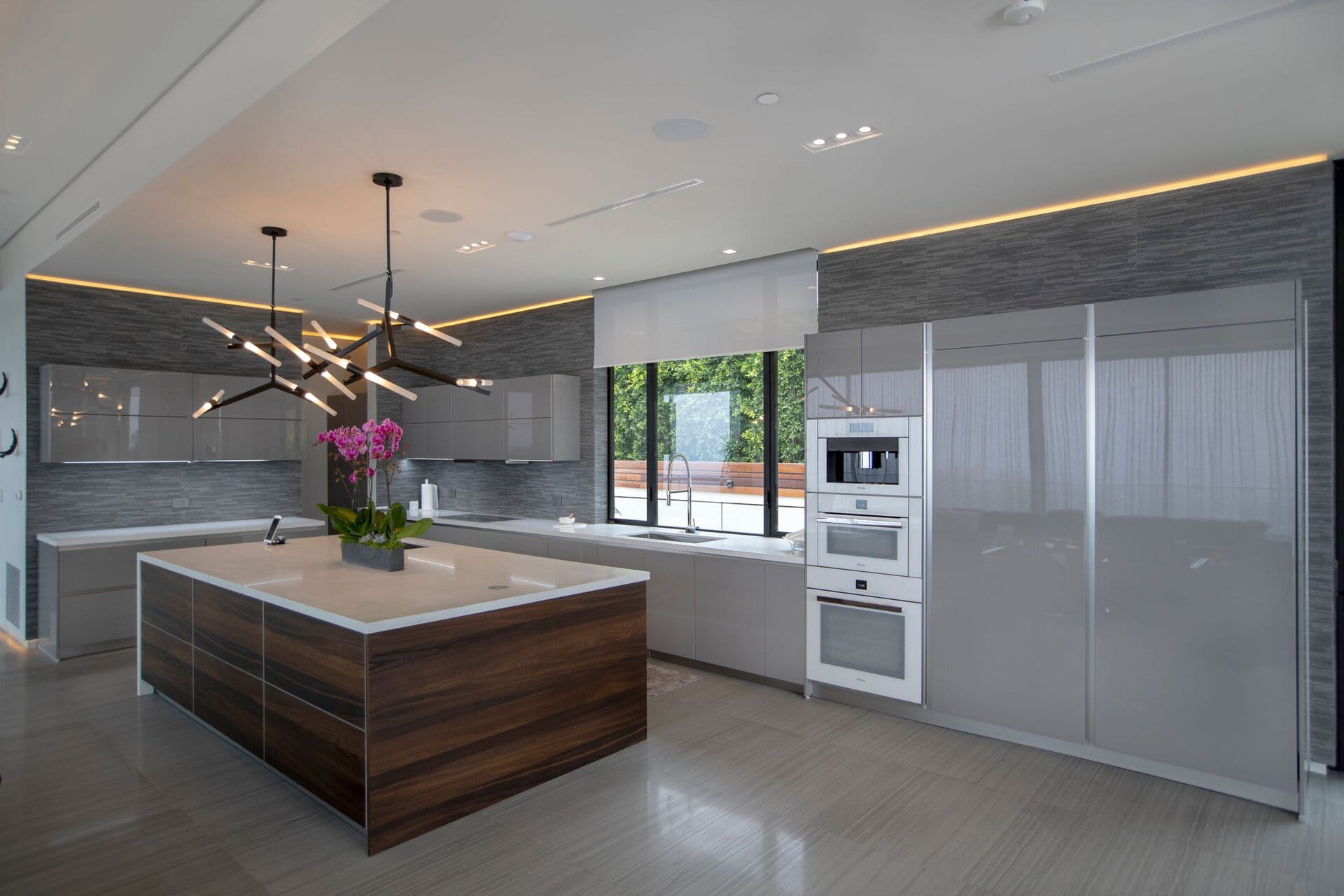
A German kitchen is not a collection of cabinets; it is a system: a coordinated grammar of base, wall, and tall units built on shared dimensions, shared construction, and shared hardware, so that any plan a designer can draw, the factory can build to ±0.1mm. Understanding the system is the single most useful preparation a buyer can make: it explains what you are paying for, what can be configured, and why a German kitchen installs and ages the way it does.
This guide maps the complete territory: the three cabinet families and what each does, frameless full-access construction, the handleless question, the modular dimensional logic, carcase engineering, the interior organization systems that do the daily work, the full range of door and front types, and how the Bauformat group’s three tiers (Baulux, Bauformat, and Burger) put the system within reach of different budgets.
Key Takeaways
- German kitchens are organized into three cabinet families (base, wall, and tall units) planned as one dimensional system.
- Frameless (full-access) construction is the European standard: no face frame, roughly ten percent more usable interior volume, and a flush plane of fronts.
- Handleless channel systems and conventional handles are both legitimate German choices; the channel demands, and demonstrates, higher manufacturing precision.
- Carcases are moisture-resistant engineered board, edge-sealed, machined to ±0.1mm, with boards meeting the 0.05 ppm CARB2/US TSCA Title VI formaldehyde ceiling.
- Front options run from laminate through lacquer and matte lacquer to real-wood veneer and glass, with white oak the NKBA’s leading wood for 2026, cited by 51% of professionals.
- The Bauformat group maps the system to three honest tiers: Baulux (uncompromising luxury), Bauformat (everyday excellence), Burger (smart budgets).
The Three Cabinet Families: Base, Wall, and Tall Units
Every German kitchen, however sculptural, resolves into three families of cabinet. The art of planning is in how the families are balanced. The 2026 direction is unmistakable: more tall storage, larger islands, and wall cabinetry used sparingly as composition rather than reflex.
Base Cabinets: The Working Foundation
Base units carry the worktop and the bulk of daily activity: sink runs, cooktop housings, drawer banks, and the island. The defining German preference here is the drawer over the door: full-extension drawers bring contents to the user rather than sending the user to the floor of a dark cupboard, and they have become the ergonomic default for pots, pans, and provisions. Islands deserve particular planning attention; roughly half of new kitchen islands now exceed seven feet, and a monolithic island built from coordinated base units is the centrepiece of the contemporary open plan.
Wall Cabinets: Composition at Eye Level
Wall units store the light and the frequent (glassware, crockery, dry goods) at eye level. The German treatments are distinctive: lift-up fronts that rise overhead and hold at any angle rather than swinging into the room, glass-front cabinets with interior lighting, and open shelving used as deliberate negative space within a run. The current design tendency is restraint: fewer wall cabinets, more breathing room, with the storage burden shifted to tall units where ergonomics are better.
Tall Cabinets: The Storage Architecture
Tall units are where German kitchens quietly win the storage argument. Floor-to-ceiling larder cabinets with internal pull-outs, appliance towers that lift ovens to eye level, and integrated refrigeration columns turn an entire wall into continuous storage architecture. Houzz’s 2026 research finds 76% of renovating homeowners adding built-ins, with pantry storage the most requested at 47%, demand the tall-unit family was engineered to answer. Planned as a continuous bank, tall cabinetry reads as wall rather than furniture, which is precisely the intent.
Frameless Full-Access Construction: The European Standard
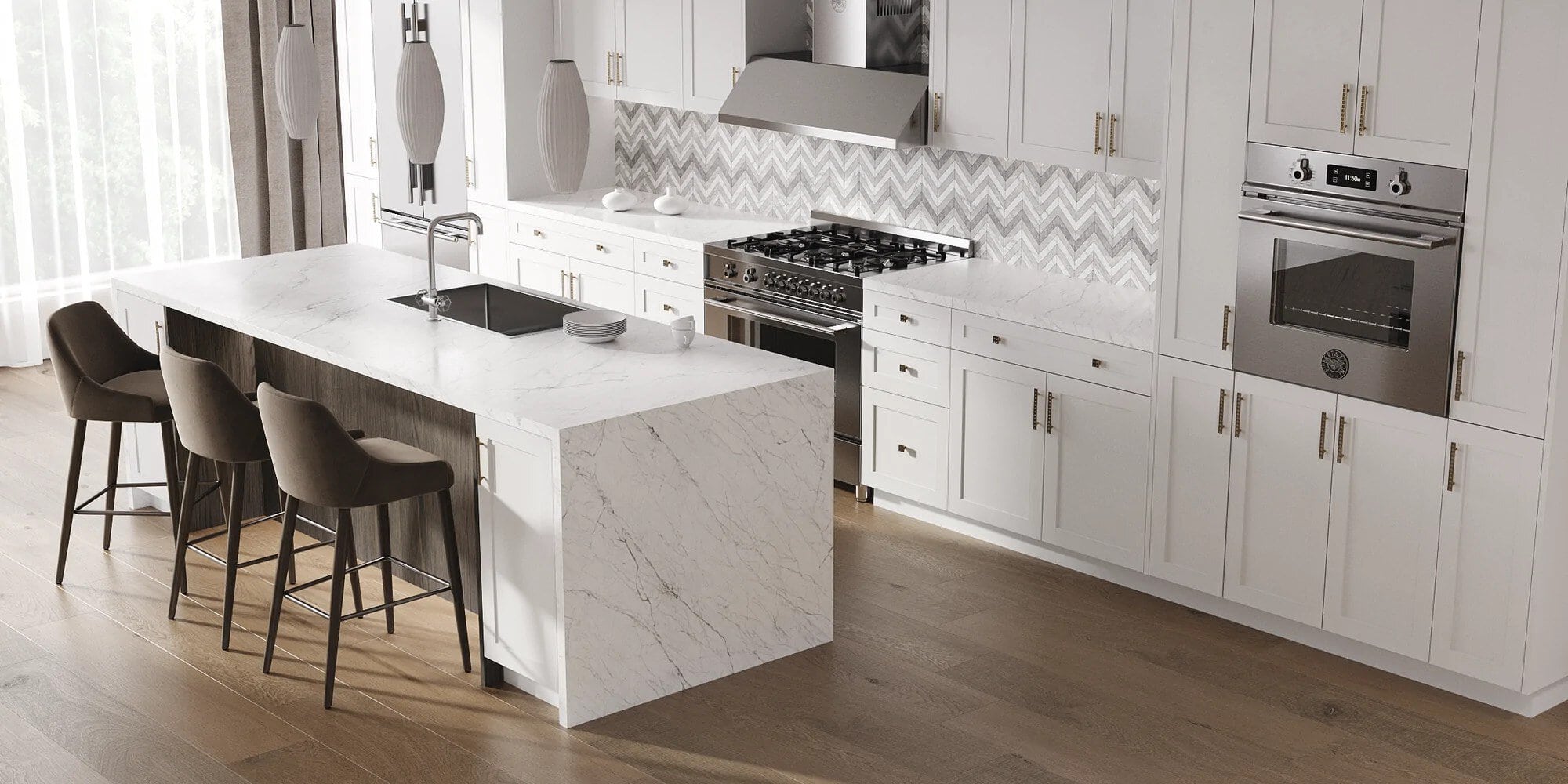
The structural idea beneath every German cabinet is frameless (also called full-access or European) construction. Where North American framed cabinets attach doors and hardware to a face frame fixed over the carcase opening, the frameless cabinet is a precise box with doors and drawers mounted directly to its sides. The consequences are practical and visible. Practically, eliminating the frame yields roughly ten percent more usable interior volume and unobstructed access: no centre stiles interrupting a drawer, no frame lip catching a pull-out. Visibly, frameless construction produces the flush, continuous plane of fronts with consistent narrow reveals that defines the German aesthetic. The trade-off is tolerance: without a frame to mask irregularity, the box itself must be perfect, which is why frameless construction at scale belongs to factories that can hold ±0.1mm, and why the style is difficult to imitate convincingly with looser methods.
Handleless Channel Systems vs. Handles
No question comes up more often in our North Vancouver showroom. The handleless kitchen replaces hardware with a continuous machined channel, a recessed grip profile running along the top of base units and the bottom of wall units, producing an uninterrupted elevation. Its appeal is architectural purity; its demands are mechanical. The channel must align perfectly across every cabinet junction, the fronts must sit dead flush, and the system often pairs with push-to-open or servo-assisted mechanisms. A well-executed handleless kitchen is therefore a public demonstration of manufacturing precision, which is much of why it became the signature of German design.
Handles remain a fully legitimate, and currently resurgent, choice. A bar pull in brushed steel or black, or a discreet edge-pull profile, adds tactility and suits the transitional direction that now leads homeowner preference. The honest guidance: choose handleless for the purest modern elevation and easy cleaning; choose handles for grip, character, and a softer register. Many of the best current kitchens mix the two (handleless tall banks with handled drawer runs, for instance) within the same system.
The Modular Dimensional System
What makes all of this configurable is the German modular grid. Cabinets are built in standardized width increments (typically from 15cm up to 120cm) against coordinated heights and depths, so that base runs, wall runs, and tall banks resolve into aligned horizontal datum lines across the room. Plinth heights adjust the working level to the cook; carcase heights and depths flex for tasks and for architecture. The grid is why a German kitchen can be planned filler-free, why fronts align across a twenty-cabinet elevation, and why made-to-measure exceptions (a reduced-depth run, a custom-height unit beneath a Vancouver condominium window) integrate without disturbing the composition. Modularity here is not a limitation; it is the precision vocabulary that makes mass customization possible: industrial accuracy, individual result.
Carcase Construction: The Engineering Inside
The carcase (the cabinet body) is where quality is decided, long before a front is chosen. German carcases are made from moisture-resistant engineered board, edge-sealed on all sides against the humidity of a working kitchen, and machined to ±0.1mm so hardware seats identically in every unit. Boards meet the CARB2 and US TSCA Title VI formaldehyde ceiling of 0.05 ppm, stricter than the EU’s own requirement. Backs are solid and housed, not stapled hardboard; shelves are rated and pinned against tipping; adjustable legs level the system on imperfect floors before the plinth conceals them.
Hardware completes the engineering. Soft-close hinges adjustable in three dimensions allow every door to be trued after installation; undermount full-extension glides carry drawers on concealed, damped steel runners rated for decades of cycles. Independent verification closes the argument: Bauformat’s cabinetry carries the Golden M (RAL-GZ 430), Europe’s strictest furniture quality mark, with laboratory testing of stability, surface durability, hardware endurance, and emissions, alongside GS tested safety and the “Furniture Made in Germany” seal.
Interior Organization Systems
Open a German drawer and the philosophy is visible: the inside is designed as deliberately as the outside. Drawer interiors take partition systems in wood or anthracite steel: fitted compartments for cutlery, knives, spices, and utensils that keep contents ordered and visible. Deep pot drawers carry plate holders and adjustable dividers. Larder pull-outs bring the full contents of a tall cabinet out into the light on both sides; corner mechanisms swing otherwise dead storage into reach; waste and recycling sort behind the sink front, sized for Vancouver’s multi-stream collection.
Lighting and power are planned as interior infrastructure: LED layers under wall units and inside glass and drawer cabinets, with in-cabinet charging and sensor switching increasingly standard, the cabinetry’s quiet answer to the NKBA’s “increasing kitchen IQ” theme for 2026, and to a smart-home ecosystem unified across brands by Matter 1.5. None of it shows when the doors are closed. All of it works every day.
Door and Front Types: Lacquer, Laminate, Veneer, and Glass
The front is the kitchen’s face, and the German range is organized less by fashion than by material logic.
Lacquer Fronts
Lacquer is the premium painted finish: multiple sprayed and cured coats (increasingly low-VOC systems) on an engineered substrate, in high-gloss, satin, or the matte that currently defines the contemporary register. Matte lacquer with anti-fingerprint surfacing has become the signature German front: deep, uniform colour with no glare and a soft touch. Lacquer offers the widest colour freedom, which matters in a year when the colour conversation spans espresso brown, khaki, jade, and soft white among the colours of the year, with aubergine searches up 495% and butter yellow emerging.
Laminate and Synthetic Fronts
Laminate is the workhorse, and modern German laminates deserve the name only technically. High-pressure surfaces with synchronized texture reproduce timber grain down to the pore, edges are laser-bonded so the joint effectively disappears, and durability against scratching, moisture, and UV is excellent. Laminate fronts carry the accessible end of the range, which is much of how the Burger tier delivers a German system at entry budgets without touching carcase or hardware quality.
Wood and Veneer Fronts
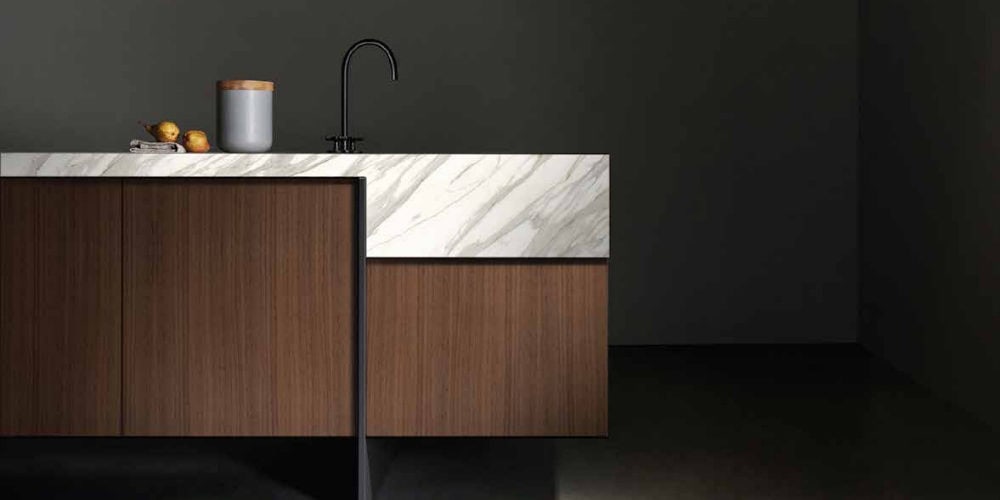
Real-wood veneer delivers the material of the moment. Veneers sliced from a single log are sequenced so grain flows continuously across doors and drawers: the grain-matched front that marks a considered kitchen. White oak leads decisively: the NKBA names it the top cabinet wood for 2026, cited by 51% of professionals, with 59% reporting growing demand for visible grain, and Houzz recording wood-tone cabinetry overtaking white for the first time, 29% to 28%. Pinterest’s data adds the pairing of the year: “white oak and black kitchen” searches up 625%. Timber-drenching (one wood tone carried across fronts, panelling, and shelving) is the fullest expression.
Glass and Framed Fronts
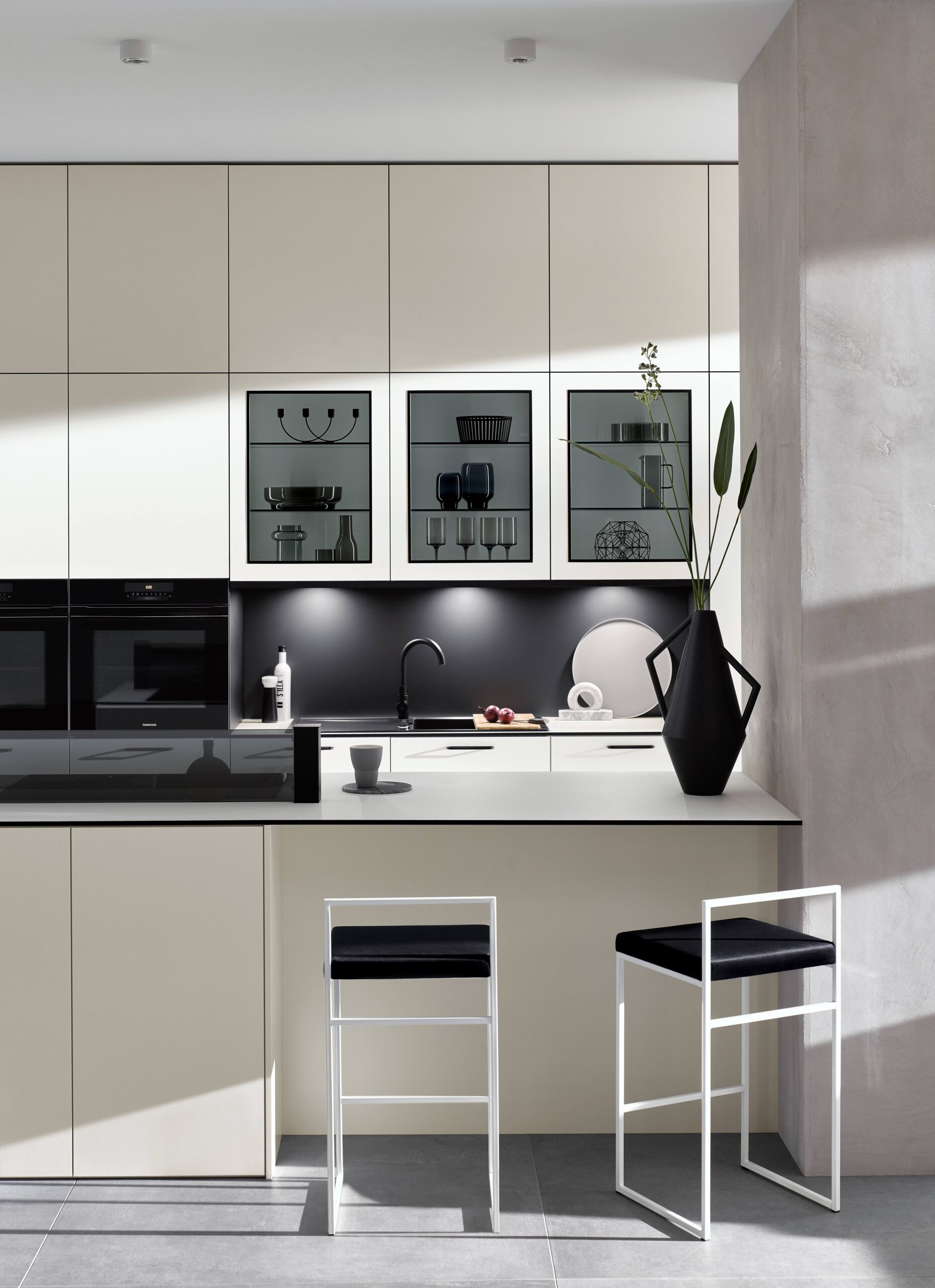
Glass fronts (satin, smoked, clear, or fluted, usually within slim aluminium frames) introduce display and depth, almost always with interior lighting. They are best deployed sparingly, as punctuation within a composed elevation: a lit glass bank between matte runs, a fluted sideboard in the dining zone. Sustainability threads through all front families: certified wood supply chains ahead of the EU Deforestation Regulation taking effect December 30, 2026, FSC-certified forests now exceeding 171 million hectares, and energy-efficient German production behind every finish.
How the Bauformat Tiers Map the System
The Bauformat group (family-owned since 1917, 650 kitchens a day from Löhne, among Europe’s top ten manufacturers) offers the entire system described above through three honestly differentiated brands. Burger, for smart budgets, delivers the core grammar: frameless carcases, the modular grid, soft-close hardware, and strong laminate and lacquer programs. Bauformat, for everyday excellence, opens the full depth: matte lacquers, veneers, handleless channel systems, and the complete interior range. Baulux, for uncompromising luxury, adds the flagship specification: grain-matched fronts, bespoke dimensions, and architectural detailing without compromise. The construction standards, quality marks, and made-to-order production are common to all three; a buyer chooses a specification depth, never a different standard of engineering.
Frequently Asked Questions
What are the main types of German kitchen cabinets?
Three families: base cabinets (worktop level: drawers, sink and cooktop units, islands), wall cabinets (eye-level storage with lift-up or glass fronts), and tall cabinets (larders, appliance towers, integrated refrigeration). They share one modular dimensional system.
What does frameless or full-access construction mean?
The cabinet is a precision box without a face frame; doors and drawers mount directly to the carcase. It yields about ten percent more usable volume, unobstructed access, and the flush front plane characteristic of German design.
Are handleless kitchens practical?
Yes. The machined channel provides a continuous, comfortable grip and removes hardware that catches clothing and collects grime. The prerequisite is precision manufacturing; the channel exposes any misalignment, which is why it is a German specialty.
Which front material should I choose?
Laminate for durable value, lacquer (especially matte) for colour and the purest contemporary surface, real-wood veneer for warmth and the leading 2026 direction, glass for lit display moments. All mount on the same carcase and hardware standard.
Can a modular German system fit an awkward Vancouver floor plan?
That is what the grid is for. Standardized increments plus made-to-measure exceptions resolve angled walls, low sills, and concrete columns filler-free, a regular exercise in Vancouver condominium projects.
What distinguishes the Baulux, Bauformat, and Burger tiers?
Specification depth, not build quality. Burger serves smart budgets, Bauformat everyday excellence, Baulux uncompromising luxury, all built in the same German factories to the same tested standards, including the Golden M (RAL-GZ 430).
The System Is the Product
Choose a German kitchen and you are choosing the system: three cabinet families on one dimensional grammar, frameless construction held to ±0.1mm, interiors engineered as carefully as elevations, and a front range that runs from workhorse laminate to grain-matched white oak. The types are not a catalogue to memorize but a vocabulary a good planner speaks fluently on your behalf, and the fastest way to learn it is to stand in front of the real thing and open everything.
See every cabinet type in person. Book a private showroom tour at Bauformat BC, 1410 Marine Dr Unit 205, North Vancouver, +1-604-770-1284.
