
Walk into a kitchen designed for 2026 and the first thing you notice is how calm it feels. The hard, glossy, all-white look that ruled the last decade has softened into something warmer and more grounded. Wood grain is back. Colour has returned, though in muted, earthy registers rather than loud accents. Surfaces are matte, tactile, and quiet. The German design tradition, with its love of clean geometry and engineering precision, has always been ahead of this curve, and 2026 is the year the wider world catches up to it.
At our Yaletown showroom we have watched Metro Vancouver homeowners move toward kitchens that work harder and shout less. This is a round-up of the directions shaping the year, each one viewed through a German-design lens, with concrete examples of how the looks come together in a real Vancouver home. Use it as a planning tool, a mood board, and a reality check on what is genuinely current versus what is already fading.
Key Takeaways
- Warm minimalism is the defining mood of 2026: clean lines made livable through natural materials, matte surfaces, and earthy colour.
- Wood grain has overtaken painted cabinets in popularity, with white oak the most-requested wood, and neutrals still dominate at 96 percent of professionals (NKBA, 2026).
- Handleless fronts, integrated appliances, and floor-to-ceiling storage create the seamless, calm look that German cabinetry delivers natively.
- Statement islands and decorative lighting are where personality lives now, with 87 percent of pros calling statement lighting a key consideration (NKBA, 2026).
- A minor kitchen remodel returned about 113 percent of its cost at resale, making thoughtful updates one of the strongest home investments (Remodeling Cost vs. Value, 2026).
Warm Minimalism: The Mood of the Year
If 2026 has a single headline, it is warm minimalism. The discipline of minimalism stays, the clean runs of cabinetry, the absence of clutter, the architectural calm, but the coldness is gone. Designers are softening hard geometry with natural texture, warmer undertones, and materials you actually want to touch. The NKBA’s 2026 report found that contemporary and minimalist styles rank second in popularity over the next three years at 60 percent, just behind transitional at 72 percent, with organic and natural styles close behind at 58 percent (NKBA, 2026). The takeaway is that pared-back design is not going anywhere, it is just getting more human.
This is the territory German cabinetry has occupied for a century. Made in Germany since 1917, Bauformat builds fronts with the flat, full-height proportions and tight reveals that warm minimalism depends on. The trick is balance. A run of warm wood-grain tall units against a matte clay-toned island reads as serene rather than stark. In a Vancouver context, where grey skies are a fact of life for much of the year, that warmth matters more than it might in a sunnier climate. A kitchen that glows softly on a wet November afternoon is doing real work.
Handleless Fronts and the Vanishing Hardware
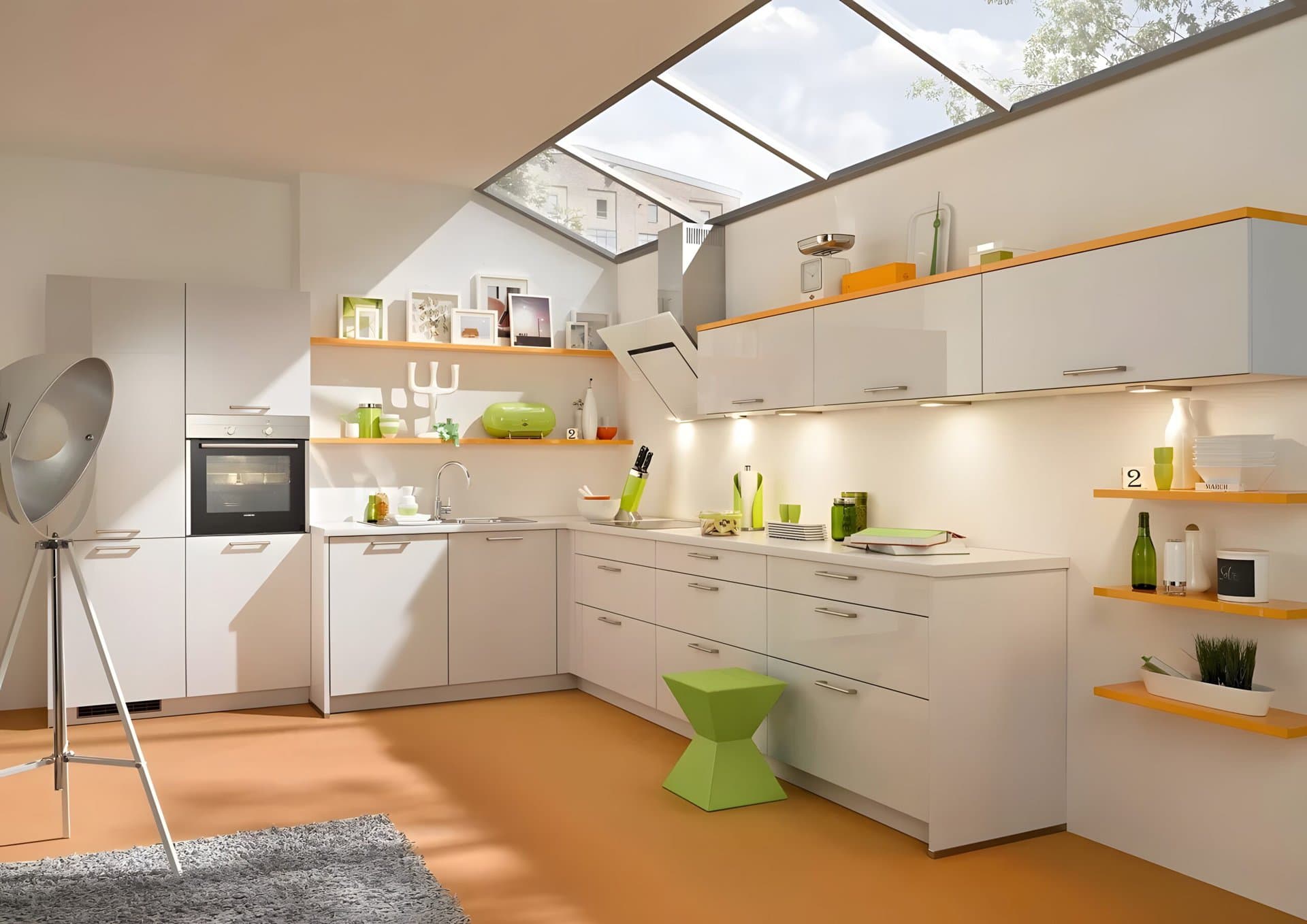
Nothing signals a current German kitchen faster than handleless fronts. Pulls and knobs interrupt the clean plane of a cabinet run, and 2026 design wants that plane uninterrupted. Handleless designs using touch-latch and recessed-grip systems are growing specifically for the minimalist look the year favours (NKBA, 2026). The result is a kitchen that reads as architecture, not furniture, with long unbroken horizontals that make even a compact space feel composed.
There are two main ways to achieve it, and both belong in the Bauformat range:
- Recessed grip rails: a continuous channel routed into the top edge of the front, so you open the door with a fingertip behind the panel. Clean, durable, and forgiving of daily use.
- Push-to-open mechanisms: a gentle press releases the door, paired with soft-close so it returns quietly. This gives the purest flat-front look with zero visible hardware.
What makes the handleless look actually pleasant to live with is the hardware behind the scenes. Full-extension soft-close runners let a drawer glide fully open and close without a slam, and 3D-adjustable concealed hinges keep door gaps even over years of use, which is exactly what keeps those tight reveals looking sharp. In a Yaletown condo or a Kitsilano character home alike, handleless fronts make a galley or single-wall kitchen feel intentional rather than cramped.
Natural and Warm Materials Take the Lead
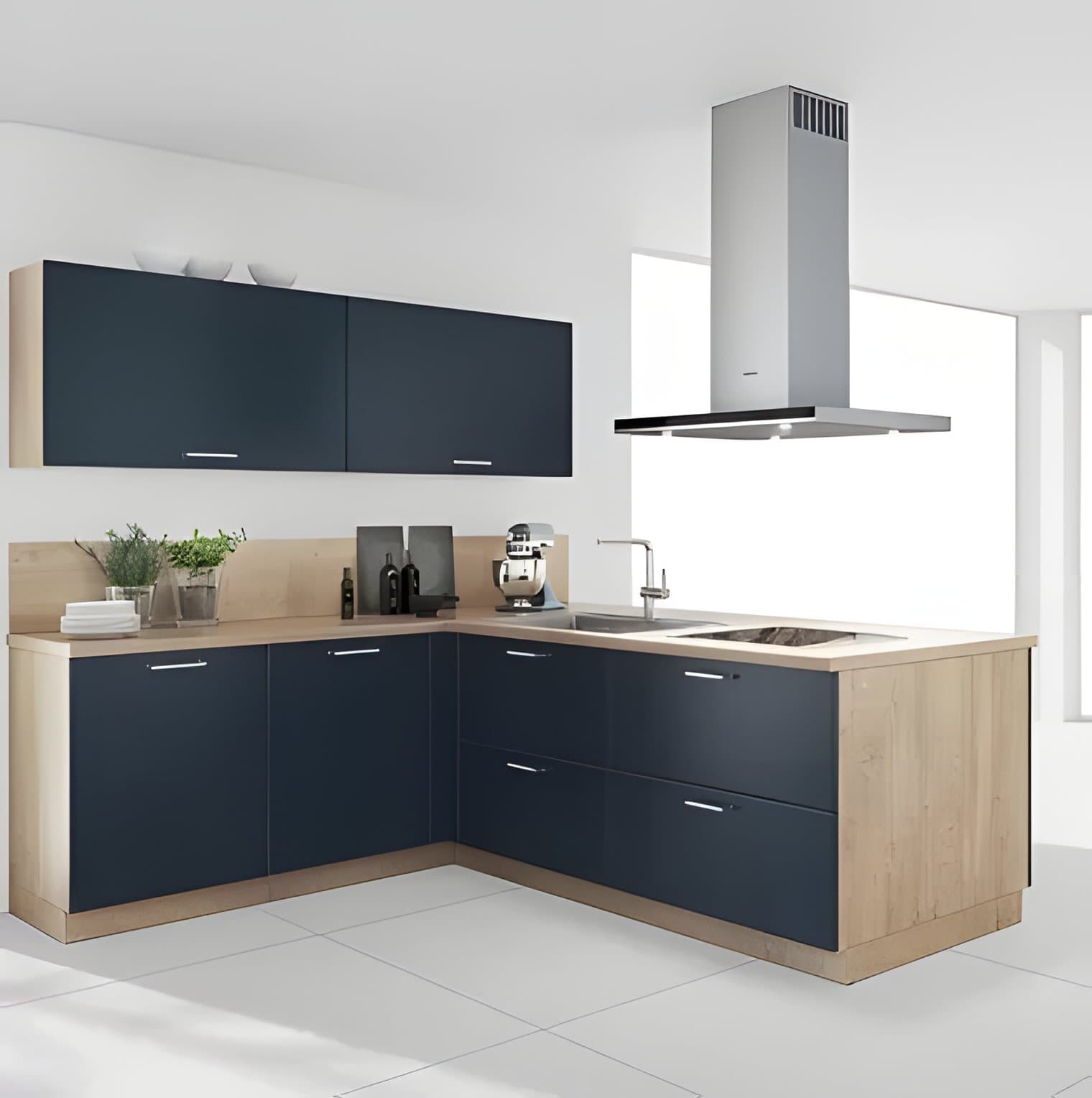
The biggest material story of 2026 is the return of wood. For the first time in years, wood grain has surpassed painted cabinets in popularity, with 59 percent of professionals naming it as growing, and white oak is the single most-requested wood type at 51 percent (NKBA, 2026). Medium and lighter natural tones lead the comeback. This is a clear break from the painted-shaker era and a move toward surfaces that show their character.
For German cabinetry this plays to a real strength. The Bauformat collection offers convincing wood-grain fronts in oak and walnut registers, with the grain running consistently across a full run so a wall of tall units reads as one continuous piece of timber rather than a patchwork. On countertops and backsplashes, natural quartzite is rising fast, sitting right behind engineered quartz at 62 percent for counters and 61 percent for backsplashes (NKBA, 2026). The pairing of a warm wood-grain base with a veined stone slab is the defining 2026 material combination.
How the look comes together
- White-oak grain base cabinets with a soft matte clay or sage on the upper run.
- A full-height stone or stone-look slab backsplash instead of tile, for an unbroken surface.
- Wood flooring underfoot, still the runaway favourite among 94 percent of pros (NKBA, 2026), tying the natural palette together.
Earthy and Moody Colour
Colour is back, but read the room before you reach for anything bright. Neutrals still dominate at 96 percent of professionals, with greens at 86 percent and blues at 78 percent the leading accent families, while loud shades like bright orange and red sit at the very bottom of the list (NKBA, 2026). The all-white kitchen is genuinely on its way out, with 86 percent of pros saying so, replaced by warm neutrals and earth tones confirmed by 67 percent of experts (kbbreview, 2026). Think mushroom, olive, clay, deep forest, and warm greige rather than anything you would call a statement on its own.
Where designers do add colour, they place it deliberately. The NKBA found new statement colours landing on backsplashes (60 percent), the island (57 percent), and decorative accessories (55 percent) rather than across every cabinet (NKBA, 2026). That measured approach suits German cabinetry well, because the matte and ultra-matte fronts in the Baulux and Bauformat ranges hold deep, complex colours beautifully. A forest-green island anchored by warm oak surrounds is a far more current move in 2026 than a kitchen painted a single bright shade throughout.
Integrated and Hidden Appliances
A calm kitchen is one where the machinery disappears. Panel-ready, integrated appliances behind cabinetry fronts are central to the 2026 look, working alongside matching slab backsplashes and hidden storage doors to create one cohesive, uninterrupted surface (NKBA, 2026). When the fridge and dishwasher wear the same front as the cabinets beside them, the eye reads the whole wall as architecture, and the warm-minimalist effect holds.
This is precisely the kind of precision German cabinetry is built around. Integration depends on consistent front thicknesses, accurate panel sizing, and hinges that carry the extra weight of an appliance door without sagging, which is where 3D-adjustable concealed hinges earn their keep. Two practical moves define the trend:
- Appliance garages: a lift-up or pocket-door cabinet that hides the kettle, toaster, and coffee machine on the counter, so the worktop stays clear.
- Integrated tall units: fridge, freezer, and ovens absorbed into a single floor-to-ceiling wall of cabinetry, often the cleanest way to handle a Vancouver open-plan condo where the kitchen is visible from the living room.
Statement Islands
If the perimeter is where 2026 stays quiet, the island is where it speaks. The island has become the social and visual centre of the kitchen, and designers are treating it as a feature in its own right: a contrasting colour or material, a thick waterfall stone edge, generous seating, and storage built into every face. Islands also rank among the top places homeowners are introducing their statement colour, at 57 percent (NKBA, 2026).
In a German cabinetry plan, the island is where you can be bold without overwhelming the room. A common 2026 approach pairs a warm wood-grain perimeter with an island in a deep matte tone, or flips it, with a calm neutral perimeter and a richly veined stone island as the hero. Because the same soft-close runners and concealed hinges run through the island as the rest of the kitchen, the bank of deep drawers facing the seating side stays just as functional as it is good-looking. For Metro Vancouver families who live in their kitchens, an island that combines a homework-and-coffee gathering spot with serious storage is the practical heart of the whole design.
Texture, Matte Surfaces, and Smart Storage
Two final threads tie the year together: how surfaces feel, and how the kitchen stays calm in daily use. Matte and ultra-matte fronts have moved from niche to mainstream, prized for the way they absorb light, resist fingerprints, and read as soft rather than slick. Texture is doing the work that bright colour used to do, with fluted and ribbed fronts, fine-grain wood, and tactile stone adding interest to an otherwise restrained palette. The Baulux collection in particular, with its ceramic, glass, and ultra-matte fronts, was built for exactly this contemporary, low-sheen direction.
Storage is the quiet hero. Floor-to-ceiling cabinetry with more drawers, deep pull-outs, and dedicated work zones is firmly in (NKBA, 2026), and it is what keeps a minimalist kitchen from drifting into clutter. German cabinetry has long led here, and the full-extension runners that let a deep drawer open completely turn a cabinet’s full depth into usable, visible space.
Lighting that does double duty
Lighting has graduated from afterthought to design feature. A full 87 percent of pros now call decorative, statement lighting a key consideration, while under-cabinet lighting (82 percent), interior cabinet lighting (72 percent), and pendants (63 percent) round out the most-cited priorities (NKBA, 2026). The 2026 approach layers them: warm under-cabinet strips wash the backsplash and make worktops usable, interior lights bring tall units to life when the doors open, and a sculptural pendant or run of pendants over the island provides the one decorative flourish a restrained room needs. In Vancouver’s long, dark winters, that layered light is not just decorative, it is what makes the kitchen feel good to be in.
Frequently Asked Questions
Is the all-white kitchen really over for 2026?
As a single dominant look, largely yes. 86 percent of professionals say the all-white kitchen is on its way out, replaced by warm neutrals and earth tones (kbbreview, 2026). White still appears, but as one quiet note in a warmer, more layered palette rather than the whole story. Wood grain and earthy colour are the directions with real momentum.
Are handleless kitchens practical for everyday use?
Very. Recessed grip rails and push-to-open mechanisms are designed for daily life, and paired with soft-close runners and adjustable concealed hinges they stay smooth and quiet for years. The lack of protruding hardware also means nothing to catch sleeves or bags on, which is a genuine bonus in a tight Vancouver galley kitchen.
Is a kitchen renovation a sound investment in Metro Vancouver?
Historically among the strongest. A minor midrange kitchen remodel returned roughly 113 percent of its cost at resale nationally, and kitchens overall recoup about 70 to 80 percent across all project scopes (Remodeling Cost vs. Value, 2026). In a high-value market like Metro Vancouver, a well-planned kitchen is one of the most visible upgrades a buyer notices.
Can German cabinetry deliver these looks at different budgets?
Yes. The Baulux collection leans into the most contemporary ceramic, glass, and ultra-matte fronts, the core Bauformat range offers the widest choice including handleless, wood-grain, matte, and high-gloss, and the Burger collection delivers the best value while keeping the same engineering underneath. The 2026 looks are achievable across that spread.
The thread running through every one of these directions is restraint with warmth: fewer hard edges, more natural texture, colour used with intent, and storage that keeps the whole thing calm. It is a sensibility German cabinetry has carried for generations, and 2026 is simply the year the rest of kitchen design arrives at the same place. For a Metro Vancouver home, that means a kitchen that feels as good in the grey of January as it looks in the long light of July.
Explore more from Bauformat BC
- Modern Kitchen Design
- Decoding German Kitchen Cabinets Vs. Italian Kitchen Cabinets
- How would Bauformat Matte Black Cabinets Change the Mood of a Kitchen?
German cabinetry, planned and built for Metro Vancouver
The kitchen is one of the highest-return rooms in a home: the 2025 Cost vs. Value Report found a minor kitchen remodel recoups roughly 96% of its cost at resale. Choosing cabinetry that lasts is central to that return, which is where German engineering earns its place. Every Bauformat kitchen is manufactured in Germany, then measured, planned, and installed by our Vancouver team, built to fit your room to the millimetre.
See the Baulux, Bauformat, and Burger collections in person at our North Vancouver showroom at 1410 Marine Dr Unit 205, learn more about the manufacturer at bauformat.de, and meet our local team at The Bau Team.
Book a 30-minute consultation with our Metro Vancouver kitchen designers to plan a kitchen built to last.
A kitchen is the most expensive room in most homes to renovate, and the part of the budget that scares people most is usually the cabinets. They cover the most surface, they take the most abuse, and they are the thing your eye lands on the second you walk in. So when the quote comes back higher than expected, cabinets are the first place people start looking to trim. That instinct is right. The trick is knowing which corners are safe to cut and which ones come back to bite you in five years.
The good news is that an honest kitchen on a sensible budget is not a compromise kitchen. Some of the smartest dollars in cabinetry go toward parts you never see, while some of the most expensive upgrades are pure cosmetics you could happily live without. This guide walks through where to save, where not to, and how to read a cabinet quote like someone who has done this before. The aim is a durable kitchen built from affordable kitchen cabinet materials that still feels solid every time you open a drawer.
Key Takeaways
- Cabinets are the single largest line in a kitchen budget, typically 30 to 45 percent of the total, so smart choices here move the whole number.
- It is fine to economize on door and front materials. Quality laminate, melamine, and painted engineered fronts look excellent and wear well.
- Never cheap out on the carcass board, edge banding, hinges, and drawer runners. These decide whether your kitchen lasts 10 years or 25.
- In Metro Vancouver, a focused refresh often returns more value than a full gut renovation, so spend where it lasts and shows.
- The Burger collection from Bauformat gives you full German build quality and the same hardware as the premium lines at the best value point.
Why Cabinets Are the Place to Get Strategic
Across Metro Vancouver, kitchen renovations in 2026 generally land between 45,000 and 75,000 dollars for a detached home or townhouse, and roughly 28,000 to 55,000 dollars for a condo, according to Vancouver General Contractors (2026). Cabinetry is almost always the biggest single piece of that. National pricing guides put cabinets at 30 to 45 percent of a kitchen budget, per Kitchen Design Solutions (2025). On a 60,000 dollar project, that is real money, somewhere in the 18,000 to 27,000 dollar range just for boxes, fronts, and hardware.
That scale is exactly why cabinets are where strategy pays off. Shaving 10 percent off a tile choice barely registers. Making one good decision about your cabinets can change the project total by thousands. And because cabinets are the bones of the room, the decision is not only about price. It is about which version of cheaper still gives you a kitchen that opens, closes, and holds its line a decade from now.

Where It Is Smart to Save
The honest truth most showrooms will not lead with is that a lot of cabinet cost lives in the visible front, and the visible front is also where you have the most room to economize without anyone being able to tell. Here is where saving is genuinely safe.
Door and front materials
A high pressure laminate or quality melamine front is not a downgrade in any way that matters day to day. It resists moisture, wipes clean, and holds colour far better than a painted surface in a busy household. A painted engineered front in a matte finish gives you the same look as far pricier options at a fraction of the cost. You are paying for the finish you see, not for fragility you have to baby.
Finish and colour, within reason
Ultra-matte, true gloss, and textured ceramic or glass fronts are gorgeous, and they sit at the top of the range for a reason. If the budget is tight, a clean laminate or melamine in a current colour delivers most of the visual impact for a lot less. You can always reserve a premium finish for an island or a single feature run and keep the perimeter economical.
Layout simplicity
Custom angles, curved ends, and one-off cabinet sizes drive cost quickly. Sticking to standard module widths and a logical layout keeps the price honest and, frankly, often works better in the real Vancouver kitchens we measure, which tend to be compact condo and townhouse footprints rather than sprawling estates.
Where Cutting Corners Costs You Later
Now the other side. There are parts of a cabinet that are invisible on day one and decisive on day three thousand. This is where a cheap kitchen reveals itself, usually right around the time the warranty would have mattered.
The carcass board
The carcass is the box itself, the part that carries the weight and holds the screws. A dense, high grade engineered board stays square, grips hardware tightly, and shrugs off the humidity that comes with a coastal climate and a busy stovetop. A flimsy core board sags under a loaded shelf, lets screws strip, and is the reason some kitchens feel loose and rattly long before they look dated. Plywood and quality engineered carcasses are rated for 15 to 30 years of service, while the cheapest cores fall apart in a fraction of that, per Kitchen Cabinet Kings (2026). Spend here.
Edge banding
Edge banding is the thin strip sealing the cut edges of every panel. It looks trivial. It is not. Unsealed or poorly applied edges let moisture creep into the core, which then swells and delaminates, especially around the sink and dishwasher. As one industry guide notes, professional grade PVC or ABS banding creates a sealed, effectively waterproof edge that protects the panel underneath, per Kitchen Cabinet Kings (2026). Thin, peeling banding is one of the clearest signs of a kitchen built down to a price.
Hinges and drawer runners
Hardware is where cheap kitchens age the fastest. Light-duty hinges sag and drawers that ride on basic runners start to stick, rattle, and droop. You open and close these things thousands of times a year. Full-extension, soft-close runners and 3D-adjustable concealed hinges are not a luxury. They are the difference between a kitchen that still feels tight in year 12 and one that feels tired in year 4.

Value Front Materials, Done Well
Affordable does not have to mean fragile. The materials below are genuinely good when they are made properly, and they are the backbone of a sensible budget kitchen.
- High pressure laminate. Tough, scratch and moisture resistant, and available in a wide range of colours and woodgrains. Quality laminate fronts commonly last 10 to 20 years, per Southwest Kitchen (2026). Excellent value for hard-working family kitchens.
- Melamine fronts. A fused resin surface over a stable engineered core. Easy to clean, colour-stable, and rated for 15 to 20 years and beyond with proper edge sealing, per Pelican Cabinets and Remodeling. The edge banding matters enormously here, which is why build quality, not just the front, decides longevity.
- Painted engineered fronts. For a classic shaker or flat-panel look without solid wood pricing. A factory-applied finish on a stable core gives you the painted look most people want at a far gentler price than full custom millwork.
The thread running through all of these is the same. A value front material on a quality carcass with proper hardware is a smart kitchen. The same front on a cheap box with weak hinges is a regret. The front is not the gamble. Everything behind it is.
The Parts You Should Not Cheap Out On
If you take one thing from this guide, make it this list. When you compare quotes, line them up against these four points before you compare anything cosmetic.
- Carcass board grade. Ask what the box is made of and how it is rated. A dense engineered carcass is the foundation of the whole kitchen.
- Edge banding type and thickness. Look for proper PVC or ABS banding, firmly bonded, with no thin or lifting edges, particularly near water.
- Hinges. Concealed, adjustable, soft-close. Adjustability matters because houses settle and doors need to be brought back into line over the years.
- Drawer runners. Full-extension and soft-close, so the whole drawer comes out and nothing slams. Cheap runners are the first thing to fail.
This is exactly where the Bauformat approach earns its keep. Made in Germany since 1917 in Lohne, every Bauformat collection ships with full-extension soft-close runners and 3D-adjustable concealed hinges as standard, including the value-focused line. You are not trading away the parts that fail first in order to hit a lower number. The build quality is consistent. The price point is what flexes.
Budget Tiers, and Reading Them Honestly
Cabinet pricing in Metro Vancouver generally sorts into a few tiers, and understanding what separates them helps you spend on purpose.
Entry value
At the lowest end you find stock boxes and basic fronts. The risk here is not the look, it is the hidden build. This is the tier where carcass board, banding, and hardware are most often quietly downgraded. If you shop this tier, the four checkpoints above are non-negotiable.
Smart value
This is the sweet spot for most Metro Vancouver homeowners, and it is where the Burger collection sits. You get the full German build, the proper hardware, the sealed edges, and a stable carcass, paired with value front materials like quality laminate and melamine. It is the widest-choice middle ground done without compromising the parts that wear. For most condo and townhouse kitchens in the city, this tier delivers the longevity people actually want at a price that respects the budget.
Premium
At the top, lines like Baulux bring ceramic, glass, and ultra-matte fronts, and the Bauformat collection opens up the widest range of configurations and finishes. Worth it when you want a feature kitchen or a specific high-end look. The important point is that the structural quality at the value tier is not a lesser version of this. The difference upstairs is mostly finish, choice, and surface, not whether the drawers will still glide in a decade.
Knowing these tiers also helps you mix. A common smart-money move is a premium finish on a small feature element and the value tier everywhere else, so the room reads high-end while the budget stays grounded.
Getting Value That Actually Lasts
The point of economizing well is not just a lower invoice today. It is a kitchen that does not need redoing the moment it goes out of style. That distinction matters more than people expect, because the cheapest kitchen is rarely the one with the lowest sticker. It is the one you only buy once.
There is a resale angle too. Minor and well-targeted kitchen updates return roughly 96 percent of their cost nationally, the strongest of any interior project in the report, per Kitchen Cabinet Kings (2026), while full upscale gut renovations recoup far less, often in the 30 to 40 percent range. The takeaway for a Metro Vancouver homeowner is clear. Money spent on solid, durable cabinetry with good hardware holds its value. Money spent over-customizing or chasing a premium finish you did not need tends not to come back. Spending where it lasts and where it shows, and saving on the rest, is simply the better financial decision.
Local context sharpens this. Vancouver kitchens skew compact, the climate is humid, and skilled labour here runs higher than the national average, so a kitchen built to be opened, fixed, and adjusted rather than torn out is a genuine saving over time. A measured, planned, and properly installed kitchen from a local team avoids the expensive re-dos that come from boxes that never sat square in the first place.
Frequently Asked Questions
Are laminate and melamine cabinets actually durable, or a compromise?
Done properly they are genuinely durable, not a compromise. Quality laminate fronts commonly last 10 to 20 years and well-built melamine 15 to 20 years or more, per Southwest Kitchen (2026) and Pelican Cabinets and Remodeling. The deciding factor is not the front itself but the carcass and the edge sealing behind it. A good front on a poor box ages badly, which is why build quality matters more than the material name.
Where should I spend the most in a budget kitchen?
On the parts you cannot see and the parts you touch most. Put your money into the carcass board, the edge banding, the hinges, and the drawer runners. These decide how the kitchen feels and how long it lasts. You can economize confidently on the front material and the finish, because those are cosmetic choices, not structural ones.
How much of my kitchen budget should go to cabinets?
Plan for cabinets to be your largest line, typically 30 to 45 percent of the total kitchen budget, per Kitchen Design Solutions (2025). In a Metro Vancouver renovation that often means somewhere in the high teens to high twenties of thousands of dollars, which is exactly why choosing the right tier rather than the cheapest option pays off.
Is a value collection lower quality than a premium one?
Not in the ways that determine durability. Across the Bauformat range, the value-focused Burger collection ships with the same full-extension soft-close runners and 3D-adjustable concealed hinges as the premium lines, and the same German build standards. The difference between value and premium is mainly in front materials, finishes, and the breadth of configuration choices, not in whether the kitchen will hold up.
Building a durable kitchen on a budget is less about spending less and more about spending in the right order. Get the box, the edges, and the hardware right, choose a value front material that suits how you actually live, and reserve the premium touches for the spots that earn them. Do that, and an affordable kitchen stops being a compromise and becomes the smart choice it should have been all along.
Explore more from Bauformat BC
- Why Choose Long-Lasting Materials for Your Kitchen Cabinets
- Kitchen Cabinet Hardware
- Bauformat: Germany’s Elite Kitchen Cabinet Craftsmen
German cabinetry, planned and built for Metro Vancouver
The kitchen is one of the highest-return rooms in a home: the 2025 Cost vs. Value Report found a minor kitchen remodel recoups roughly 96% of its cost at resale. Choosing cabinetry that lasts is central to that return, which is where German engineering earns its place. Every Bauformat kitchen is manufactured in Germany, then measured, planned, and installed by our Vancouver team, built to fit your room to the millimetre.
See the Baulux, Bauformat, and Burger collections in person at our North Vancouver showroom at 1410 Marine Dr Unit 205, learn more about the manufacturer at bauformat.de, and meet our local team at The Bau Team.
Book a 30-minute consultation with our Metro Vancouver kitchen designers to plan a kitchen built to last.
A kitchen is one of the largest, most material-heavy purchases a household makes. It is also one that tends to stay put for a very long time. So the green question is not only what this is made of, but how long will it last, and what does it put into the air I breathe while I cook dinner. Those two questions, durability and indoor air quality, end up mattering more than almost any single eco-label on a brochure.
German-engineered cabinetry has a reputation for precision, but the sustainability story is quieter and more specific than the marketing usually lets on. It comes down to low-emission engineered boards, responsibly sourced wood, hardware built to outlast trends, and manufacturing that wastes less. For eco-conscious buyers across Metro Vancouver, where the city is actively trying to keep building materials out of the landfill, those details are worth understanding before you commit.
Key Takeaways
- Indoor air quality is a real sustainability factor. European formaldehyde norms are tightening: from 6 August 2026, furniture and wood-based articles sold in the EU must emit no more than 0.062 mg/m3, half the long-standing E1 threshold of 0.124 mg/m3 (TUV Rheinland / Fraunhofer WKI, 2026).
- Responsibly sourced wood is verifiable. FSC-certified forest area passed 171 million hectares globally by the end of 2025, growing more than 6% in a year (FSC, 2025).
- Durability is the underrated green move. Cabinets built to last decades avoid the waste of an early teardown. Solid, well-built kitchens can serve far longer than the budget boards that may need replacing in 5 to 10 years.
- Waste is a local issue. In 2022, building materials made up 31% of waste landfilled or incinerated by Vancouver residents and businesses, with wood alone around 46,000 tonnes a year (City of Vancouver, 2026).
- The greenest choice is the one you keep. Look for low-emission boards, certified wood, repairable hardware, and a build quality that earns its place for the long haul.
Low-Emission Boards and the Air in Your Kitchen
Most kitchen cabinets, German or otherwise, are built largely from engineered wood boards: particleboard and MDF, faced with veneers, laminates, or lacquers. That is not a compromise, it is good engineering. Engineered boards make efficient use of timber, stay flat and stable through Vancouver’s damp winters, and hold hardware reliably. The sustainability concern with these boards is the adhesive, because some resins release formaldehyde over time, and a kitchen is a room you spend hours in every day.
This is where European standards do real work. The familiar benchmark has been the E1 class, which limits formaldehyde emissions to roughly 0.124 mg/m3 (about 0.1 ppm) when tested under EN 717-1. German manufacturing has long built to E1 as a baseline rather than a stretch goal. The bar is now moving further. Under a new REACH restriction, from 6 August 2026 furniture and wood-based articles placed on the EU market must not exceed 0.062 mg/m3, which is exactly half the old E1 limit (TUV Rheinland, 2026; Fraunhofer WKI, 2026).
Why this matters for a healthy home is straightforward. Lower emissions from the boards mean less off-gassing into your indoor air, which is the air a family actually breathes far more than outdoor air. For households with young children, older relatives, or anyone sensitive to indoor pollutants, choosing cabinetry built to the stricter European norm is a tangible, measurable benefit rather than a vague green promise.
What to ask about emissions
- Are the carcase boards built to E1 or the newer, lower European limit?
- What finish is used on the fronts, and is it a low-emission lacquer or laminate?
- Is there documentation, not just a salesperson’s reassurance?
Responsibly Sourced and FSC-Certified Wood
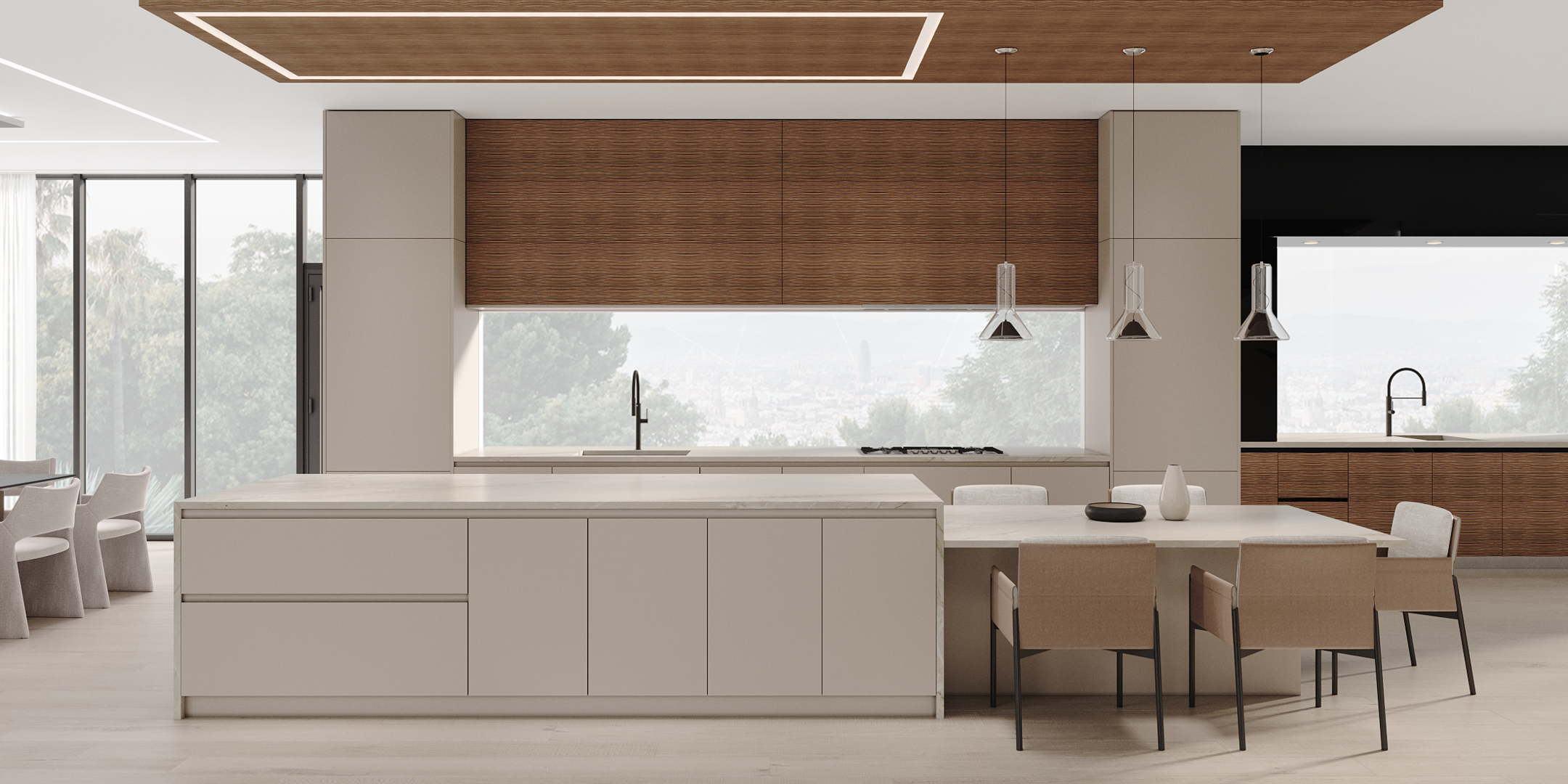
Even the most efficient board starts as a tree. Responsible sourcing means that timber comes from forests managed for the long term, with attention to regrowth, biodiversity, and the communities who depend on those forests. The most recognized way to verify this is Forest Stewardship Council (FSC) certification, which tracks wood from a managed forest through the supply chain.
The scale here is meaningful. By the end of December 2025, FSC-certified forest area had surpassed 171 million hectares worldwide, having grown by more than 6%, over 12 million hectares, in a single year (FSC, 2025). German cabinet makers, working within a strict European regulatory environment, are well positioned to source from certified and responsibly managed supply chains, and many do.
A word of honesty, because this topic invites greenwashing: a certification on the timber does not automatically make an entire kitchen sustainable. It is one credential among several. The point is to look for verifiable sourcing claims you can check, FSC chain-of-custody being the clearest, rather than soft language like eco wood that means nothing in particular.
Durability as Sustainability
Here is the part that gets overlooked. The single greenest thing a kitchen can do is last. Every cabinet you do not have to replace is timber not harvested, resin not manufactured, a truck not driven, and a load not sent to the landfill. A kitchen that serves you well for 25 or 30 years is dramatically lower-impact than two or three cheaper kitchens fitted over the same span.
This is where build quality stops being a luxury talking point and becomes an environmental one. Industry guidance puts the typical kitchen lifespan somewhere in the 15 to 20 year range, but the materials and hardware swing that number hard in both directions. Lower-grade boards and bargain mechanisms can start failing in as little as 5 to 10 years, while solid construction and durable runners and hinges can keep a kitchen functional and good-looking for decades.
The mechanical parts matter as much as the boxes. Bauformat cabinets use full-extension soft-close runners and 3D-adjustable concealed hinges. The 3D adjustment is quietly important for longevity: doors can be realigned as a house settles, so a small sag becomes a two-minute fix rather than a reason to replace a front. Soft-close mechanisms reduce the daily slamming that wears out joints and finishes. None of this is glamorous, but it is exactly the kind of detail that decides whether a kitchen is still serving its second owner or sitting in a demolition bin.
Why early replacement is the real waste
- Embodied impact compounds. Replacing a kitchen twice doubles the timber, resin, finishing, and transport behind it.
- Repairable beats disposable. Adjustable hinges, replaceable runners, and refinishable surfaces extend useful life.
- Timeless design helps. Cabinets you do not tire of in five years are cabinets you keep.
The Local Angle: Vancouver’s Waste Problem
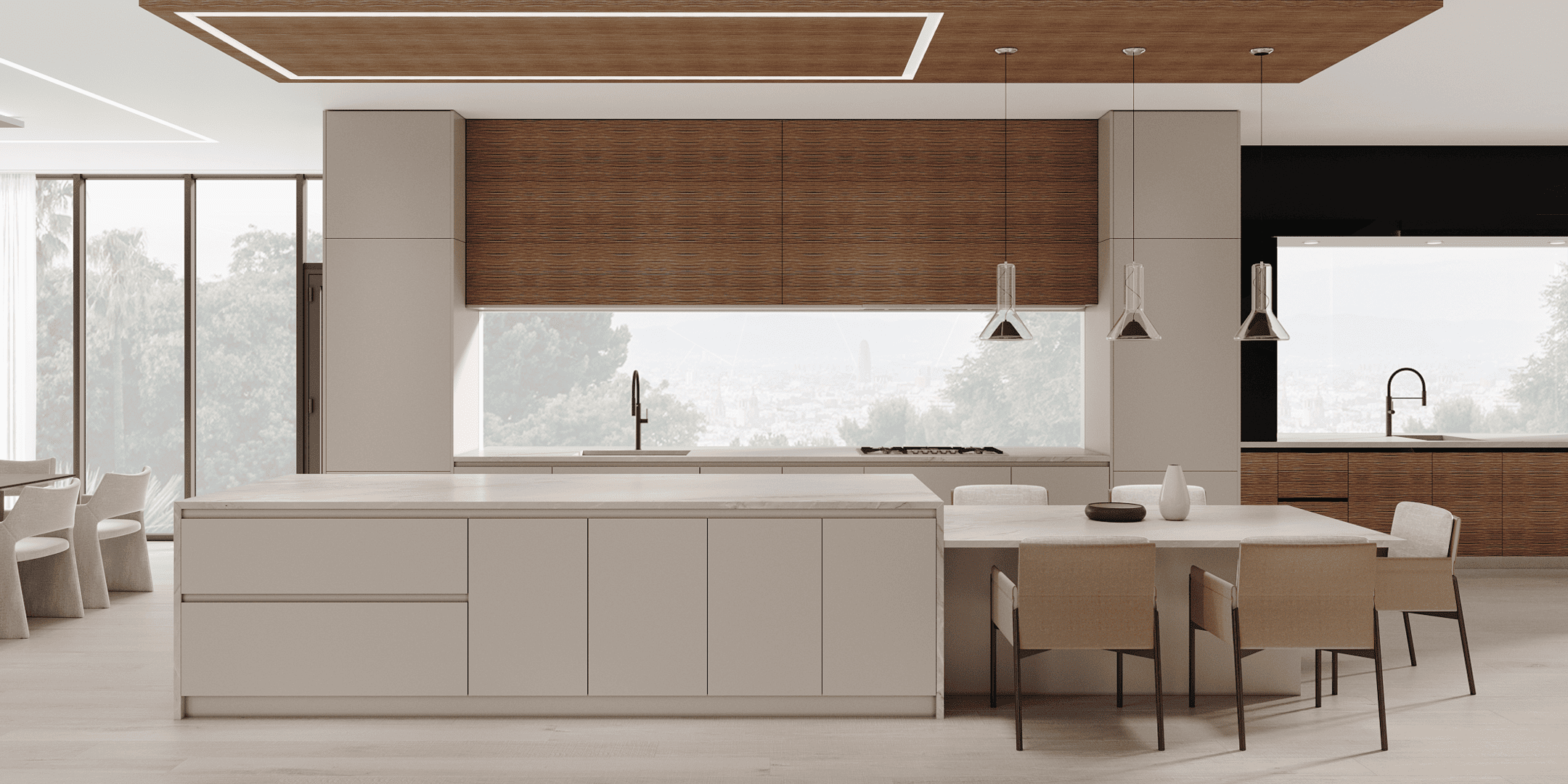
Durability is not an abstract virtue in Metro Vancouver, it is a local policy concern. The City of Vancouver has set a Zero Waste 2040 goal, and building materials are squarely in its sights. In 2022, building materials made up 31% of the waste landfilled or incinerated by Vancouver residents and businesses, and wood alone accounted for roughly 46,000 tonnes a year (City of Vancouver, 2026).
That figure reframes what a renovation actually is. When an early teardown sends old cabinetry to the dump, it is part of that 31%. Choosing a kitchen built to last, and choosing it once, is one of the more practical ways a household can shrink its own contribution to that stream. For eco-conscious buyers in Yaletown, Kitsilano, the North Shore, and across the region, the most sustainable cabinet is the one that never becomes construction waste in the first place.
Efficient German Manufacturing
German cabinet production leans on a manufacturing culture built around precision and low waste. Bauformat has been making cabinets in Lohne since 1917, and that longevity reflects a process refined over generations. Two things tend to follow from precision engineering. First, tight tolerances mean less offcut and rework, because parts are cut and machined to fit the first time. Second, standardized, modular components are easier to produce efficiently and easier to service or replace later, which loops right back to durability.
There is also a logistics reality worth naming plainly, without overstating it. Shipping cabinets from Germany to British Columbia carries transport emissions, and it would be greenwashing to pretend otherwise. The honest sustainability case is not that overseas shipping is free of impact. It is that a single well-made kitchen that lasts 25 years, sourced responsibly and emitting little into your home, generally outperforms a closer-made kitchen that has to be torn out and rebuilt twice in the same period. Longevity and low emissions are the variables that move the needle most, and those are the ones to weigh.
What to Look For as an Eco-Conscious Buyer
It is easy to be told a kitchen is green. It is harder, and more useful, to know what to check. A few concrete questions separate genuine substance from marketing.
A practical checklist
- Emission class. Ask whether boards meet E1 at minimum, ideally the newer, lower European limit taking effect in 2026. Ask for documentation.
- Verified wood sourcing. Look for FSC or equivalent chain-of-custody, not vague sustainable wood wording.
- Hardware quality. Full-extension soft-close runners and adjustable concealed hinges signal a kitchen designed to be serviced and kept.
- Repairability. Can a single front, runner, or hinge be replaced, or does a fault mean a bigger teardown?
- Build for your climate. Stable engineered boards and quality finishes hold up better through coastal BC humidity, which extends real-world lifespan.
- Design you will still like later. A configuration you do not outgrow is the most sustainable specification of all.
Bauformat’s range gives room to make those choices well. Baulux brings ceramic, glass, and ultra-matte fronts; the core Bauformat collection offers the widest set of options; and Burger covers strong value. Across all of them, the durable build and serviceable hardware are what carry the sustainability argument, because they are what keep a kitchen out of the waste stream.
Frequently Asked Questions
Are engineered boards less sustainable than solid wood cabinets?
Not necessarily, and often the opposite. Engineered boards use timber efficiently and resist warping in humid coastal conditions, which helps a kitchen last. The variable that matters most is the resin and its emissions. A low-emission engineered board built to E1 or the stricter 2026 European limit can be both a sound environmental choice and a healthier one for indoor air.
What does the European E1 standard actually mean?
E1 is a formaldehyde emission class limiting release to roughly 0.124 mg/m3 (about 0.1 ppm) under EN 717-1 testing. It has been the European baseline for wood-based panels. From 6 August 2026, a tighter REACH limit of 0.062 mg/m3 applies to furniture and wood-based articles sold in the EU, half the old E1 level (TUV Rheinland, 2026).
How long should a quality German kitchen last?
Typical kitchens are often cited at 15 to 20 years, but materials and hardware drive that figure. Budget boards and mechanisms can falter in 5 to 10 years, while solid construction with durable runners and adjustable hinges can keep a kitchen working and looking good for several decades, which is the heart of the durability-as-sustainability case.
Does buying German cabinetry undercut its green benefits because of shipping?
Shipping does carry transport emissions, and that is real. The fuller picture is that a responsibly sourced, low-emission kitchen that lasts 25 years and is never torn out early usually has a lower overall impact than cheaper cabinetry replaced two or three times. Longevity and indoor air quality tend to outweigh the one-time freight footprint.
Sustainability in a kitchen is less about a single badge and more about a set of honest, checkable details: what the boards put into your air, where the wood came from, how well the hardware is built, and whether the whole thing is made to last long enough that you only buy it once. German-engineered cabinetry tends to score well on each of those, and in a city working hard to keep building materials out of its landfills, a kitchen you keep for decades is a quietly meaningful choice for a Metro Vancouver home.
Explore more from Bauformat BC
- Why Choose Long-Lasting Materials for Your Kitchen Cabinets
- Decoding German Kitchen Cabinets Vs. Italian Kitchen Cabinets
- Bauformat: Germany’s Elite Kitchen Cabinet Craftsmen
German cabinetry, planned and built for Metro Vancouver
The kitchen is one of the highest-return rooms in a home: the 2025 Cost vs. Value Report found a minor kitchen remodel recoups roughly 96% of its cost at resale. Choosing cabinetry that lasts is central to that return, which is where German engineering earns its place. Every Bauformat kitchen is manufactured in Germany, then measured, planned, and installed by our Vancouver team, built to fit your room to the millimetre.
See the Baulux, Bauformat, and Burger collections in person at our North Vancouver showroom at 1410 Marine Dr Unit 205, learn more about the manufacturer at bauformat.de, and meet our local team at The Bau Team.
Book a 30-minute consultation with our Metro Vancouver kitchen designers to plan a kitchen built to last.
Anyone who has cooked in a downtown Vancouver condo knows the particular feeling of standing in the kitchen, holding a colander, and having nowhere to put it. The counter is already covered. The cabinet above is jammed. The drawer sticks halfway. In a city where space costs more per square foot than almost anywhere in Canada, that small daily friction adds up to real frustration.
The good news is that a compact kitchen does not have to feel cramped or chaotic. The difference between a kitchen that fights you and one that works with you usually comes down to what is happening inside the cabinets, not the size of the room. That is the heart of kitchen space optimization, and it is something German-engineered cabinetry was built to solve.
Key Takeaways
- Kitchen space optimization is mostly about cabinet interiors, not floor area. Full-extension pull-outs and smart organizers can reclaim the dead space hidden inside ordinary cabinets.
- Metro Vancouver condos are getting smaller, which makes every reclaimed inch more valuable for the people living in high-density neighbourhoods like Yaletown.
- Zoning your kitchen into prep, cook, clean, and store areas reduces wasted steps and makes a small footprint feel larger.
- Tall pull-out pantries, deep pan drawers, corner units, and drawer-in-drawer systems are the workhorses of small-space storage.
- A well-planned kitchen renovation is also one of the strongest returns you can make on a home, which matters in an expensive market.
Why Space Optimization Matters More in Metro Vancouver
Vancouver is the most densely populated city in Canada, with roughly 5,750 people per square kilometre, more than any other Canadian municipality with a population above 5,000 (Statistics Canada census data, 2025). Metro Vancouver as a whole passed three million residents in early 2025 and is projected to reach 3.8 million by 2046 (Metro Vancouver Regional District, 2025). More people on the same land base means more vertical living, and more vertical living means smaller kitchens.
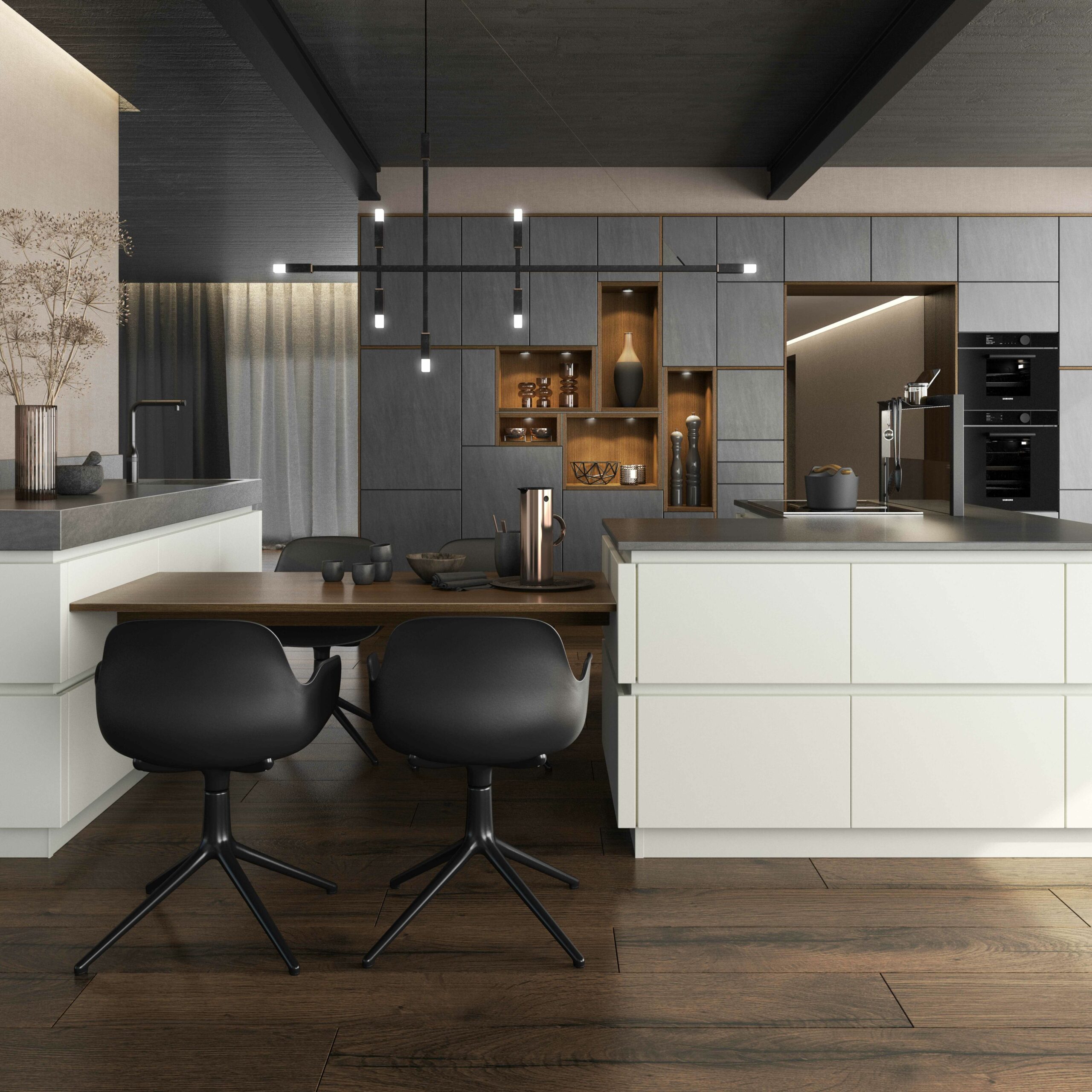
The numbers bear this out. The median size of newer Metro Vancouver condos has been shrinking, with units built in the mid-2010s running about 16 percent smaller than those built between 1971 and 1990 (Business in Vancouver, 2025). When the room itself is getting tighter, the only way to gain usable storage is to be smarter about the space you already have. That is exactly where interior engineering earns its keep.
Start With Zoning and Workflow
Before you think about any single cabinet, think about how you actually move through your kitchen. Professional designers organize a kitchen into zones, and the principle works just as well in a 600 square foot condo as it does in a sprawling home.
The five working zones
- Consumables: dry goods, canned items, and snacks, ideally grouped in one tall pantry pull-out.
- Non-consumables: dishes, glasses, and everyday tableware, stored close to the dishwasher.
- Cleaning: the sink, dishwasher, recycling, and the cabinet underneath for cloths and cleaners.
- Preparation: your main run of counter, with knives, boards, and bowls in the drawers directly below.
- Cooking: the cooktop and oven, with pots, pans, and utensils within arm’s reach.
When each item lives in the zone where you use it, you stop crossing the room for a colander. In a galley or single-wall condo kitchen, good zoning is the single biggest thing that makes a tight layout feel calm rather than cluttered. It costs nothing extra. It just requires planning the interiors around how you cook, which is the part of the process our Vancouver team works through with every client.
Tall Pull-Out Pantries: The Vertical Win
In a small kitchen, a traditional pantry cupboard is often a poor use of space. You can see the front row of items, but everything behind disappears into the dark. A tall pull-out pantry flips this. The entire unit glides out toward you on full-extension soft-close runners, so the back of the cabinet becomes as reachable as the front.
For a condo with limited cabinet runs, this is one of the most efficient things you can install. A single narrow column, sometimes as little as 30 centimetres wide, can hold an astonishing amount when it pulls out and gives you access from both sides. Shelves stay visible, nothing gets lost behind a forgotten can, and you reclaim the deep dead zone that ordinary pantries waste. Across the Bauformat, Baulux, and Burger collections, these tall units are designed to use the full height of the cabinet, floor to top.

Deep Drawers Beat Deep Cupboards
If there is one upgrade that changes how a small kitchen feels every single day, it is replacing lower door cabinets with deep drawers. A standard base cabinet with a door and a shelf forces you to crouch, reach into the dark, and shuffle pots to find the one at the back. A deep pan drawer brings everything to you.
Why drawers win in tight kitchens
- Full visibility: open the drawer and every pot, lid, and pan is in plain sight.
- Full-extension access: the drawer pulls all the way out, so nothing hides at the back.
- Soft-close runners: drawers glide shut quietly, which matters in an open-plan condo where the kitchen shares the room.
- Heavy-load capacity: well-built runners carry stacked cookware and full dish sets without sagging.
For tableware and utensils, a drawer-in-drawer system adds a shallow second tier inside a deep drawer, so cutlery and small tools sit above your pots without claiming a separate cabinet. In a kitchen with only a handful of base units, that hidden second layer can be the difference between a tidy drawer and a junk pile.
Conquering the Corner
Every kitchen with an L-shaped or U-shaped layout has a corner, and the corner is where storage usually goes to die. A blind corner cabinet swallows your stockpot into a void you can only reach by lying half inside it. In a small kitchen, you cannot afford to lose that volume.
Engineered corner solutions fix this completely. Swing-out and pull-out corner units bring the contents into the open with a single motion, so the back of the corner travels out to meet you. Curved shelving systems rotate, and articulated trays fold forward as the door opens. Whichever style suits your layout, the goal is the same. The corner stops being wasted cubic footage and starts pulling its weight, which in a compact condo kitchen can mean an extra cabinet’s worth of usable storage you already paid for.
Going Vertical: Full-Height Cabinetry
When floor space is fixed, the only direction left is up. Many older kitchens stop the upper cabinets short and leave a strip of dead space, often a dust-collecting gap, between the cabinet top and the ceiling. Full-height cabinetry runs all the way up, turning that wasted band into real storage.
The top shelves are perfect for the things you reach for a few times a year, like seasonal serving platters, the big roasting pan, or holiday dishware. Keeping those items up high frees the prime, eye-level and waist-level zones for everyday essentials. In a condo with tall ceilings, which many newer Vancouver buildings have, going full-height can add a surprising amount of capacity without claiming a single extra centimetre of floor. Tall units paired with concealed, 3D-adjustable hinges keep the doors aligned and the lines clean, even on a long vertical run.
Other vertical tricks worth using
- Lift-up upper doors: hinged to swing up and out of the way, ideal when the kitchen opens onto a living area and a swinging door would be awkward.
- Interior dividers: vertical slots that store baking sheets and cutting boards upright instead of stacked flat.
- Toe-kick drawers: the strip of space beneath your base cabinets, reclaimed for flat items like trays and linens.
Islands, Peninsulas, and Small-Space Tactics
Not every condo has room for a full island, but many can fit a peninsula or a compact island that does double duty. The secret is to treat it as storage first and surface second. A peninsula can hold deep drawers on the kitchen side and open shelving or seating on the living side, giving you a prep surface, a casual eating spot, and a wall of storage in one piece of cabinetry.
For the smallest layouts, a few targeted moves go a long way:
- Carry one wall up to full height rather than spreading short cabinets around the whole room.
- Choose drawers over doors on every base cabinet you can.
- Use the inside of cabinet doors for slim organizers that hold wraps, lids, or spices.
- Keep counters clear by giving small appliances a dedicated home behind a cabinet door, so the working surface stays open for actual cooking.
This kind of planning is also a sound investment. A 2025 national report found that a minor kitchen remodel returned roughly 96 percent of its cost at resale, among the strongest returns of any home project (Remodeling Cost vs. Value Report, 2025). In a market as expensive as Vancouver, a kitchen that stores more and works better is rarely money spent. It is money parked somewhere it tends to come back.
Frequently Asked Questions
How do I get more storage in a small condo kitchen without renovating the whole space?
Focus on the interiors. Swapping lower door cabinets for deep pull-out drawers, adding a tall pantry pull-out, and fitting a corner solution can roughly double the usable storage of the cabinets you already have, all without moving a single wall. Going full-height on at least one cabinet run captures the dead space near the ceiling too.
Are deep drawers really better than cupboards for pots and pans?
For most people, yes. A deep drawer pulls fully out so you can see and reach everything at once, while a cupboard hides the back row behind whatever is in front. Drawers also spare you the daily crouch-and-dig. With heavy-duty soft-close runners, they handle stacked cookware easily and close quietly, which is a real benefit in open-plan condos where the kitchen is part of the living space.
What is the smartest fix for a blind corner cabinet?
A dedicated pull-out or swing-out corner unit. Instead of reaching blindly into a void, you pull a mechanism that brings the entire contents forward into the light. In a compact kitchen, recovering that corner can give you back the equivalent of a whole extra cabinet that was previously unusable.
Does German-engineered cabinetry actually fit smaller kitchens?
It tends to suit them especially well. Because the interior hardware, pull-outs, and organizers are designed to extract every usable inch, the value is highest exactly where space is tightest. Cabinetry made in Germany since 1917 is measured, planned, and installed by a local Vancouver team, so the layout is built around your specific room rather than forced to fit a generic box.
A small kitchen is not a limitation so much as a design problem with good answers. Once the corners stop swallowing your cookware, the pantry pulls out instead of hiding things in the dark, and every base cabinet works as a drawer, even a modest Yaletown condo kitchen can hold more and feel calmer than rooms twice its size. The space was always there. It just needed to be engineered to give it back.
Explore more from Bauformat BC
- Modern Kitchen Design
- Kitchen Cabinet Hardware
- Unveiling the Top 5 Compact Kitchen Island Designs from Bauformat, You Can’t Ignore
German cabinetry, planned and built for Metro Vancouver
The kitchen is one of the highest-return rooms in a home: the 2025 Cost vs. Value Report found a minor kitchen remodel recoups roughly 96% of its cost at resale. Choosing cabinetry that lasts is central to that return, which is where German engineering earns its place. Every Bauformat kitchen is manufactured in Germany, then measured, planned, and installed by our Vancouver team, built to fit your room to the millimetre.
See the Baulux, Bauformat, and Burger collections in person at our North Vancouver showroom at 1410 Marine Dr Unit 205, learn more about the manufacturer at bauformat.de, and meet our local team at The Bau Team.
Book a 30-minute consultation with our Metro Vancouver kitchen designers to plan a kitchen built to last.
A kitchen is one of the few rooms you use every single day, often before your first coffee and again long after dinner. Drawers get yanked open with wet hands, doors get bumped by hips and grocery bags, and the cabinet under the sink quietly lives in a damp little microclimate of its own. After a few years, the difference between a kitchen that still feels solid and one that feels tired comes down to something most people never see when they sign off on a design: the materials underneath the finish.
In Metro Vancouver, where the air sits above 70 per cent relative humidity on average for much of the year (Weather and Climate, 2025), that difference shows up faster. Moisture is patient. It finds the weak edge, the cheap board, the hinge that was never built to be adjusted. So before you fall for a colour or a handle, it is worth understanding what actually makes a cabinet last, and how to tell good construction from a good photograph.
Key Takeaways
- The carcass board is the foundation. A dense, moisture-resistant board (EN 312 P3 grade or better) is what keeps a cabinet square and swelling-free in a coastal climate.
- Edges and fronts do the visible work. Tightly bonded edge banding and well-built door fronts, whether lacquer, ceramic, glass or real wood, are where wear and moisture try to get in first.
- Hardware decides the daily feel. Full-extension soft-close runners and adjustable concealed hinges are the parts you touch thousands of times a year, so they have to be engineered, not afterthoughts.
- Durability is a value and sustainability decision. With Vancouver kitchen renovations commonly running 35,000 to 85,000 dollars (Quay Construction, 2025), a cabinet that lasts 25 years instead of 12 is both cheaper per year and far kinder to the landfill.
- German engineering is built around longevity. Bauformat has been made in Lohne, Germany since 1917, with construction standards aimed at decades of use rather than a single trend cycle.
Start with the Carcass: the Board Nobody Sees
The carcass, or cabinet box, is the structural skeleton of every unit. It carries the weight of your dishes, holds the hinges and runners in place, and keeps everything square so doors close flush years from now. Yet it is the one component buyers almost never inspect, because it disappears the moment the doors go on.
Most quality cabinet boxes are made from engineered wood panels rather than solid timber, and that is not a compromise. Solid wood expands and contracts with humidity, which can crack panels and throw doors out of alignment. A well-made engineered board stays dimensionally stable. The key is density and moisture resistance.
What to look for in a carcass board
- Moisture resistance: Look for board rated to the European EN 312 P3 standard, which is designed for non-load-bearing use in humid areas and resists swelling when exposed to temporary higher humidity (Pfleiderer, 2025). In a Vancouver kitchen, that rating is not a luxury, it is the baseline.
- Density: A denser board holds screws and hinge mounts more firmly, so hardware does not loosen and sag over time. Lift a sample drawer if you can. Quality construction has a reassuring heft.
- Thickness: Sturdier side panels and backs resist racking, the slow twisting that makes old cabinets feel loose.
Plywood and MDF carcasses typically last 20 to 30 years depending on moisture exposure and daily use, while cheaper untreated particleboard can break down in a fraction of that time once water finds its way in (Coohom, 2025). The board is invisible, but it sets the ceiling on how long the whole kitchen can last.
Edge Banding: the Detail That Quietly Decides Everything
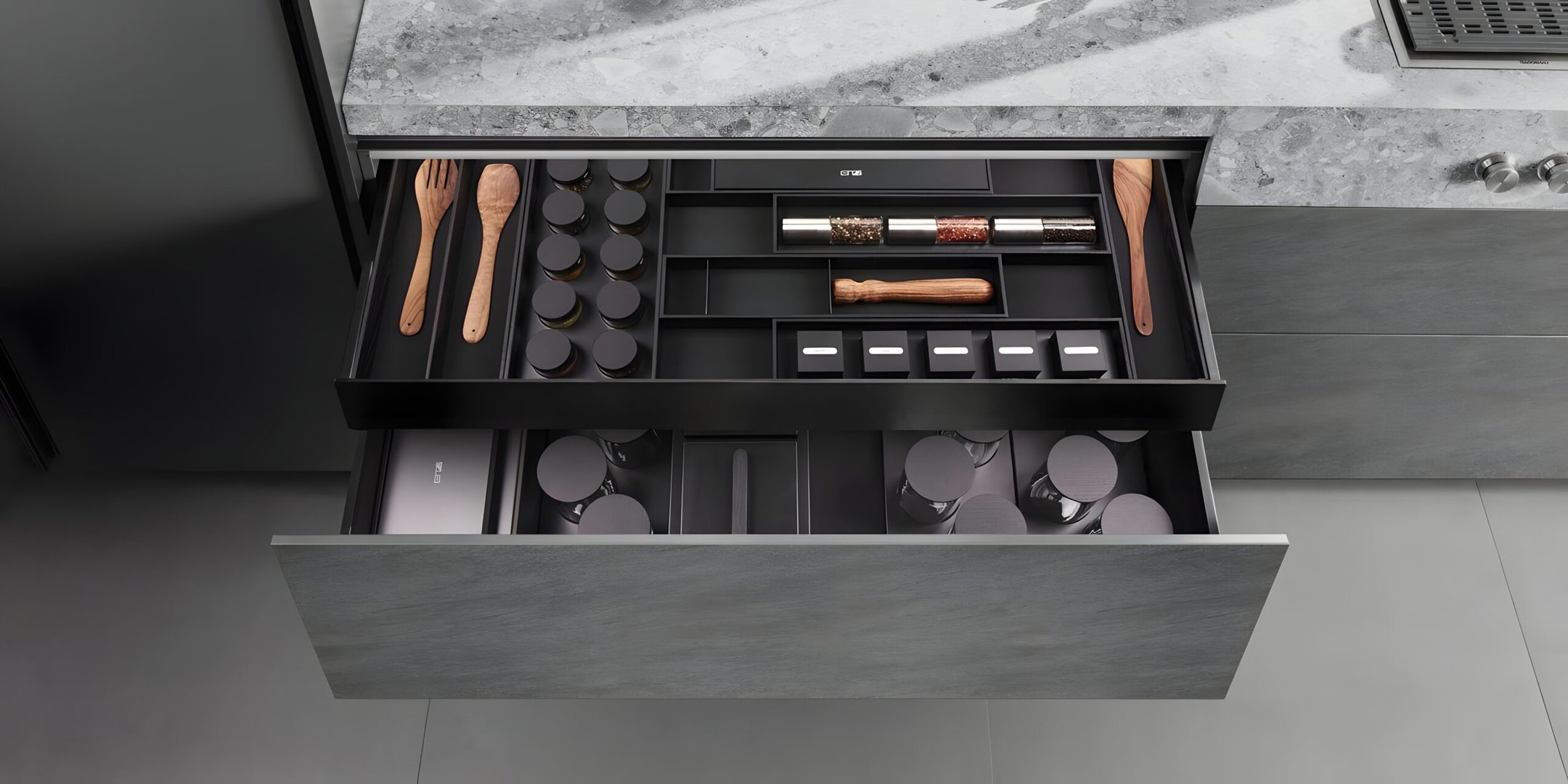
If the carcass is the skeleton, edge banding is the skin that protects it. Engineered boards are vulnerable along their cut edges, where the core is exposed. Edge banding seals those edges so moisture, steam and spills cannot soak in. It is a small strip of material, and it is one of the most reliable ways to judge a cabinet’s real quality.
Cheap edge banding is glued on with ordinary adhesive that, over years of humidity and dishwasher steam, lets go at the corners. Once an edge lifts, water wicks into the board and the swelling begins. Better cabinets use thicker, tightly bonded banding, often laser or hot-air applied, so the seam between band and surface is nearly invisible and far more durable.
How to test it in a showroom
- Run a fingernail along the top edge of a door and drawer. You should feel a smooth, continuous surface, not a ridge or a gap.
- Check the inside corners of cabinet boxes, especially near the sink base, the wettest spot in any kitchen.
- Ask what the banding is made of and how it is bonded. A confident answer is a good sign.
Door Fronts: Where Style Meets Longevity
Fronts are what you see, touch and clean every day, so they take the most visible abuse. Each material ages differently, and the right choice depends partly on how you cook and live.
Lacquer
Multi-coat lacquer, whether high-gloss or ultra-matte, gives a deep, even finish that resists moisture and cleans easily. Quality matters here: the number of coats and the curing process determine how well the surface resists scratching and yellowing. Ultra-matte lacquers, like those in the Baulux collection, also use anti-fingerprint technology so the surface does not show every touch in a busy family kitchen.
Ceramic and Glass
Ceramic and glass fronts are about as durable as kitchen surfaces get. They shrug off heat, moisture, UV fading and most scratches, and they wipe clean with a cloth. They carry a more premium feel and price, which is why they anchor the Baulux range. In a damp climate, their imperviousness to moisture is a genuine practical advantage, not just a design statement.
Real Wood
Solid wood and veneer fronts bring warmth and natural grain that engineered surfaces cannot fully imitate. They can last for decades and can often be refinished. They do ask for a little more care around moisture and direct sun, but a properly sealed wood front in a well-ventilated kitchen ages beautifully.
Across all of these, the lesson is the same: the surface you choose should match your life. Custom and premium fronts can stay functional for 30 years or more, while thinner laminate and foil fronts tend to show wear in the 10 to 20 year range (Coohom, 2025). The Bauformat collection offers the widest spread of fronts, and the Burger collection delivers durable construction at the best value, so longevity is available at more than one budget.
Hardware: the Parts You Touch Thousands of Times
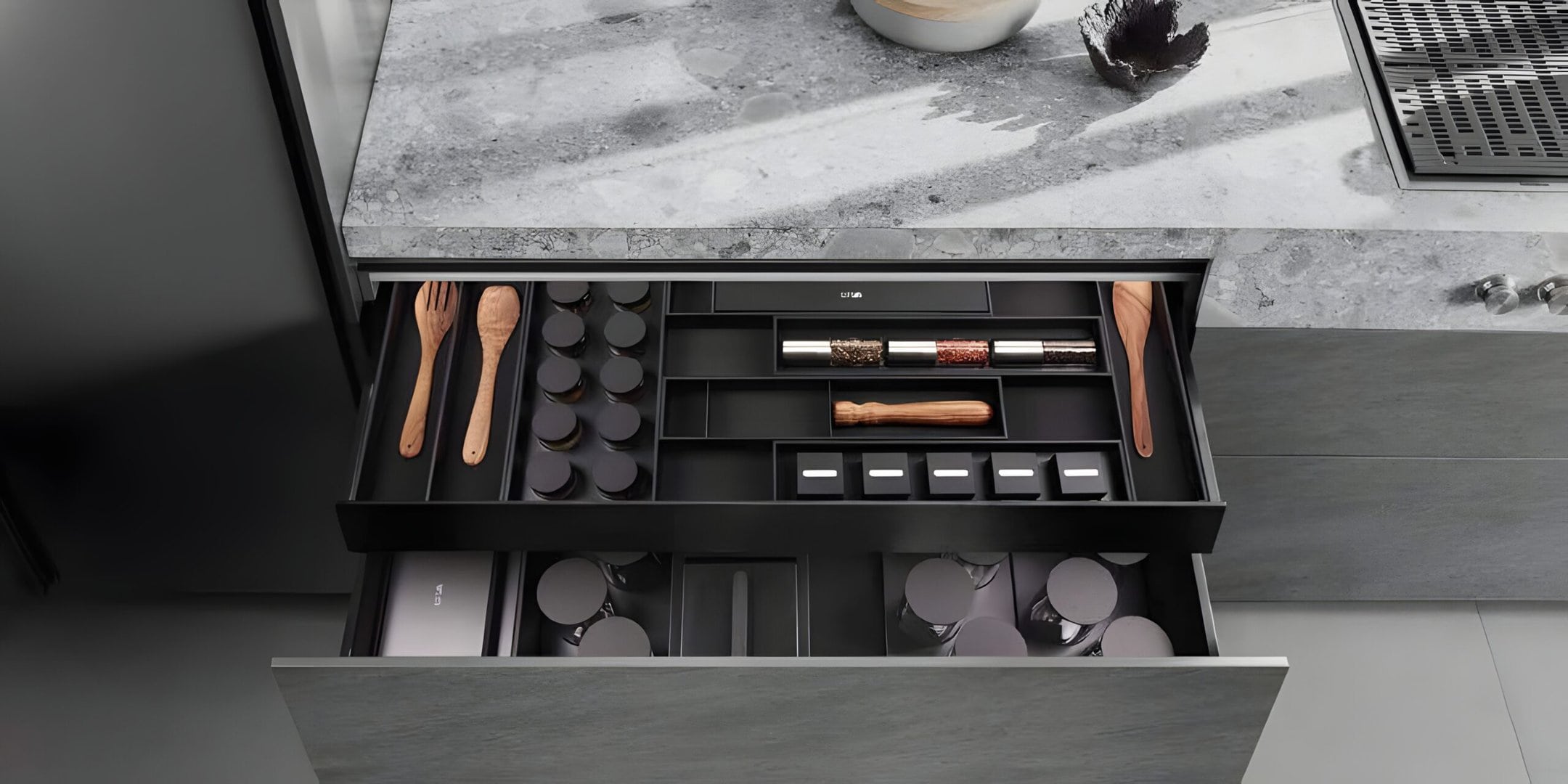
You open a kitchen drawer several times a day without thinking about it. Multiply that over years and the hardware quietly becomes the hardest-working component in the room. It is also the first thing to fail in a poorly built kitchen: drawers that scrape, doors that drop, runners that stick.
Good hardware is engineered to absorb that repetition. The features that matter most:
- Full-extension soft-close runners: Full extension means you can reach the very back of a deep drawer, so no storage is wasted. Soft-close means the drawer pulls itself shut gently instead of slamming, which protects both the contents and the cabinet over the long run. Bauformat fits these as standard.
- 3D-adjustable concealed hinges: Concealed hinges keep clean lines, but the real advantage is adjustability. A 3D-adjustable hinge lets your installer fine-tune each door in three directions, so the gaps stay even and the doors keep closing perfectly years after install, even as a house settles. In an older Vancouver home that shifts with the seasons, that adjustability is a quiet form of insurance.
Hardware quality is hard to fake and easy to test. Open and close. A well-made runner feels smooth and weighted. A cheap one tells you everything in the first inch of travel.
Durability and the Coastal Climate Factor
Everything above matters more here than it would in a dry interior climate. Metro Vancouver’s average relative humidity runs around 70 per cent and climbs past 80 per cent in the wettest winter months (Weather and Climate, 2025). That constant moisture in the air, combined with steam from cooking and dishwashing, is exactly what untreated boards and weak edges cannot handle.
In practice, the damp coast punishes shortcuts. A standard particleboard carcass with thin, lightly glued edge banding may look identical to a premium cabinet on day one. Two or three winters later, the difference is obvious: swollen edges near the sink, doors that no longer line up, a faint musty note under the counter. Moisture-resistant board, sealed edges and adjustable hardware are not upgrades in this region. They are what keeps a kitchen looking new through a decade of West Coast winters.
There is also a ventilation lesson worth noting. Even the best materials last longer with a good range hood and the occasional open window. Materials do the heavy lifting, but habits help them.
Durability as a Value and Sustainability Decision
It is tempting to treat durability as a quality preference, the sort of thing that is nice if you can afford it. The numbers tell a more practical story.
A full kitchen renovation in Vancouver commonly runs between 35,000 and 85,000 dollars, with high-end projects passing 100,000 dollars, and cabinets alone often account for 30 to 40 per cent of the total budget (Quay Construction, 2025; Magic Window, 2025). Spread that over the life of the cabinets and the math becomes clear. A cabinet that genuinely lasts 25 years costs far less per year than one that needs replacing at 12, even if the upfront price is higher. Durability is not the expensive choice, it is usually the economical one over time.
Then there is what gets thrown away. Canada’s construction, renovation and demolition sector generates roughly 4 million tonnes of waste a year, and a single kitchen remodel can produce 1 to 2 tonnes of material waste on its own (Miller Waste Systems, 2025). Replacing a kitchen twice instead of once doubles that footprint. The most sustainable kitchen is simply the one you do not have to tear out and rebuild.
This is where engineering and longevity meet. Bauformat has been built in Lohne, Germany since 1917, with construction standards aimed at decades of daily use, and in Metro Vancouver it is measured, planned and installed by a local team that understands how these materials behave in our climate. Buying once and buying well is the version of this decision that is easiest on both your budget and the landfill.
Frequently Asked Questions
How long should a quality kitchen last?
Well-built cabinets made from dense, moisture-resistant materials commonly last 20 to 30 years, and premium fronts and solid construction can stay functional for 30 years or more (Coohom, 2025). Many kitchens get replaced earlier for style reasons rather than failure, which is an argument for choosing timeless finishes alongside durable materials.
Are engineered boards worse than solid wood for cabinets?
No. For cabinet boxes, a quality moisture-resistant engineered board is often more stable than solid wood, because it does not expand and contract with humidity the way solid timber does. The grade of the board matters far more than the label. Look for moisture resistance to the EN 312 P3 standard or better (Pfleiderer, 2025).
Does Vancouver’s damp climate really affect cabinet life?
Yes. With average humidity around 70 per cent and winter levels above 80 per cent (Weather and Climate, 2025), moisture is a constant. Untreated boards and weakly bonded edges swell and fail faster here than in drier regions, which is why moisture-resistant construction and sealed edge banding are worth prioritizing on the coast.
What is the single best indicator of a durable cabinet?
If you can only check one thing, check the edges and the hardware together. Smooth, tightly bonded edge banding signals a sealed, moisture-protected box, and smooth, weighted soft-close runners signal engineering that will hold up. Both are easy to test by hand and hard to fake.
Choosing long-lasting kitchen cabinet materials is really a series of small, informed decisions: a denser board, a better-sealed edge, a front matched to how you cook, hardware built to be adjusted rather than replaced. Made individually, each feels minor. Added together, they are the difference between a kitchen that survives a decade of damp Vancouver winters and one that quietly looks great for a generation.
Explore more from Bauformat BC
- Kitchen Cabinet Hardware
- Why Opt for Economical Kitchen Cabinet Materials?
- Bauformat: Germany’s Elite Kitchen Cabinet Craftsmen
German cabinetry, planned and built for Metro Vancouver
The kitchen is one of the highest-return rooms in a home: the 2025 Cost vs. Value Report found a minor kitchen remodel recoups roughly 96% of its cost at resale. Choosing cabinetry that lasts is central to that return, which is where German engineering earns its place. Every Bauformat kitchen is manufactured in Germany, then measured, planned, and installed by our Vancouver team, built to fit your room to the millimetre.
See the Baulux, Bauformat, and Burger collections in person at our North Vancouver showroom at 1410 Marine Dr Unit 205, learn more about the manufacturer at bauformat.de, and meet our local team at The Bau Team.
Book a 30-minute consultation with our Metro Vancouver kitchen designers to plan a kitchen built to last.
Open a drawer. Close a cabinet door. You probably do this a few hundred times a day without thinking about it, which is exactly the point. The hardware inside a kitchen is the part you touch more than any other, and yet it is the part most people never see. A door that drifts shut without a slam, a heavy pan drawer that glides out to its full length and stops gently, a corner cabinet that actually gives up the pot hiding at the back. These small moments add up to whether a kitchen feels good to live in.
They also decide how long that kitchen lasts. Countertops and door fronts get the attention in a showroom, but it is the hinges and runners doing the quiet work for fifteen, twenty, thirty years. In a region like Metro Vancouver, where a renovation is a serious investment and homes are held for the long term, the hardware is where good engineering pays you back every single day. Here is what to look for, and why the difference is bigger than it first appears.
Key Takeaways
- Hardware is the part you use most. Hinges and runners get opened and closed hundreds of times daily, so their quality shapes daily life more than any finish.
- Soft-close is now a baseline expectation, not a luxury. The mechanism protects doors, drawers, and your patience for decades.
- 3D-adjustable hinges keep doors aligned over time, which matters in homes that settle and in our humid coastal climate.
- Full-extension runners earn their keep by giving you the whole drawer, including the back, with no reaching or guessing.
- Interior organization is where ergonomics lives: pan drawers, pull-outs, and corner solutions turn dead space into usable storage.
Why Hardware Quality Decides How Long a Kitchen Lasts
Cabinet performance is measurable, and the standards are stricter than most people realize. Under the ANSI/KCMA A161.1 certification, doors are swung open and closed through a full ninety degrees for 25,000 cycles, and drawers are loaded and operated 25,000 times, all without failure or loosening (KCMA, 2025). That is the floor, not the ceiling. Better hardware is engineered well beyond it, which is why a quality kitchen still feels tight and quiet long after a budget one has started to sag and rattle.
This matters financially too. A focused, well-built kitchen update returns roughly 96.1 percent of its cost at resale, the strongest payback of any common renovation according to the 2025 Cost vs. Value Report (Zonda Media, 2025). Hardware is a big part of why. Buyers and appraisers notice when drawers glide and doors sit perfectly square, even if they cannot name what they are reacting to. In Metro Vancouver, where a mid-range kitchen renovation commonly runs from 35,000 to 90,000 dollars (180 Kitchens, 2026), protecting that investment with hardware built to outlast the trends is simply sound math.
Bauformat has been made in Germany since 1917, and that long manufacturing history shows up most clearly in the parts you cannot see. The hinges, runners, and storage systems are specified to perform for the life of the kitchen, not just to pass inspection on installation day.

Concealed Soft-Close Hinges, and Why 3D Adjustment Matters
The hinge is the hardest-working joint in your kitchen. A good one disappears completely. Concealed hinges sit fully inside the cabinet when the door is closed, so you see a clean run of fronts with no metal interrupting the line. That clean look is the easy part. The engineering is what keeps it that way.
Soft-close, explained simply
A soft-close hinge has a small damper built in. As the door approaches the frame, the mechanism catches it and eases it shut over the last few centimetres. No bang, no bounce, no pinched fingers. Beyond the obvious comfort, this protects the door front and the cabinet box from thousands of small impacts over the years. A door that is slammed shut a dozen times a day ages quickly. A door that is guided shut does not.
What 3D adjustability buys you
Houses move. Wood expands and contracts, foundations settle, and Metro Vancouver’s damp coastal air adds its own seasonal swing. A 3D-adjustable hinge lets the installer fine-tune a door on three axes: side to side, up and down, and in and out. The practical result is that every door sits perfectly aligned, with consistent gaps, and stays that way. If a door drifts out of line a year or two down the road, it can be brought back true with a turn of a screwdriver rather than a service call and replacement parts. Bauformat’s 3D-adjustable concealed hinges are standard across the Baulux, Bauformat, and Burger collections for exactly this reason.
Full-Extension Soft-Close Drawer Runners
Here is a test worth doing in any showroom. Open a drawer all the way and look at how much of it you can actually reach. With a partial-extension runner, the back several inches stay hidden inside the cabinet, which is where forgotten lids and spare batteries go to disappear. A full-extension runner pulls the entire drawer clear of the cabinet, so the back of the drawer is as usable as the front.
Combine that with a soft-close damper and load it with a stack of plates, and the difference in daily life is hard to overstate. The drawer glides out smoothly under weight, then closes itself the last bit of the way without a slam, no matter how full it is or how distracted you are. The best runners are rated to carry serious loads, which is what makes deep pan drawers practical instead of a strain to open.
What good runners feel like
- Smooth under load. A heavy drawer should move with one finger, not a tug.
- Quiet. No metallic scraping, no rattle when you close the drawer next to it.
- Consistent. The soft-close should engage every time, whether the drawer is empty or packed.
- Stable when fully open. No tipping, no sag at the front, even at full extension.
Bauformat fits full-extension soft-close runners as standard, so the deep drawers that do the real storage work in a modern kitchen are genuinely pleasant to use.

Handles or Handleless: A Real Choice, Not Just a Look
How you open a cabinet is a design decision and an ergonomic one. Both approaches work beautifully when the hardware behind them is right.
Handles and knobs
A handle gives you something definite to grip, which many people prefer, especially on heavy drawers and for anyone who finds a flat front harder to manage. Handles are also a quick way to change a kitchen’s character. A slim bar reads modern, a rounded knob reads softer and more classic. Because they are easy to swap, handles let you refresh the look years later without touching the cabinets.
Handleless
Handleless designs remove the hardware from the equation entirely, leaving an uninterrupted run of fronts. There are two common ways to achieve it: a continuous recessed channel along the top edge of the drawer or door that your fingers tuck into, or a push-to-open mechanism that releases the door with a light press. The look is calm and architectural, and it suits the clean lines of a lot of Vancouver condos and contemporary homes. It also means no handles to catch a sleeve or a hip in a tight galley kitchen. Bauformat offers both handle and handleless options across its collections, so the choice can follow your space and how you cook rather than being dictated by the cabinets.
Interior Organization: Where Ergonomics Actually Live
A kitchen is only as good as how easily you can get to your things. This is the part of the hardware story that quietly transforms how a space works, and it is where thoughtful planning separates a kitchen that looks good from one that lives well.
Pan drawers
Deep drawers under the hob hold pots, pans, and lids far better than a low cabinet with a single shelf. You see everything from above, you lift nothing out of the way to reach the back, and full-extension runners mean the whole drawer comes to you. For most cooks this single change is the biggest day-to-day upgrade in a new kitchen.
Pull-outs
Tall, narrow pull-outs make use of slivers of space that would otherwise be wasted, and they bring the contents out to where you can see and reach them. They are ideal for oils and bottles beside the hob, or for a slim larder of dry goods. Under-sink pull-outs tame the most chaotic cabinet in any kitchen.
Corner solutions
The corner cabinet is the classic problem: a deep, awkward cavity where things vanish. Modern corner systems solve it with shelves that swing or pull fully out of the cabinet, bringing the back corner into the open. Instead of crawling halfway into a cupboard, you pull the contents toward you. In smaller Metro Vancouver kitchens, where every cubic inch counts, reclaiming the corner is often the difference between cramped and comfortable.
What to Look For When You Compare Hardware
Door fronts and finishes are easy to judge by eye. Hardware takes a little more attention, because the qualities that matter are about how it works over time. Use this as your checklist.
- Soft-close on everything. Doors and drawers should all close themselves gently. Test a few and listen.
- Full extension on drawers. Confirm you can reach the very back, then load one and feel how it moves.
- 3D-adjustable hinges. Ask whether doors can be realigned later. The answer tells you how the kitchen will age.
- Load ratings that match real life. Pan drawers carry weight. The runners need to be specified for it.
- Certified construction. Standards like ANSI/KCMA A161.1 confirm the cabinets and hardware have been cycle-tested, not just assembled to look right.
- Local measuring and installation. Even excellent hardware underperforms if it is fitted poorly. A kitchen measured, planned, and installed by a local team is set up correctly from the start.
This last point is easy to overlook. Bauformat kitchens in our region are measured, planned, and installed by the local Vancouver team, which means the 3D hinges are dialled in, the runners are level, and the soft-close behaves as engineered on day one. Hardware quality and installation quality are two halves of the same result.
Frequently Asked Questions
Is soft-close hardware worth the extra cost?
For most people, yes, and increasingly it is simply standard on quality cabinetry rather than an upgrade. Beyond the comfort of no slamming, the damper protects doors and drawer boxes from thousands of small impacts over the years, which extends the life of the kitchen. Given that a well-built kitchen update returns roughly 96.1 percent of its cost at resale (Zonda Media, 2025), the small premium for hardware that lasts is easy to justify.
How long should good cabinet hardware last?
Certified cabinet hardware is tested to survive at least 25,000 open-and-close cycles under load without failing (KCMA, 2025), and premium German hardware is engineered well beyond that threshold. In practice, quality hinges and runners are built to perform for the full life of the kitchen, often two to three decades, provided they are installed correctly.
Should I choose handles or go handleless?
Both work well. Choose handles if you like a definite grip, want easy changes to the look later, or have heavy drawers that benefit from a solid pull. Choose handleless for a clean, architectural front and for tight kitchens where protruding handles get in the way. It is genuinely a preference, so it helps to try both in person and see which suits how you cook.
Can cabinet doors be realigned if they drift over time?
With 3D-adjustable concealed hinges, yes, and easily. The door can be fine-tuned side to side, up and down, and in and out with a screwdriver. This matters in Metro Vancouver, where seasonal humidity and normal house movement can shift things slightly. Adjustable hinges mean a small tweak rather than a replacement.
The hardware is the part of a kitchen you never compliment out loud and never stop relying on. Get it right and you stop noticing it entirely, which is the highest praise a hinge can earn. Choose soft-close throughout, full-extension runners on the drawers that carry weight, adjustable hinges that keep everything square, and interior storage planned around the way you actually cook. Done well, and fitted carefully by a team who knows the homes here, it is the difference between a kitchen that looks new and one that keeps feeling new for decades.
Explore more from Bauformat BC
- Why Choose Long-Lasting Materials for Your Kitchen Cabinets
- Why Opt for Economical Kitchen Cabinet Materials?
- Bauformat: Germany’s Elite Kitchen Cabinet Craftsmen
German cabinetry, planned and built for Metro Vancouver
The kitchen is one of the highest-return rooms in a home: the 2025 Cost vs. Value Report found a minor kitchen remodel recoups roughly 96% of its cost at resale. Choosing cabinetry that lasts is central to that return, which is where German engineering earns its place. Every Bauformat kitchen is manufactured in Germany, then measured, planned, and installed by our Vancouver team, built to fit your room to the millimetre.
See the Baulux, Bauformat, and Burger collections in person at our North Vancouver showroom at 1410 Marine Dr Unit 205, learn more about the manufacturer at bauformat.de, and meet our local team at The Bau Team.
Book a 30-minute consultation with our Metro Vancouver kitchen designers to plan a kitchen built to last.
Modern does not mean cold. The kitchens that stop people in their tracks right now are the ones that look effortless, where the eye runs along an unbroken row of fronts without snagging on a single handle, and where the toaster, the recycling, and the spice jars have all quietly disappeared into the cabinetry. That calm is the whole point. A modern kitchen is less about chrome and gloss for its own sake and more about removing visual noise so the room can breathe.
In Metro Vancouver, that idea has to survive real life. A downtown condo measures every centimetre. A North Shore house wants its kitchen to flow into the living room and out toward the trees. An open-concept main floor in Burnaby or Richmond needs a kitchen that looks finished from the sofa, not just from the cook’s side of the island. The good news is that the modern look and genuine, everyday function are not in tension. Done with the right engineering, they are the same thing.
Key Takeaways
- Modern kitchen design is built on clean lines, handleless or low-profile fronts, integrated appliances, and storage that hides clutter rather than displaying it.
- A focused, mid-range kitchen update returns its cost better than a full gut renovation. Zonda’s 2025 Cost vs. Value Report put a minor kitchen remodel at roughly 113% recouped nationally, up from 96.1% the year before.
- Handleless fronts are now treated as a design standard in contemporary kitchens, not a passing trend, with consistency (one handle strategy throughout) being the key rule.
- Metro Vancouver renovations run roughly 20 to 30% above the national Canadian average, so material durability and a layout that lasts matter more here than almost anywhere in the country.
- The modern look only ages well when the hardware underneath, runners, hinges, and adjustment, holds its alignment over years of daily use.
Start With the Layout, Not the Finishes
Every modern kitchen worth living in starts as a circulation problem before it becomes a beauty problem. The classic work triangle, sink to cooktop to fridge, still holds, but in open-concept Metro Vancouver homes the island has become a fourth point that does most of the heavy lifting: prep, casual seating, and a buffer between cooking mess and the people you are cooking for.
A few principles keep a modern layout from feeling like a showroom that nobody can use:
- Keep runs long and unbroken. A continuous bank of base cabinets reads as calm. Break it only where function demands it.
- Push tall storage to one wall. Floor-to-ceiling pantry and appliance towers grouped together free the rest of the room for clean horizontal lines.
- Let the island do the work. In a condo, a slim island or a peninsula can hold the sink or cooktop and reclaim a whole wall for storage.
- Plan the sightline from the living room. In an open plan, the back of the island and the tall wall are what guests actually see, so they deserve the most considered finishes.
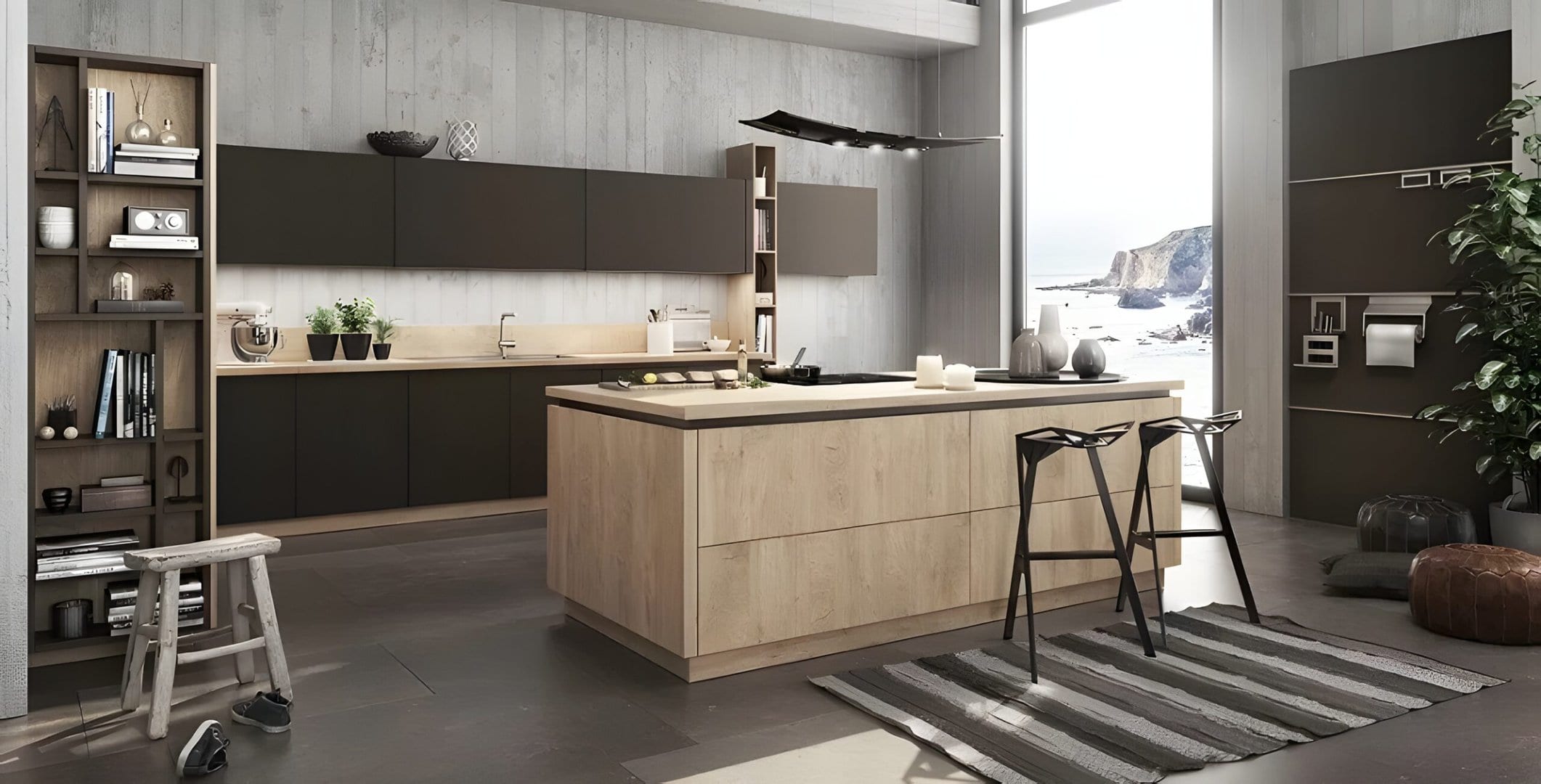
Handleless and Minimalist Fronts
If one detail defines the modern kitchen, it is the absence of the handle. Designers now describe handleless cabinetry as a standard for contemporary kitchens rather than a trend, achieved through integrated grip channels, push-to-open mechanisms, or slim recessed pulls. The practical bonus is real: nothing to catch a hip or a tea towel as you move through a busy room.
The single most important rule is consistency. Pick one handle strategy and carry it across the entire kitchen rather than mixing several. That discipline is what separates a coherent modern look from a busy one.
Ways to go handleless or low-profile
- Continuous grip rail. A recessed channel runs along the top edge of base cabinets, giving a finger pull without any visible hardware.
- Push-to-open. A light press releases the door or drawer, ideal for tall units and uppers where a grip rail would interrupt the line.
- Slim profile pulls. For homeowners who want a tactile handle, a fine edge pull in a matte finish keeps things quiet.
Our Bauformat collection carries the widest range here, including handleless fronts in both high-gloss and matte. For the most pared-back look, the Baulux line leans into ceramic, glass, and ultra-matte surfaces that suit a minimalist front beautifully, since the material itself becomes the detail.
Fronts, Materials, and Finishes
Finish is where a modern kitchen declares its personality. The current direction is warm minimalism: clean forms softened by natural-feeling materials, rather than the stark white-on-white of a decade ago. The choice usually comes down to how much light and reflection you want in the room.
Matte versus gloss
- Ultra-matte and ceramic fronts absorb light, hide fingerprints well, and give a soft, architectural feel. They suit North Shore houses where the cabinetry should recede and let the view lead.
- High-gloss fronts bounce light around and make compact spaces feel larger, which is why they remain popular in downtown condos with limited natural light.
For surfaces, premium countertop materials such as quartz and engineered stone continue to earn their keep, delivering strong per-dollar returns within a renovation while standing up to daily wear. In a coastal climate, durability is not a luxury. Cabinet fronts and surfaces in a Vancouver kitchen contend with humidity, so the stability of the material and the quality of the edge banding matter as much as the colour.
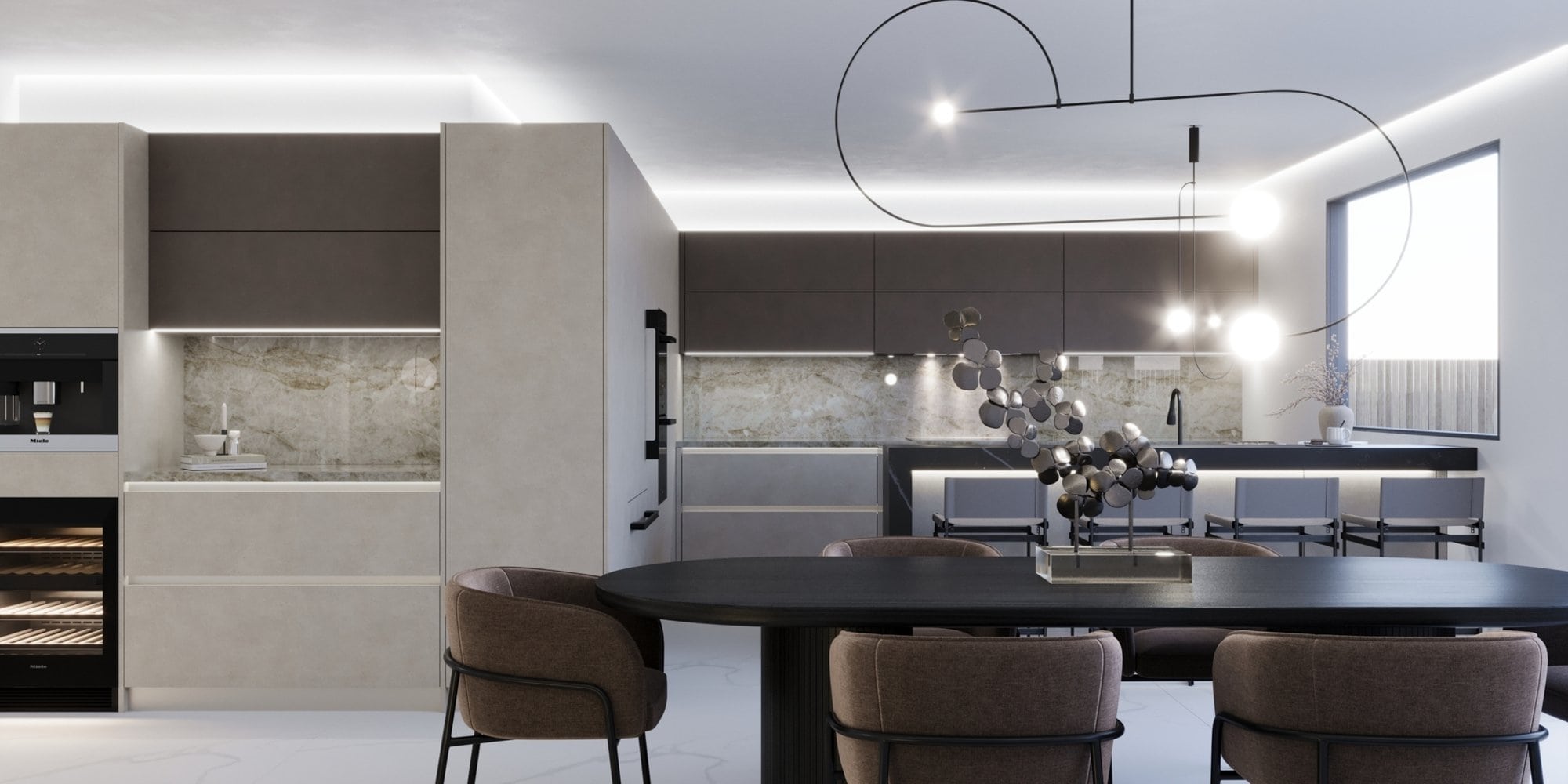
Smart Storage That Stays Hidden
Minimalism on the outside only works if the inside is ruthlessly organized. The modern trend toward hidden function means the clutter goes somewhere, and that somewhere is engineered drawer and pantry systems that use every cubic centimetre.
- Deep pot drawers on full-extension runners replace the old reach-in base cupboard, so nothing gets lost at the back.
- Tall pull-out pantries bring the whole shelf to you, a serious advantage in a narrow condo galley.
- Corner solutions turn the dead corner into usable, swing-out storage.
- Appliance garages and integrated bins keep the kettle, the small appliances, and the recycling off the counter and out of sight.
This is where engineering quietly decides whether a kitchen feels modern in year one and year ten. Full-extension, soft-close runners let a heavy drawer glide all the way out and close without a slam. The 3D-adjustable concealed hinge is the unsung hero of the handleless look, because perfectly even gaps between doors are what make a long run of fronts read as one clean plane. When a door drifts out of line over time, that adjustability lets the local team bring it back true.
Lighting the Modern Kitchen
Lighting is what makes clean lines look intentional rather than flat. A modern scheme works in layers, and skipping any one of them tends to be what makes a beautiful kitchen feel a little lifeless after dark.
- Task lighting under the upper cabinets puts light directly on the counter where you prep, with no shadow from your own hands.
- Ambient lighting from recessed ceiling fixtures fills the room evenly.
- Accent lighting inside glass cabinets or along a grip channel adds depth and shows off the materials.
- Feature lighting, usually pendants over the island, anchors the room and marks the social centre.
Vancouver’s grey winters make this layered approach more than decorative. With short days from November through February, a kitchen that relies on a single overhead fixture feels gloomy for half the year. Warm, dimmable layers let the same room shift from a bright morning workspace to a softer evening gathering place.
Making Modern Work in Small and Open Spaces
The two most common Metro Vancouver scenarios pull modern design in opposite directions, and each has its own playbook.
The downtown condo
In a compact condo, modern design is mostly about visual tricks that buy back space. Handleless fronts keep walls flat and uninterrupted. A consistent, light or reflective finish makes the room feel larger. Integrated appliances, the dishwasher and fridge hidden behind matching fronts, stop the eye from counting separate objects and reading the kitchen as cramped. Tall storage on one wall does the heavy lifting so the rest can stay open.
The open-concept main floor
In a North Shore house or a Surrey new build with an open main floor, the kitchen is furniture as much as it is a workspace. Here the island becomes a design statement, often in a contrasting finish, and the goal is for the kitchen to look as composed from the dining table as it does from the sink. Integrated appliances and hidden storage matter for the same reason: from across an open room, every visible handle and exposed appliance adds clutter to the scene.
Because Metro Vancouver renovation costs track meaningfully above the national average, getting the layout and the durable elements right the first time is where the budget is best spent. A focused, well-planned update consistently returns more of its cost than a sprawling gut job, which is an argument for spending on the cabinetry and engineering that last rather than on moving walls and plumbing you will rarely recover.
Why German Engineering Holds the Look
A modern kitchen lives or dies on its lines. Even gaps, doors that hang true, drawers that close softly and squarely, this is what reads as quality, and it is entirely a function of the hardware behind the fronts. Bauformat has built cabinets in Germany since 1917, and that long manufacturing discipline is what keeps a handleless run looking precise after years of daily use.
The three collections give Metro Vancouver homeowners a clear path. Baulux is the most overtly modern, with ceramic, glass, and ultra-matte fronts for a minimalist statement. The Bauformat collection offers the widest choice, including handleless high-gloss and matte. Burger delivers the best value without giving up the soft-close runners and adjustable hinges that make the difference. Whichever line fits, the local Vancouver team measures, plans, and installs, so the engineering that looks effortless in a brochure actually lands square in your room.
Frequently Asked Questions
Are handleless kitchens practical for everyday use?
Yes. With nothing protruding from the fronts, there is nothing to catch on as you move around a busy kitchen, which is one reason designers now treat handleless cabinetry as a standard rather than a novelty. The grip channel or push-to-open mechanism does the work of a handle without interrupting the clean line. The main thing is to choose one approach and use it consistently throughout the kitchen.
Does a modern kitchen renovation add resale value in Metro Vancouver?
A focused, mid-range kitchen update tends to recoup its cost well. Zonda’s 2025 Cost vs. Value Report placed a minor kitchen remodel at roughly 113% recouped nationally, the strongest of any interior project, up from 96.1% the previous year. Larger gut renovations return a much smaller share, so the value is in a smart, contained update rather than tearing everything out.
Is high-gloss or matte better for a condo kitchen?
Both work, and the choice depends on light. High-gloss fronts reflect light and can make a compact, dim downtown condo feel larger and brighter. Ultra-matte and ceramic fronts hide fingerprints and give a softer, more architectural look. In a small space with limited natural light, many people lean toward the reflective option.
How do I keep a modern look from feeling cold?
Warm minimalism is the current answer. Pair clean, handleless cabinetry with natural-feeling materials, a warmer finish on the island, layered and dimmable lighting, and a few open or glass-fronted sections to break up the flat planes. The structure stays modern while the materials and light bring warmth.
Modern kitchen design, at its best, is quiet confidence. It is the run of fronts with no handle to interrupt them, the drawer that glides shut without a sound, the appliances you forget are there until you need them, and the light that makes all of it look considered on a dark Vancouver evening. Get the layout and the engineering right, choose finishes that suit your space and your light, and a modern kitchen stops looking like a trend and starts looking like the way your home was always meant to work.
Explore more from Bauformat BC
- How would Bauformat Matte Black Cabinets Change the Mood of a Kitchen?
- German Kitchen Design Inspiration for 2026
- Mastering the Art of Kitchen Space Optimization
German cabinetry, planned and built for Metro Vancouver
The kitchen is one of the highest-return rooms in a home: the 2025 Cost vs. Value Report found a minor kitchen remodel recoups roughly 96% of its cost at resale. Choosing cabinetry that lasts is central to that return, which is where German engineering earns its place. Every Bauformat kitchen is manufactured in Germany, then measured, planned, and installed by our Vancouver team, built to fit your room to the millimetre.
See the Baulux, Bauformat, and Burger collections in person at our North Vancouver showroom at 1410 Marine Dr Unit 205, learn more about the manufacturer at bauformat.de, and meet our local team at The Bau Team.
Book a 30-minute consultation with our Metro Vancouver kitchen designers to plan a kitchen built to last.
Stand in two different kitchen showrooms on the same afternoon and you can feel the difference before anyone says a word. One room is quiet and exact, with drawers that close like they were measured to the millimetre. The other is warm and theatrical, full of bold colour, sculptural shapes, and finishes that look like they belong in a fashion magazine. Both are beautiful. They are just chasing different things.
That contrast is the heart of the German versus Italian kitchen cabinet question. It is less a fight over quality and more a difference in temperament. German cabinetry leans on precision engineering, function, and durability built to last decades. Italian cabinetry leans on expressive style and finishes that move with fashion. If you are renovating a home anywhere across Metro Vancouver, understanding that split helps you choose with confidence instead of guessing. Here is a fair, useful look at both, and an honest note on why German engineering tends to fit our coast.
Key Takeaways
- Two philosophies, not two quality tiers. German cabinetry prioritizes engineering, modular systems, and longevity. Italian cabinetry prioritizes expressive, fashion-led design.
- Germany leads the world in kitchen furniture exports, a reputation built on standardized precision and durability rather than seasonal trend.
- Italy leads Europe in overall furniture and design revenue, with real strength in the high-end, style-driven kitchen segment.
- Climate matters here. Metro Vancouver’s damp, humid winters reward moisture-resistant construction and hardware that stays aligned for years.
- Bauformat is made in Germany and fitted locally, so you get German engineering measured, planned, and installed by a Vancouver team that knows our homes.
Two Design Philosophies, Side by Side
The simplest way to understand the difference is to think about what each tradition treats as the starting point. German design starts with the system. Everything is built on standardized dimensions, repeatable construction, and components that fit together with very little tolerance for error. The look follows the function. Clean lines, handleless fronts, and restrained colour palettes are not just a style choice, they are what happens when engineering leads.
Italian design starts with the statement. The question is how the kitchen will make you feel and how it will read as a piece of design in the room. Finish, texture, and proportion carry the project. Italian makers are famous for finishes that feel current and daring, the kind of surfaces and colours that show up in interiors coverage first and in mainstream kitchens a few years later.
Where German cabinetry shines
- Engineering and tolerances. Tight, consistent build quality across every unit, so the whole run looks even and aligned.
- Durability. Construction and hardware designed to survive decades of daily use.
- Modular flexibility. Standardized systems make planning, expanding, and replacing parts straightforward.
- Hardware quietly doing its job. Soft-close runners and adjustable hinges that keep working long after install day.
Where Italian cabinetry shines
- Expressive finishes. Adventurous colours, lacquers, and textures that feel like fashion.
- Sculptural design. Strong shapes and statement pieces that anchor a room.
- Trend leadership. Often first to a new look, which appeals if you want something striking right now.
- Material drama. Bold pairings of stone, metal, and wood used as visual centrepieces.
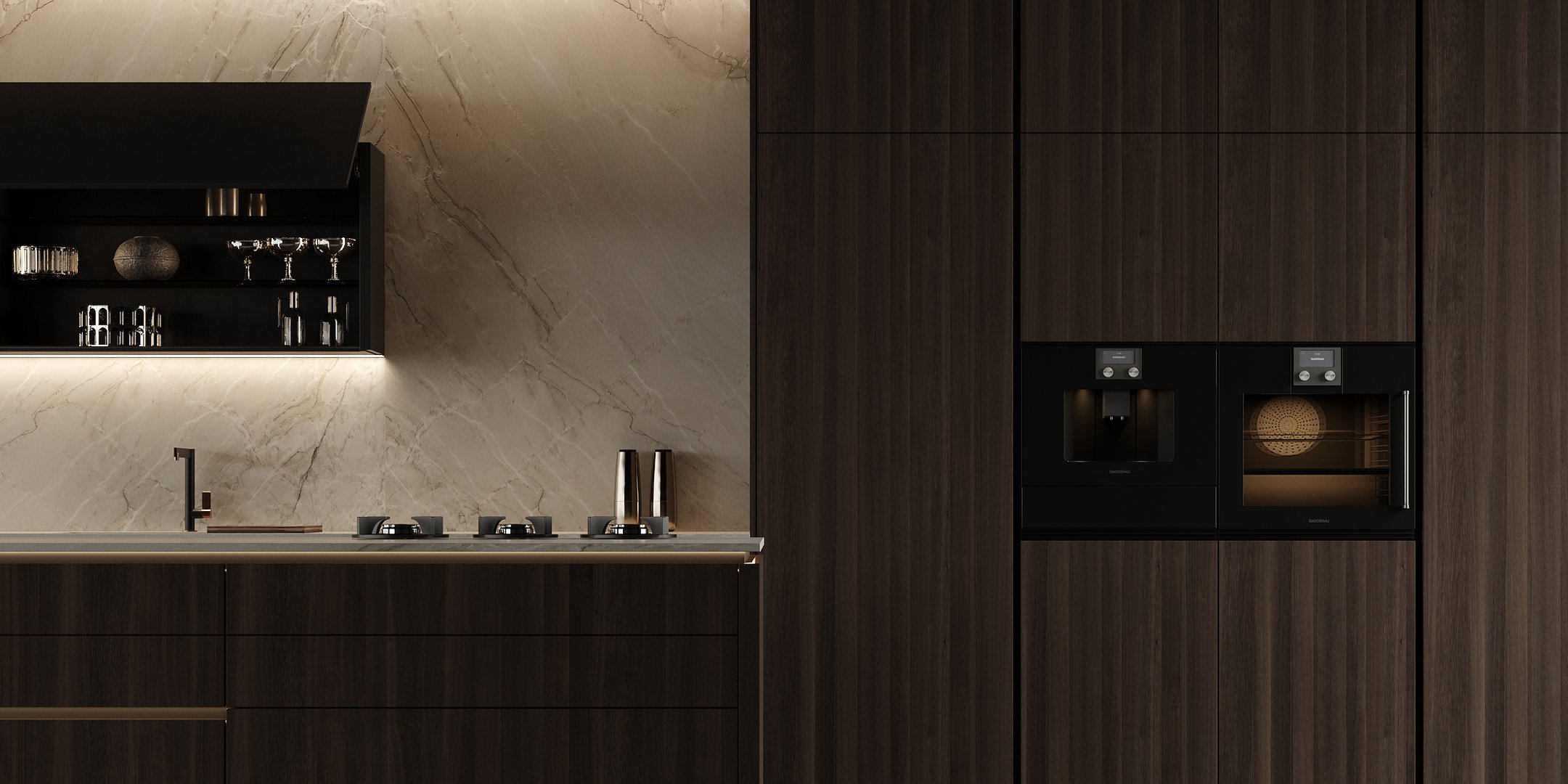
What the Numbers Say About Each Tradition
The reputations are not just marketing. They show up in trade data. Germany remains the undisputed leading exporter of kitchen furniture worldwide, according to a 2024 ResearchAndMarkets world market outlook, a position it has held consistently within a global kitchen furniture sector worth roughly USD 59 billion. That export dominance is the practical result of an industry organized around precision and repeatable quality, the qualities that travel well across borders and survive long after a trend fades.
Italy, meanwhile, leads Europe in furniture and design overall. The Italian furniture and design sector reached 26.7 billion euros in revenue in 2025, consolidating its leadership ahead of Germany, per FIRSTonline reporting on 2025 figures. Italy’s strength is concentrated at the top of the market. Its high-end positioning peaks near a 25 percent share in the kitchen segment, one of the most strategic globally. In plain terms, when people pay a premium for kitchen as fashion, Italy captures a large slice of that spending. Both countries are leaders. They simply lead in different lanes, Germany in engineering and export reliability, Italy in design prestige.
Durability and Daily Life
A kitchen is the hardest-working room in any home. Doors open and shut thousands of times a year, drawers carry real weight, and hinges take constant small stresses. This is where the German emphasis on engineering earns its keep. The value of tight tolerances is not visible on day one when both kitchens look flawless. It shows up in year eight, when one set of doors still sits perfectly flush and the other has started to drift.
Good hardware is the quiet hero here. Full-extension soft-close runners let a drawer pull all the way out so nothing gets lost at the back, then glide shut without a slam. Concealed hinges with 3D adjustment can be nudged in three directions, which means a door that shifts slightly over time can be brought back into perfect alignment in minutes rather than replaced. These are the details that separate a kitchen that ages gracefully from one that starts to feel tired. Italian cabinetry can absolutely be built to last, and plenty of it is, but durability is the headline of the German philosophy rather than a supporting act.
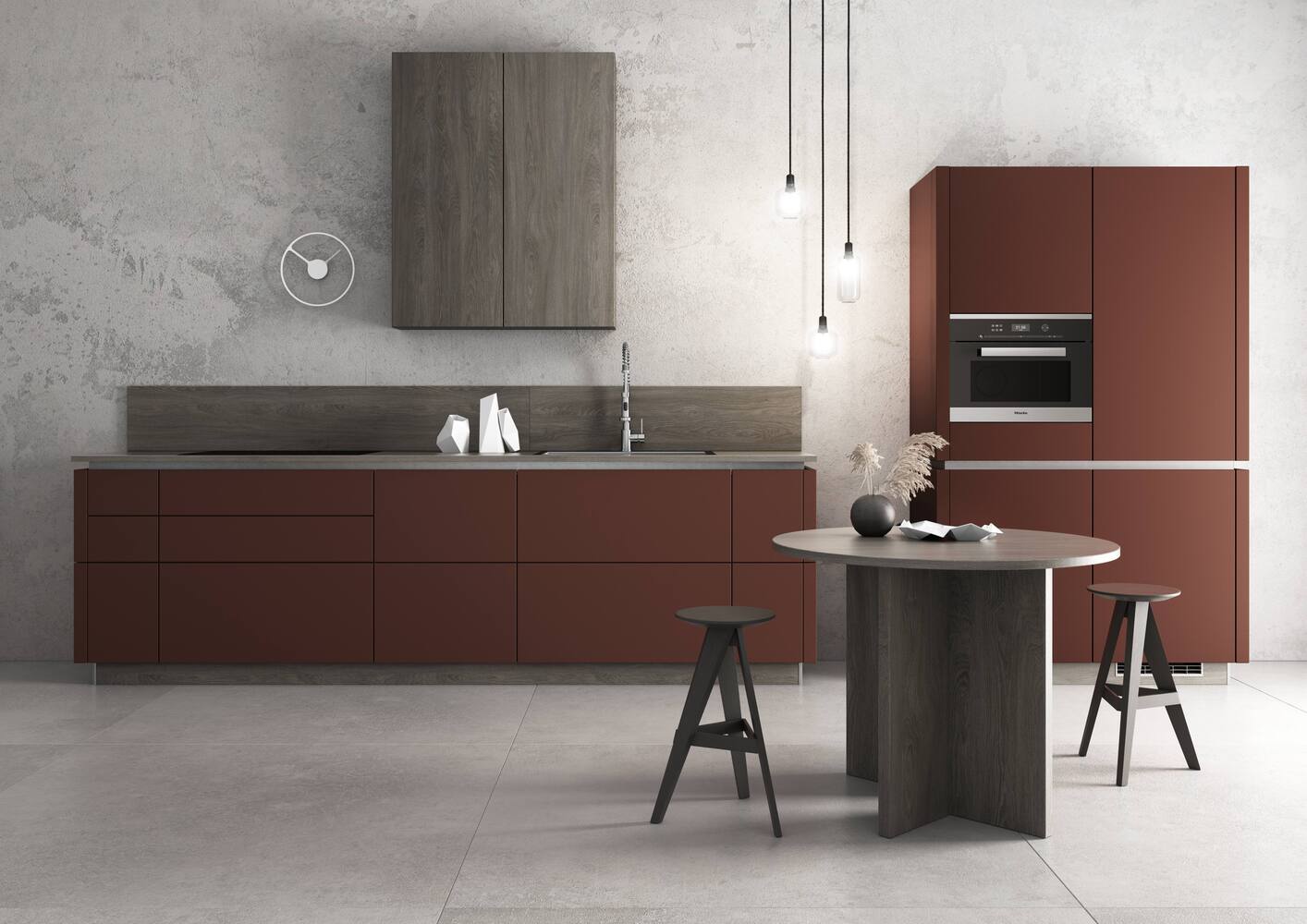
Why German Engineering Suits Metro Vancouver
Style preferences are personal, but our climate is not. Metro Vancouver gives cabinetry a specific challenge. Long, wet winters and high humidity put stress on materials, joints, and finishes, especially in kitchens where steam and temperature swings are constant. Moisture is the enemy of cabinetry that was not built to handle it. Edges can swell, finishes can lift, and doors can shift as materials react to damp air.
This is where engineering-first construction quietly pays off. Cabinetry built to tight, consistent standards, with hardware designed to stay aligned, copes better with the daily expansion and contraction that our climate brings. A handleless German kitchen in a Yaletown condo is not just a clean look. It is also fewer crevices for moisture and grease to collect, and a build designed to keep performing through years of coastal winters. When you are investing in a room you will use every single day, construction that respects the local environment is worth as much as the finish on the doors.
The Investment Picture for Vancouver Homes
Kitchens are expensive here, so it is worth knowing where the money goes and what it returns. A kitchen renovation in Metro Vancouver typically runs between 45,000 and 75,000 dollars for a detached home or townhouse, with condo kitchens often landing between 28,000 and 55,000 dollars, according to 2025 to 2026 figures from Delana Interiors. High-end projects can climb well past 100,000 dollars depending on finishes and layout.
The good news is that kitchens reward the investment. A kitchen renovation has the potential to increase a home’s value by up to 20 percent, according to a Royal LePage survey of Canadian agents cited by Morningstar Canada in 2025. The smart move is to spend where the return lives. Cabinetry you will open every day for the next twenty years is exactly the kind of long-life component worth doing once and doing well, rather than refinishing in a decade when a trend-led finish has dated. That logic favours the German approach, durable construction that holds its look and function long after the renovation is done.
How Bauformat fits into this
Bauformat has been made in Germany since 1917, in the town of Lohne, which gives it more than a century of refinement in exactly the engineering tradition described above. The range is built to suit different goals and budgets without leaving the German philosophy behind:
- Baulux for ceramic, glass, and ultra-matte luxury finishes when you want a statement surface.
- Bauformat for the widest choice across styles, colours, and configurations.
- Burger for the best value when budget is the priority and you still want German build quality.
Across all three, the hardware is consistent, full-extension soft-close runners and 3D-adjustable concealed hinges. And because the kitchens are measured, planned, and installed by the local Vancouver team, the German engineering is matched to the realities of your actual space, whether that is a heritage home on the east side or a high-rise condo near the water.
So Which Philosophy Is Right for You?
There is no wrong answer, only the right fit for how you live. If you want your kitchen to be a bold, of-the-moment design statement and you love the idea of leading the trend, the Italian philosophy speaks that language fluently. If you want a kitchen that looks clean and current, works flawlessly for decades, and quietly handles the demands of coastal living, the German philosophy is built for exactly that.
For most Metro Vancouver homeowners weighing a major investment in a room they use constantly, the case for German engineering is strong. You are buying durability, precision, and a finish that ages well, in a climate that punishes anything less. The expressive beauty is still there. It just sits on top of construction designed to outlast the trends.
Frequently Asked Questions
Are German kitchen cabinets better than Italian ones?
Neither is simply better. They are built around different goals. German cabinetry prioritizes engineering, durability, and modular precision, while Italian cabinetry prioritizes expressive, fashion-led style. Germany leads the world in kitchen furniture exports, and Italy leads Europe in design revenue, so both traditions are genuinely world class. The right choice depends on whether you value long-term function and longevity or a bold, trend-leading look.
Do German cabinets handle Vancouver’s damp climate better?
Construction quality matters more than nationality, but the engineering-first approach common in German cabinetry tends to handle humidity and temperature swings well. Tight tolerances, durable materials, and hardware that stays aligned all help cabinetry cope with the moisture stresses of long coastal winters. That is a meaningful advantage in Metro Vancouver, where kitchens deal with steam and damp air for much of the year.
Is German cabinetry more expensive than Italian?
Price overlaps heavily, and both traditions span value to luxury tiers. Italy is especially dominant in the very high end of the kitchen market, where price reflects design prestige. German ranges often span a wide spread, from best-value lines to luxury collections, so you can find German engineering at several price points rather than only at the top.
What hardware should I look for in a quality kitchen?
Two details tell you a lot. Full-extension soft-close runners let drawers open completely and close gently, which protects both the contents and the cabinet over years of use. Concealed hinges with 3D adjustment let you realign doors in three directions, so a kitchen can be fine-tuned over time instead of replaced. These are standard in well-engineered German cabinetry and a reliable sign of a build meant to last.
Choosing between German and Italian cabinetry is really about choosing what you want your kitchen to be, a piece of expressive design or a precisely engineered tool that stays beautiful for the long haul. Both traditions are worthy. For a home that has to stand up to Metro Vancouver winters and decades of daily use, German engineering makes a quietly compelling case, and that is the thinking behind every Bauformat kitchen fitted by our Yaletown team.
Explore more from Bauformat BC
- Bauformat: Germany’s Elite Kitchen Cabinet Craftsmen
- Why Choose Long-Lasting Materials for Your Kitchen Cabinets
- Kitchen Cabinet Hardware
German cabinetry, planned and built for Metro Vancouver
The kitchen is one of the highest-return rooms in a home: the 2025 Cost vs. Value Report found a minor kitchen remodel recoups roughly 96% of its cost at resale. Choosing cabinetry that lasts is central to that return, which is where German engineering earns its place. Every Bauformat kitchen is manufactured in Germany, then measured, planned, and installed by our Vancouver team, built to fit your room to the millimetre.
See the Baulux, Bauformat, and Burger collections in person at our North Vancouver showroom at 1410 Marine Dr Unit 205, learn more about the manufacturer at bauformat.de, and meet our local team at The Bau Team.
Book a 30-minute consultation with our Metro Vancouver kitchen designers to plan a kitchen built to last.
Walk into a German-built kitchen and you notice it before you can name it. A tall pantry door swings shut and stops with a quiet cushion instead of a clack. A 90-centimetre drawer rolls all the way out, loaded with cast iron, and never sags or sticks. The gaps between fronts are even down to the millimetre, top to bottom, like the cabinets were cut from a single piece. That precision is not decoration. It is the result of more than a century of doing one thing carefully.
Bauformat has been making kitchens in Lohne, Germany since 1917. Every cabinet that ends up in a Yaletown condo or a West Vancouver family home is still built there, then measured, planned, and installed by the local Vancouver team. For a Metro Vancouver homeowner weighing a renovation, the question is simple: what does German craftsmanship actually buy you, and why does it hold up here? This article answers that honestly.
Key Takeaways
- Bauformat has built kitchens in Lohne, Germany since 1917, and every cabinet is still made in Germany before the local Vancouver team measures, plans, and installs it.
- German craftsmanship shows up in three places you can verify yourself: the board and edge materials, the build tolerances, and the hardware.
- Three collections cover the full range. Baulux for ceramic, glass, and ultra-matte fronts, Bauformat for the widest choice of colours and finishes, and Burger for the best value with a full German build.
- Full-extension soft-close runners and 3D-adjustable concealed hinges are standard, not upgrades, which matters in humid coastal homes that move with the seasons.
- A focused kitchen renovation remains one of the strongest returns in home improvement, and build quality is what protects that value over fifteen and twenty years.
Made in Lohne since 1917, fitted in Vancouver
Lohne sits in Lower Saxony, in a region of northern Germany that has produced furniture for generations. Bauformat started there in 1917 and never left. That continuity matters more than a marketing line suggests. A factory that has refined the same craft across more than a hundred years has had time to standardise the things that go wrong in cheaper kitchens: edges that peel, hinges that drift, fronts that no longer line up after a few winters.
The German furniture industry as a whole turned over roughly 15.8 billion euros in 2025 (VDM, 2025), and the kitchen-furniture segment alone accounted for just under 5.6 billion euros (VDM, 2025), with close to 46 percent of that sold for export. Those numbers tell you something useful. Germany did not become the reference point for kitchen manufacturing by accident. It built an industry on engineering discipline, and the homes that import those kitchens, including here in Metro Vancouver, are buying into that discipline.
What does not get shipped from Germany is the fit. A cabinet built to a tenth of a millimetre still has to land in a real room with walls that lean, floors that slope, and a heritage ceiling that drops two centimetres over three metres. That is where the local Vancouver team comes in. They measure the actual space, plan the layout around your plumbing and your sightlines, and install with the German hardware doing exactly what it was designed to do. Factory precision and local fit are two different skills, and you need both.
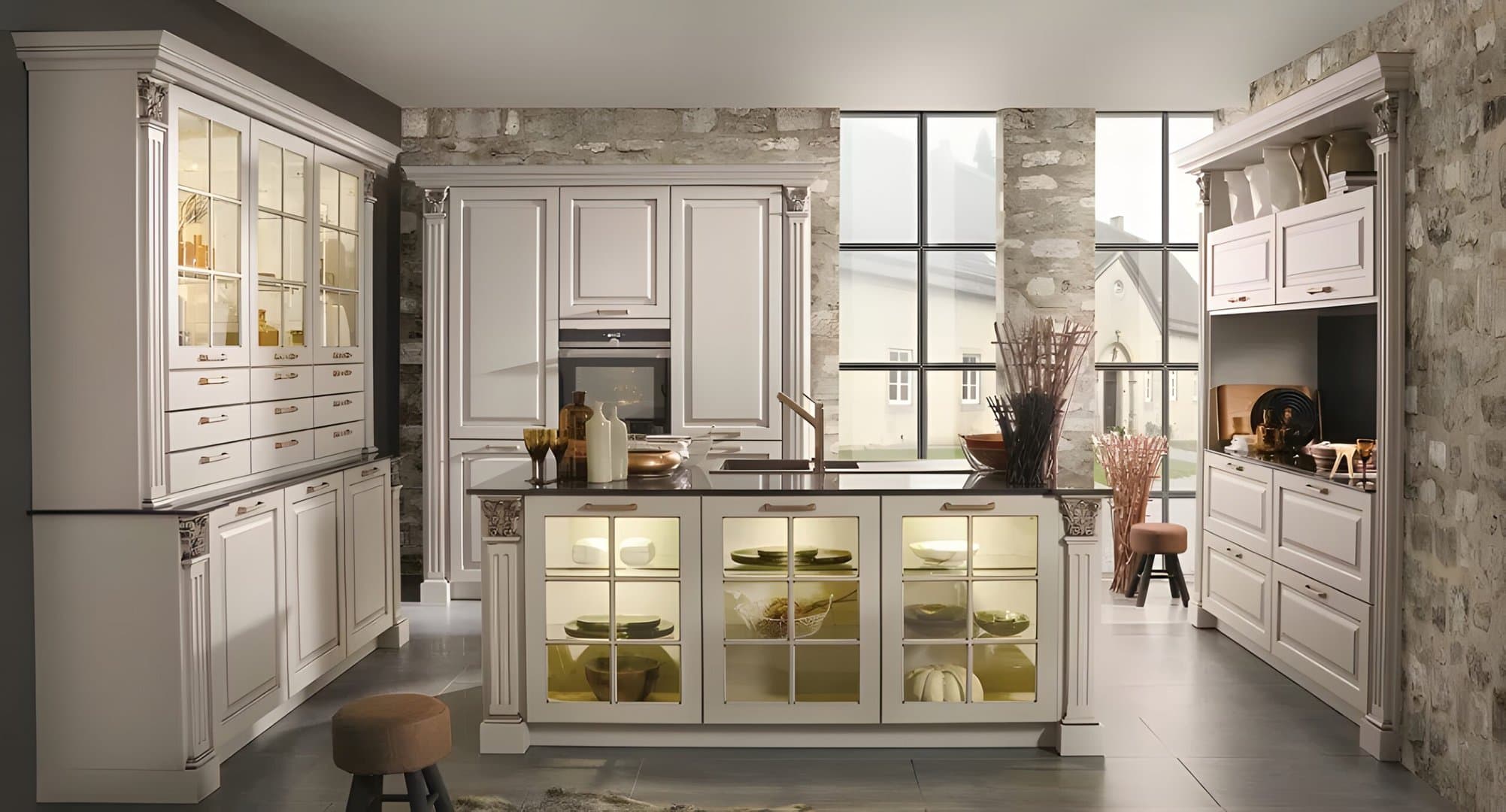
What German craftsmanship actually means
The phrase gets used loosely, so here is the specific version. Three things separate a genuinely well-built cabinet from one that only photographs well.
Materials you can rely on
It starts with the carcass, the box behind the door. German kitchen cabinets use dense, moisture-resistant board with edges banded under heat and pressure so tightly that the seam disappears and water cannot creep in. That edge banding is the first thing to fail in a low-cost kitchen. Near a sink or a dishwasher, a poorly bonded edge swells within a couple of years. A properly banded one does not. The fronts themselves run from real lacquered surfaces to ceramic and glass, each chosen to wear evenly and hold colour rather than yellow or chalk over time.
Tolerances measured in millimetres
Tolerance is the quiet hero of a good kitchen. It means how close every part lands to its intended size and position. German lines are cut and assembled to tolerances so tight that a run of twelve cabinets reads as one continuous surface, with reveal lines that stay even from the first door to the last. You feel this every day. Drawers that align, doors that sit flush, a worktop that meets the cabinet without a gap to trap crumbs. Loose tolerances are why budget kitchens look slightly off in a way most people sense but cannot articulate.
Hardware that earns its keep
Open and close a kitchen drawer a few thousand times a year and the hardware becomes the whole experience. Bauformat fits full-extension, soft-close runners as standard, so the drawer pulls all the way out and you reach the back without crouching, then closes itself the last few centimetres without a slam. The doors run on 3D-adjustable concealed hinges, which let an installer fine-tune a door in three directions long after the kitchen is in. That adjustability is exactly what you want in a coastal climate, where wood and walls move with the seasons and a door that was perfect in June may need a quarter-turn by January.
Three collections, one standard of build
One of the more practical things about Bauformat is that the engineering does not change between price levels. The carcass, the runners, and the hinges are built to the same standard across the range. What changes is the front, the finish, and the breadth of choice. There are three collections, and most Metro Vancouver projects find their home in one of them.
Baulux, the top tier
Baulux is where the most advanced surfaces live: ceramic, glass, and ultra-matte fronts. Ceramic and glass resist heat, scratches, and fingerprints in a way painted fronts cannot match, which suits a high-use family kitchen or a design-forward downtown condo where the kitchen is on permanent display in an open-plan space. Ultra-matte fronts give that deep, soft, light-absorbing finish that has become the signature of contemporary German design.
Bauformat, the widest choice
The core Bauformat collection offers the broadest range of finishes and colours of the three. This is the one for homeowners who have a specific palette in mind, whether that is a warm muted green for a Kitsilano character home, a crisp handleless white for a North Shore new build, or a wood-grain front that picks up the tone of an oak floor. The range is wide enough that you rarely have to compromise the colour to get the build quality.
Burger, the value collection
Burger is the best-value line, and the important word is value rather than cheap. It carries the full German build, the same dense carcass and quality hardware, at a more accessible price. For a rental suite, a secondary kitchen, or a first renovation on a tighter budget, Burger lets you put a genuinely German-engineered kitchen in the room without stretching past what the project can carry.
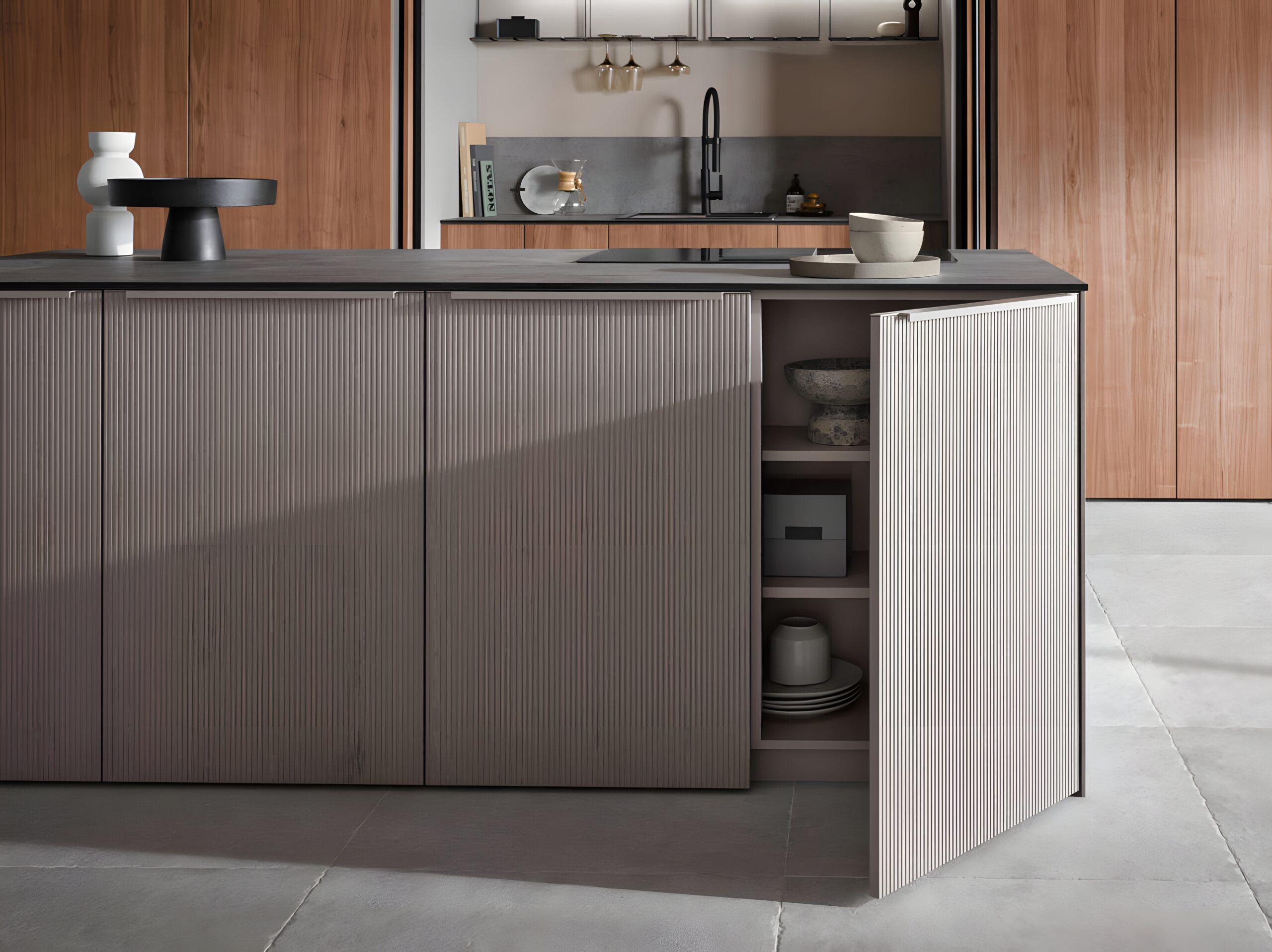
Why this matters for a Metro Vancouver home
Vancouver is a demanding place to own a kitchen. The coastal air is humid, homes swing between damp winters and dry, heated interiors, and a lot of the housing stock, from Yaletown towers to East Van character houses, has the kind of imperfect walls and tight footprints that punish a poorly built kitchen. German cabinets are engineered for exactly these conditions. Moisture-resistant boards shrug off the humidity, and 3D-adjustable hinges let the installer keep every door true as the house moves through the year.
There is a money argument too, and it is a strong one. Kitchen work remains one of the best returns in home improvement. The 2025 Cost vs. Value Report put the national return on a minor kitchen remodel at roughly 96 percent of cost recovered at resale (2025 Cost vs. Value Report), the leading interior project in the study. Build quality is what protects that figure over the long run. A kitchen that still closes softly and lines up cleanly after twenty years reads as an asset to a buyer. One that has started to sag and peel reads as a future expense.
The local cost picture sharpens the point. A standard Metro Vancouver kitchen renovation generally lands somewhere between 40,000 and 70,000 dollars (Quay Construction, 2025), and downtown and west-side projects often sit at the higher end because of labour and logistics. At that level of investment, the difference between a cabinet that lasts a decade and one that lasts two or three is not a luxury detail. It is the core of whether the money was well spent.
The quiet details that separate a kitchen that lasts
Beyond the headline features, German manufacturing shows up in the interior fittings most people never think about until they live with them. Smart interior storage turns a deep corner cabinet from dead space into usable shelving that swings out to meet you. Drawer organisers hold cutlery and utensils so nothing rattles loose. Internal drawers within a deep pan drawer give you a second tier of storage without a second cabinet.
These are not gimmicks. They are the result of a manufacturer that has spent a century watching how people actually cook and storing the lessons in the product. A well-planned German interior means you use more of the kitchen you paid for, and you reach what you need without bending, digging, or shifting three pots to find the fourth. When the local team plans your layout, this is the layer of detail that turns a good-looking kitchen into one that works hard every single day.
Frequently Asked Questions
Are Bauformat cabinets really still made in Germany?
Yes. Every Bauformat cabinet is built in Lohne, Germany, where the company has manufactured kitchens since 1917. The cabinets are then measured, planned, and installed by the local Vancouver team, so you get German factory precision with a fit tailored to your actual room.
Which collection is right for my kitchen?
It depends on your finish and budget rather than the build, because the engineering is consistent across all three. Choose Baulux for ceramic, glass, and ultra-matte fronts, the core Bauformat collection for the widest range of colours and finishes, and Burger when you want the full German build at the best value. The local team can walk you through samples to match your home.
How long should a German kitchen last in Vancouver’s climate?
A properly built and installed German kitchen is designed to perform for decades, not years. Moisture-resistant boards and sealed edges handle the coastal humidity, while 3D-adjustable hinges and full-extension runners can be tuned and maintained as the home settles, which means the kitchen keeps working and looking right well beyond the typical renovation cycle.
Does German engineering really make a noticeable difference day to day?
It does, mostly in small ways that add up. Drawers that glide fully open and close softly, doors that stay aligned through every season, surfaces that resist scratches and fingerprints, and interiors organised so you reach what you need without digging. None of it shouts, which is exactly the point.
Kitchen design keeps moving toward calmer surfaces, smarter storage, and finishes that handle real life rather than just looking good on day one. A manufacturer that has been refining the same craft since 1917 is built to keep pace with that, and a Metro Vancouver homeowner planning a renovation today is buying into a standard of engineering that will still feel current, and still work properly, long after the trends of this year have passed.
Explore more from Bauformat BC
- Decoding German Kitchen Cabinets Vs. Italian Kitchen Cabinets
- Why Choose Long-Lasting Materials for Your Kitchen Cabinets
- Modern Kitchen Design
German cabinetry, planned and built for Metro Vancouver
The kitchen is one of the highest-return rooms in a home: the 2025 Cost vs. Value Report found a minor kitchen remodel recoups roughly 96% of its cost at resale. Choosing cabinetry that lasts is central to that return, which is where German engineering earns its place. Every Bauformat kitchen is manufactured in Germany, then measured, planned, and installed by our Vancouver team, built to fit your room to the millimetre.
See the Baulux, Bauformat, and Burger collections in person at our North Vancouver showroom at 1410 Marine Dr Unit 205, learn more about the manufacturer at bauformat.de, and meet our local team at The Bau Team.
Book a 30-minute consultation with our Metro Vancouver kitchen designers to plan a kitchen built to last.
A German kitchen is not a collection of cabinets; it is a system: a coordinated grammar of base, wall, and tall units built on shared dimensions, shared construction, and shared hardware, so that any plan a designer can draw, the factory can build to ±0.1mm. Understanding the system is the single most useful preparation a buyer can make: it explains what you are paying for, what can be configured, and why a German kitchen installs and ages the way it does.
This guide maps the complete territory: the three cabinet families and what each does, frameless full-access construction, the handleless question, the modular dimensional logic, carcase engineering, the interior organization systems that do the daily work, the full range of door and front types, and how the Bauformat group’s three tiers (Baulux, Bauformat, and Burger) put the system within reach of different budgets.
Key Takeaways
- German kitchens are organized into three cabinet families (base, wall, and tall units) planned as one dimensional system.
- Frameless (full-access) construction is the European standard: no face frame, roughly ten percent more usable interior volume, and a flush plane of fronts.
- Handleless channel systems and conventional handles are both legitimate German choices; the channel demands, and demonstrates, higher manufacturing precision.
- Carcases are moisture-resistant engineered board, edge-sealed, machined to ±0.1mm, with boards meeting the 0.05 ppm CARB2/US TSCA Title VI formaldehyde ceiling.
- Front options run from laminate through lacquer and matte lacquer to real-wood veneer and glass, with white oak the NKBA’s leading wood for 2026, cited by 51% of professionals.
- The Bauformat group maps the system to three honest tiers: Baulux (uncompromising luxury), Bauformat (everyday excellence), Burger (smart budgets).
The Three Cabinet Families: Base, Wall, and Tall Units
Every German kitchen, however sculptural, resolves into three families of cabinet. The art of planning is in how the families are balanced. The 2026 direction is unmistakable: more tall storage, larger islands, and wall cabinetry used sparingly as composition rather than reflex.
Base Cabinets: The Working Foundation
Base units carry the worktop and the bulk of daily activity: sink runs, cooktop housings, drawer banks, and the island. The defining German preference here is the drawer over the door: full-extension drawers bring contents to the user rather than sending the user to the floor of a dark cupboard, and they have become the ergonomic default for pots, pans, and provisions. Islands deserve particular planning attention; roughly half of new kitchen islands now exceed seven feet, and a monolithic island built from coordinated base units is the centrepiece of the contemporary open plan.
Wall Cabinets: Composition at Eye Level
Wall units store the light and the frequent (glassware, crockery, dry goods) at eye level. The German treatments are distinctive: lift-up fronts that rise overhead and hold at any angle rather than swinging into the room, glass-front cabinets with interior lighting, and open shelving used as deliberate negative space within a run. The current design tendency is restraint: fewer wall cabinets, more breathing room, with the storage burden shifted to tall units where ergonomics are better.
Tall Cabinets: The Storage Architecture
Tall units are where German kitchens quietly win the storage argument. Floor-to-ceiling larder cabinets with internal pull-outs, appliance towers that lift ovens to eye level, and integrated refrigeration columns turn an entire wall into continuous storage architecture. Houzz’s 2026 research finds 76% of renovating homeowners adding built-ins, with pantry storage the most requested at 47%, demand the tall-unit family was engineered to answer. Planned as a continuous bank, tall cabinetry reads as wall rather than furniture, which is precisely the intent.
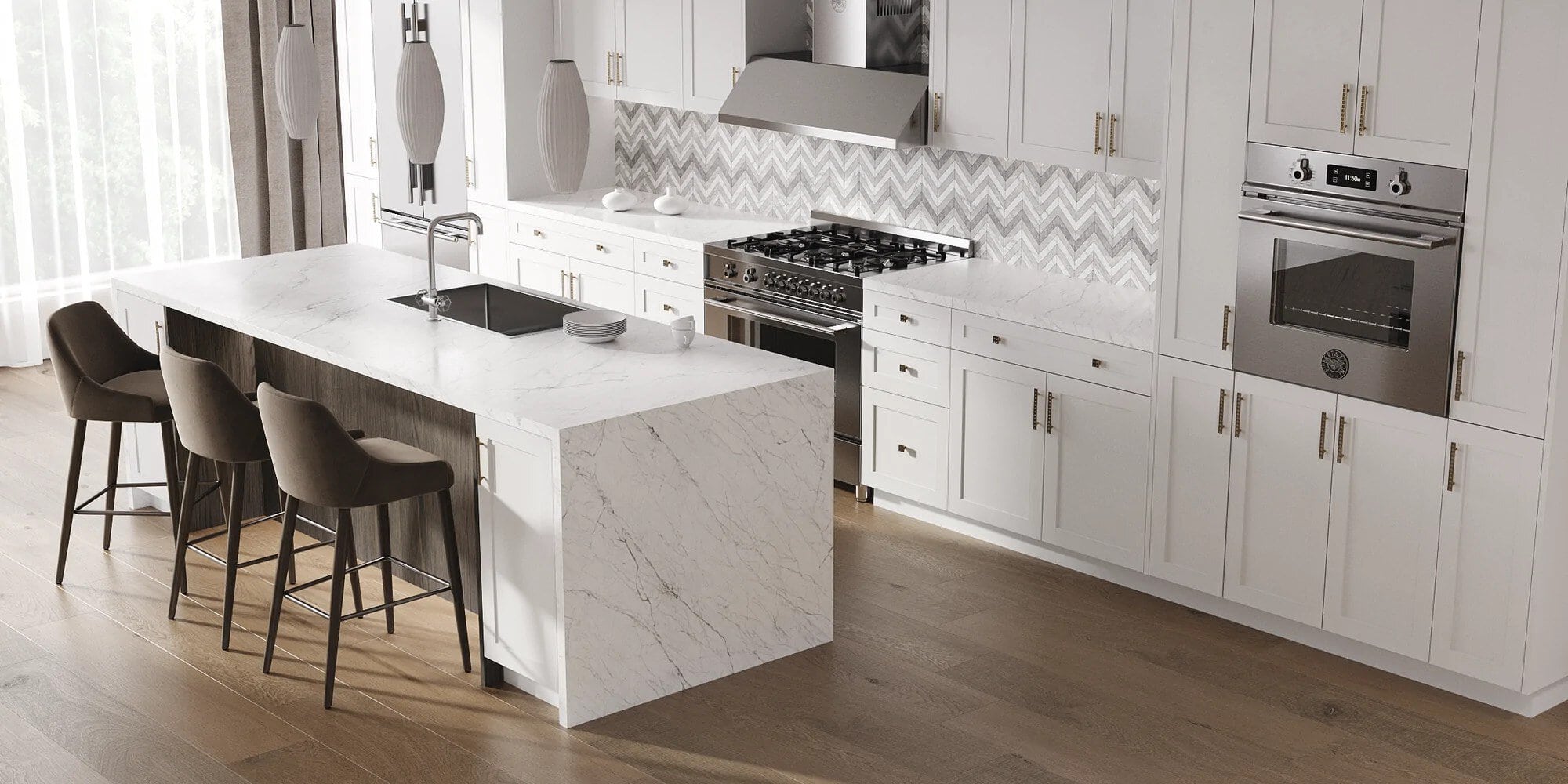
Frameless Full-Access Construction: The European Standard
The structural idea beneath every German cabinet is frameless (also called full-access or European) construction. Where North American framed cabinets attach doors and hardware to a face frame fixed over the carcase opening, the frameless cabinet is a precise box with doors and drawers mounted directly to its sides. The consequences are practical and visible. Practically, eliminating the frame yields roughly ten percent more usable interior volume and unobstructed access: no centre stiles interrupting a drawer, no frame lip catching a pull-out. Visibly, frameless construction produces the flush, continuous plane of fronts with consistent narrow reveals that defines the German aesthetic. The trade-off is tolerance: without a frame to mask irregularity, the box itself must be perfect, which is why frameless construction at scale belongs to factories that can hold ±0.1mm, and why the style is difficult to imitate convincingly with looser methods.
Handleless Channel Systems vs. Handles
No question comes up more often in our North Vancouver showroom. The handleless kitchen replaces hardware with a continuous machined channel, a recessed grip profile running along the top of base units and the bottom of wall units, producing an uninterrupted elevation. Its appeal is architectural purity; its demands are mechanical. The channel must align perfectly across every cabinet junction, the fronts must sit dead flush, and the system often pairs with push-to-open or servo-assisted mechanisms. A well-executed handleless kitchen is therefore a public demonstration of manufacturing precision, which is much of why it became the signature of German design.
Handles remain a fully legitimate, and currently resurgent, choice. A bar pull in brushed steel or black, or a discreet edge-pull profile, adds tactility and suits the transitional direction that now leads homeowner preference. The honest guidance: choose handleless for the purest modern elevation and easy cleaning; choose handles for grip, character, and a softer register. Many of the best current kitchens mix the two (handleless tall banks with handled drawer runs, for instance) within the same system.
The Modular Dimensional System
What makes all of this configurable is the German modular grid. Cabinets are built in standardized width increments (typically from 15cm up to 120cm) against coordinated heights and depths, so that base runs, wall runs, and tall banks resolve into aligned horizontal datum lines across the room. Plinth heights adjust the working level to the cook; carcase heights and depths flex for tasks and for architecture. The grid is why a German kitchen can be planned filler-free, why fronts align across a twenty-cabinet elevation, and why made-to-measure exceptions (a reduced-depth run, a custom-height unit beneath a Vancouver condominium window) integrate without disturbing the composition. Modularity here is not a limitation; it is the precision vocabulary that makes mass customization possible: industrial accuracy, individual result.
Carcase Construction: The Engineering Inside
The carcase (the cabinet body) is where quality is decided, long before a front is chosen. German carcases are made from moisture-resistant engineered board, edge-sealed on all sides against the humidity of a working kitchen, and machined to ±0.1mm so hardware seats identically in every unit. Boards meet the CARB2 and US TSCA Title VI formaldehyde ceiling of 0.05 ppm, stricter than the EU’s own requirement. Backs are solid and housed, not stapled hardboard; shelves are rated and pinned against tipping; adjustable legs level the system on imperfect floors before the plinth conceals them.
Hardware completes the engineering. Soft-close hinges adjustable in three dimensions allow every door to be trued after installation; undermount full-extension glides carry drawers on concealed, damped steel runners rated for decades of cycles. Independent verification closes the argument: Bauformat’s cabinetry carries the Golden M (RAL-GZ 430), Europe’s strictest furniture quality mark, with laboratory testing of stability, surface durability, hardware endurance, and emissions, alongside GS tested safety and the “Furniture Made in Germany” seal.
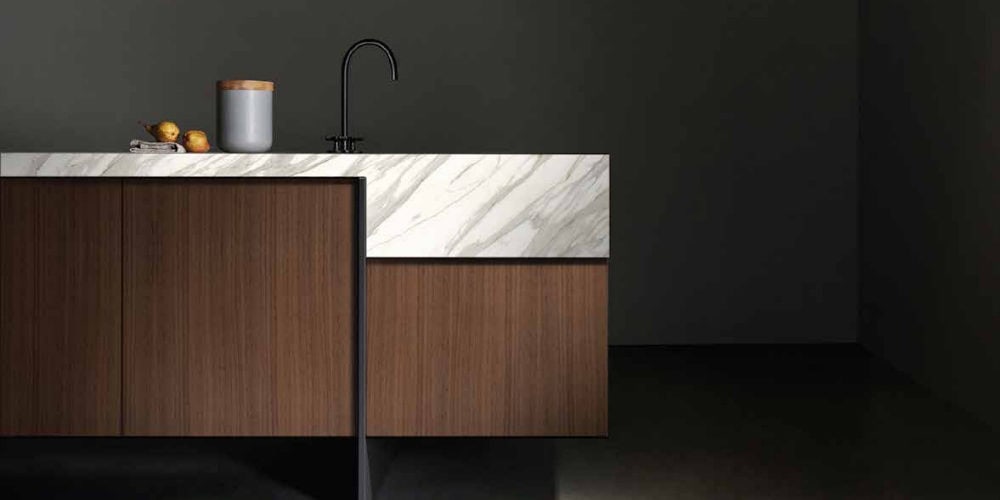
Interior Organization Systems
Open a German drawer and the philosophy is visible: the inside is designed as deliberately as the outside. Drawer interiors take partition systems in wood or anthracite steel: fitted compartments for cutlery, knives, spices, and utensils that keep contents ordered and visible. Deep pot drawers carry plate holders and adjustable dividers. Larder pull-outs bring the full contents of a tall cabinet out into the light on both sides; corner mechanisms swing otherwise dead storage into reach; waste and recycling sort behind the sink front, sized for Vancouver’s multi-stream collection.
Lighting and power are planned as interior infrastructure: LED layers under wall units and inside glass and drawer cabinets, with in-cabinet charging and sensor switching increasingly standard, the cabinetry’s quiet answer to the NKBA’s “increasing kitchen IQ” theme for 2026, and to a smart-home ecosystem unified across brands by Matter 1.5. None of it shows when the doors are closed. All of it works every day.
Door and Front Types: Lacquer, Laminate, Veneer, and Glass
The front is the kitchen’s face, and the German range is organized less by fashion than by material logic.
Lacquer Fronts
Lacquer is the premium painted finish: multiple sprayed and cured coats (increasingly low-VOC systems) on an engineered substrate, in high-gloss, satin, or the matte that currently defines the contemporary register. Matte lacquer with anti-fingerprint surfacing has become the signature German front: deep, uniform colour with no glare and a soft touch. Lacquer offers the widest colour freedom, which matters in a year when the colour conversation spans espresso brown, khaki, jade, and soft white among the colours of the year, with aubergine searches up 495% and butter yellow emerging.
Laminate and Synthetic Fronts
Laminate is the workhorse, and modern German laminates deserve the name only technically. High-pressure surfaces with synchronized texture reproduce timber grain down to the pore, edges are laser-bonded so the joint effectively disappears, and durability against scratching, moisture, and UV is excellent. Laminate fronts carry the accessible end of the range, which is much of how the Burger tier delivers a German system at entry budgets without touching carcase or hardware quality.
Wood and Veneer Fronts
Real-wood veneer delivers the material of the moment. Veneers sliced from a single log are sequenced so grain flows continuously across doors and drawers: the grain-matched front that marks a considered kitchen. White oak leads decisively: the NKBA names it the top cabinet wood for 2026, cited by 51% of professionals, with 59% reporting growing demand for visible grain, and Houzz recording wood-tone cabinetry overtaking white for the first time, 29% to 28%. Pinterest’s data adds the pairing of the year: “white oak and black kitchen” searches up 625%. Timber-drenching (one wood tone carried across fronts, panelling, and shelving) is the fullest expression.
Glass and Framed Fronts
Glass fronts (satin, smoked, clear, or fluted, usually within slim aluminium frames) introduce display and depth, almost always with interior lighting. They are best deployed sparingly, as punctuation within a composed elevation: a lit glass bank between matte runs, a fluted sideboard in the dining zone. Sustainability threads through all front families: certified wood supply chains ahead of the EU Deforestation Regulation taking effect December 30, 2026, FSC-certified forests now exceeding 171 million hectares, and energy-efficient German production behind every finish.
How the Bauformat Tiers Map the System
The Bauformat group (family-owned since 1917, 650 kitchens a day from Löhne, among Europe’s top ten manufacturers) offers the entire system described above through three honestly differentiated brands. Burger, for smart budgets, delivers the core grammar: frameless carcases, the modular grid, soft-close hardware, and strong laminate and lacquer programs. Bauformat, for everyday excellence, opens the full depth: matte lacquers, veneers, handleless channel systems, and the complete interior range. Baulux, for uncompromising luxury, adds the flagship specification: grain-matched fronts, bespoke dimensions, and architectural detailing without compromise. The construction standards, quality marks, and made-to-order production are common to all three; a buyer chooses a specification depth, never a different standard of engineering.
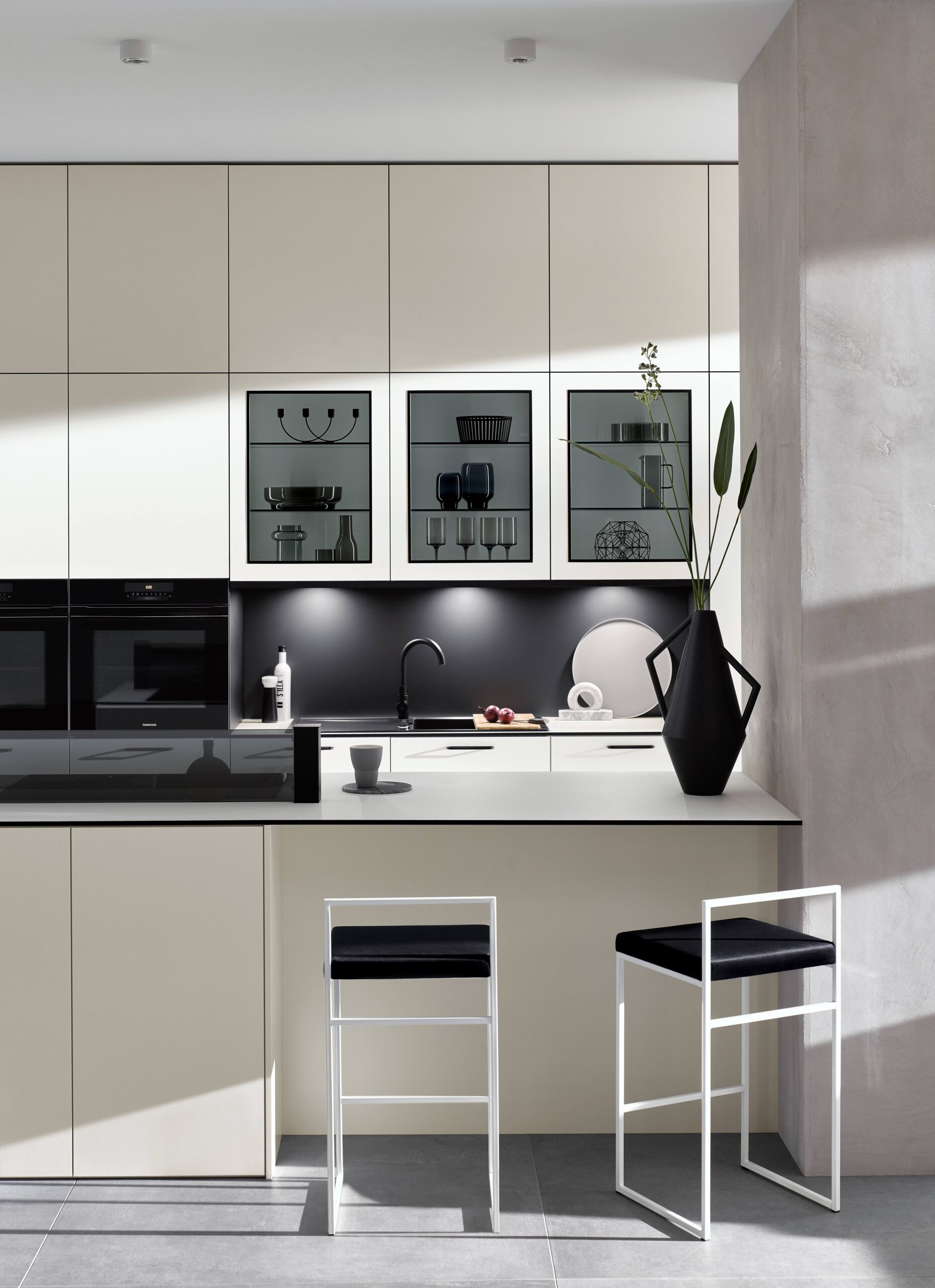
Frequently Asked Questions
What are the main types of German kitchen cabinets?
Three families: base cabinets (worktop level: drawers, sink and cooktop units, islands), wall cabinets (eye-level storage with lift-up or glass fronts), and tall cabinets (larders, appliance towers, integrated refrigeration). They share one modular dimensional system.
What does frameless or full-access construction mean?
The cabinet is a precision box without a face frame; doors and drawers mount directly to the carcase. It yields about ten percent more usable volume, unobstructed access, and the flush front plane characteristic of German design.
Are handleless kitchens practical?
Yes. The machined channel provides a continuous, comfortable grip and removes hardware that catches clothing and collects grime. The prerequisite is precision manufacturing; the channel exposes any misalignment, which is why it is a German specialty.
Which front material should I choose?
Laminate for durable value, lacquer (especially matte) for colour and the purest contemporary surface, real-wood veneer for warmth and the leading 2026 direction, glass for lit display moments. All mount on the same carcase and hardware standard.
Can a modular German system fit an awkward Vancouver floor plan?
That is what the grid is for. Standardized increments plus made-to-measure exceptions resolve angled walls, low sills, and concrete columns filler-free, a regular exercise in Vancouver condominium projects.
What distinguishes the Baulux, Bauformat, and Burger tiers?
Specification depth, not build quality. Burger serves smart budgets, Bauformat everyday excellence, Baulux uncompromising luxury, all built in the same German factories to the same tested standards, including the Golden M (RAL-GZ 430).
The System Is the Product
Choose a German kitchen and you are choosing the system: three cabinet families on one dimensional grammar, frameless construction held to ±0.1mm, interiors engineered as carefully as elevations, and a front range that runs from workhorse laminate to grain-matched white oak. The types are not a catalogue to memorize but a vocabulary a good planner speaks fluently on your behalf, and the fastest way to learn it is to stand in front of the real thing and open everything.
See every cabinet type in person. Book a private showroom tour at Bauformat BC, 1410 Marine Dr Unit 205, North Vancouver, +1-604-770-1284.
Kitchen design in Metro Vancouver is shifting in 2026, away from cold, all-white minimalism and toward warmer, calmer, more tactile spaces. Here are the trends we’re seeing most in Vancouver homes this year, and how to get the look with German-engineered cabinetry.
1. Quiet luxury over flashy design
“Quiet luxury” is the defining look of 2026: understated, high-quality materials, clean lines, and finishes that feel expensive without shouting. Think seamless cabinet runs, hidden hardware, and a restrained palette, the opposite of trend-chasing. German cabinetry suits this perfectly because the quality is in the build, not the bling.
2. Warm wood tones make a comeback
Wood has overtaken plain white as the most-requested cabinet finish. Medium-toned woods lead the way, white oak, walnut, and rift-cut oak, often paired with stone or matte surfaces for contrast. The Bauformat series offers wood-veneer fronts that bring this warmth into a Vancouver kitchen while keeping German durability.
3. Handleless, flat-front cabinets
Flat-front, handleless doors with push-to-open or recessed grip rails continue to dominate. They create the seamless, uncluttered look that defines modern European kitchens and make a smaller Vancouver kitchen feel larger and calmer.
4. Deep, moody colours
Alongside warm woods, rich hues are having a moment, navy, graphite, forest green, and deep charcoal, often on islands or lower cabinets. These pair beautifully with brass or matte-black accents. The Baulux series offers ceramic and tempered-glass fronts that hold these deep tones with a premium finish.
5. Seamless, integrated kitchens
Panel-ready appliances, full-height cabinetry, and continuous surfaces are in demand as homeowners look for a clean, built-in feel. German modular systems are designed for exactly this kind of millimetre-precise integration.
6. Tactile, mixed materials
2026 is about texture: hand-finished cement, fluted wood, matte lacquer, and natural stone combined in one space. Mixing two or three complementary finishes, for example a wood-tone perimeter with a contrasting island, adds depth without clutter.
Bringing 2026 trends into your Vancouver kitchen
The good news: every one of these looks is achievable with German cabinetry built to last. Whether you want the practical Burger series, the versatile Bauformat range, or the luxury Baulux line, our team plans and installs every kitchen here in Vancouver.
Browse our 2026 catalogues for finish inspiration, then book a consultation at our Yaletown showroom to see the materials in person.
Frequently asked questions
What is the biggest kitchen trend for 2026?
Quiet luxury, warm, high-quality, understated kitchens with natural wood tones, seamless cabinetry, and restrained colour palettes.
Are white kitchens out of style in 2026?
Not entirely, but warm woods and deeper tones have overtaken stark all-white as the most-requested look in Vancouver.
Which cabinet colour is most popular in 2026?
Medium wood tones like white oak and walnut, often paired with a deep accent colour such as navy or charcoal on the island.
If you’re planning a kitchen renovation in Metro Vancouver, the first question is almost always the same: how much do German kitchen cabinets cost? The honest answer is that it depends on the size of your kitchen, the door fronts and materials you choose, and how custom the layout needs to be, but this 2026 guide gives you realistic Vancouver ranges so you can budget with confidence.
German kitchen cabinet costs in Vancouver (2026)
Across Metro Vancouver, cabinetry typically accounts for 40–50% of a full kitchen renovation budget. As a rough 2026 guide for the cabinetry portion alone:
- Semi-custom German cabinets: roughly $10,000–$30,000 for an average kitchen.
- Fully custom / luxury German cabinets: roughly $25,000–$100,000+, depending on fronts and size.
For context, most Vancouver homeowners spend between $50,000 and $120,000 on a complete mid-range kitchen renovation once countertops, appliances, and installation are included. Vancouver labour costs run well above the national average, so local pricing is usually higher than U.S. or national estimates you may find online.
The three Bauformat BC series, and where they fit your budget
At Bauformat BC we carry three German-engineered series so there’s a fit for most budgets, from practical to fully bespoke:
- Burger, entry tier. German build quality at the most practical price, with soft-close hardware standard. The best starting point if you want German engineering on a tighter budget.
- Bauformat, mid tier. The widest choice of front materials and finishes, with storage planned around how you cook. The most popular pick for Vancouver renovations.
- Baulux, luxury tier. Our top series, with ceramic, tempered glass, hand-finished cement, and Dekton fronts for a true high-end kitchen.
What’s included in a German cabinet price
German cabinets cost more upfront than flat-pack alternatives, but the price reflects what you actually get:
- Cabinets engineered and built in Germany to tight tolerances.
- Soft-close drawers and doors as standard.
- Durable, moisture-resistant cabinet boxes designed to last decades.
- Planning and installation by our Vancouver team, built to fit your room to the millimetre.
What drives the cost up or down
- Kitchen size and cabinet count, more linear footage means more cabinets.
- Front material, laminate and melamine are the most affordable; lacquer, wood veneer, glass, ceramic, and Dekton sit higher.
- Layout complexity, islands, tall pantry units, and custom interior fittings add cost.
- Hardware and accessories, specialty pull-outs, lighting, and organizers.
How to get an accurate Vancouver quote
Every kitchen is different, so the most reliable way to know your number is a real quote. You can browse our catalogues to compare series and fronts, then contact our Yaletown showroom or book a 30-minute consultation. A designer will measure your space, plan the layout around how you live, and give you a clear, itemized price.
Frequently asked questions
Are German kitchen cabinets worth the cost?
For most homeowners, yes, the build quality, soft-close hardware, and longevity mean fewer replacements and a kitchen that still looks and works well a decade later. German cabinetry also tends to protect resale value.
What’s the cheapest way to get German cabinets in Vancouver?
The Burger series is our most practical price point while keeping genuine German construction and soft-close hardware.
How long does a kitchen take?
Because German cabinets use pre-engineered modular components, installation is efficient, but plan to be without your kitchen for roughly 4–8 weeks across the full renovation.
Do you handle design and installation?
Yes. Bauformat kitchens are built in Germany, then measured, planned, and installed by our own team in Vancouver.
Ready to price your kitchen? Get in touch with Bauformat BC for a personalized quote on Burger, Bauformat, or Baulux cabinets.
