

A kitchen takes a beating that most rooms never see. Doors and drawers open thousands of times a year, steam rises off the stovetop, water splashes around the sink, and the whole space swings through temperature and humidity changes every single day. In a coastal city like Vancouver, where damp air settles in for months at a stretch, that daily wear adds up fast. The cabinets that shrug it off are not the lucky ones. They are the ones engineered to handle it from the first cut of board to the final adjustment of a hinge.
That is the real story behind durable German kitchen cabinets. Longevity is not an accident or a marketing claim. It is the predictable result of tight tolerances, sealed materials, hardware tested to survive decades of use, and a fit measured for one specific room. Bauformat has been refining that approach in Lohne, Germany since 1917, and our Vancouver team carries it through to the install. Here is how durability actually gets built into a kitchen, and why it matters so much for Metro Vancouver homes.
Key Takeaways
- German cabinet durability comes from precision manufacturing and tight tolerances, not chance, so parts fit and stay fitting for decades.
- Quality carcass boards and fully sealed edges keep moisture out, which matters in Vancouver’s damp coastal climate.
- Cabinet hardware is cycle-tested in the lab. Leading runners and hinges are rated from 50,000 to 200,000 open-close cycles, simulating decades of daily use.
- Made-to-order construction removes the gaps and filler strips that become weak points in stock cabinets.
- Buying once and keeping it for 25 to 40 years often costs less over time than replacing cheaper cabinets twice, and a quality kitchen refresh holds strong resale value.
Precision Manufacturing: Durability Starts at the Tolerances
Walk through how a German cabinet is made and the first thing you notice is how little is left to guesswork. Boards are cut by computer-controlled machinery to tolerances measured in fractions of a millimetre. Holes for shelf pins, hinge cups, and connecting hardware are drilled to the same exacting standard, so every part lines up the way it was designed to.
That precision is not just about looking sharp on day one. When panels meet at perfectly square corners and joints close tight, the carcass carries weight evenly and resists the racking and sagging that loosens lesser cabinets over time. A drawer front that sits a hair out of alignment will rub, bind, and wear unevenly for years. A door hung on a frame that is even slightly off-square will stress its hinges every time it swings. Tight tolerances spread the load and remove those small daily stresses, which is exactly why precision-built cabinets stay solid long after cheaper ones start to sag and gap. Durability, in other words, is engineered at the factory before a single screw goes in.
Quality Carcass Materials and Sealed Edges
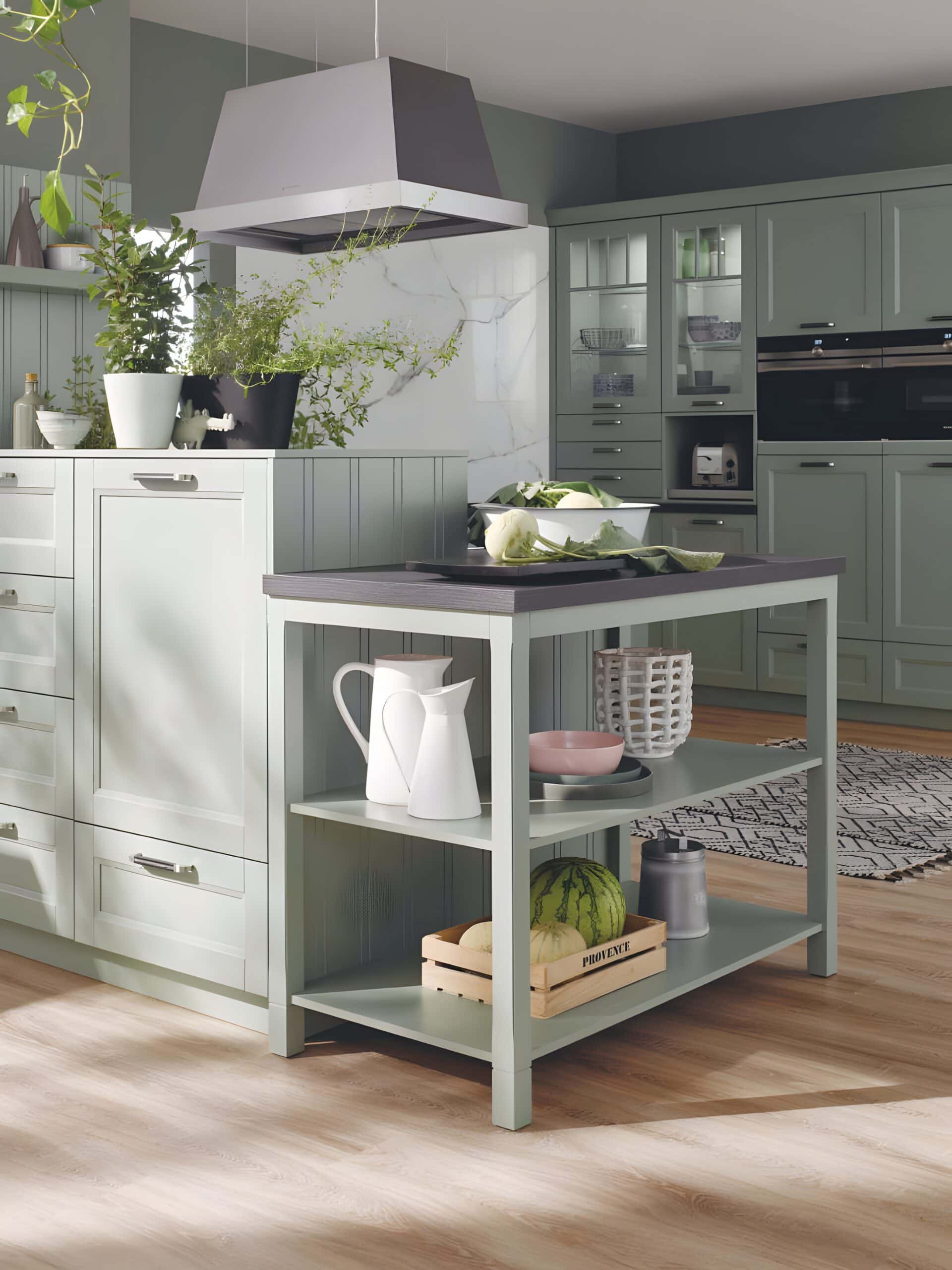
The carcass is the box that does the real work, and it is where corners get cut in lower-end kitchens. German manufacturers build carcasses from dense, high-grade engineered board chosen for dimensional stability, meaning it holds its shape rather than swelling, bowing, or warping as conditions change. A stable box keeps doors aligned, drawers running true, and the whole kitchen feeling tight years down the road.
Just as important is what happens at the edges. Raw board edges are the entry point for moisture, and once water wicks into the core, the board swells and the surface lifts. German cabinets are finished with edge banding bonded under heat and pressure so the seal is continuous, with no open seams for damp air to creep into. Industry guidance on cabinet materials notes that high-quality engineered boards typically last 20 to 30 years, while well-built cabinets as a whole commonly run 25 to 40 years or more when made with durable materials and properly installed (cabinet industry data, 2025). That sealing is the quiet hero of a long-lasting kitchen. It is also why this matters more here than almost anywhere else, which brings us to the coast.
Hardware Tested for Tens of Thousands of Cycles
Open a well-made drawer and you feel it immediately. It glides out fully, takes weight without complaint, and eases itself shut without a slam. That motion is the most-used mechanical action in your whole home, and it is the one most likely to fail in a budget kitchen. This is where German engineering earns its reputation.
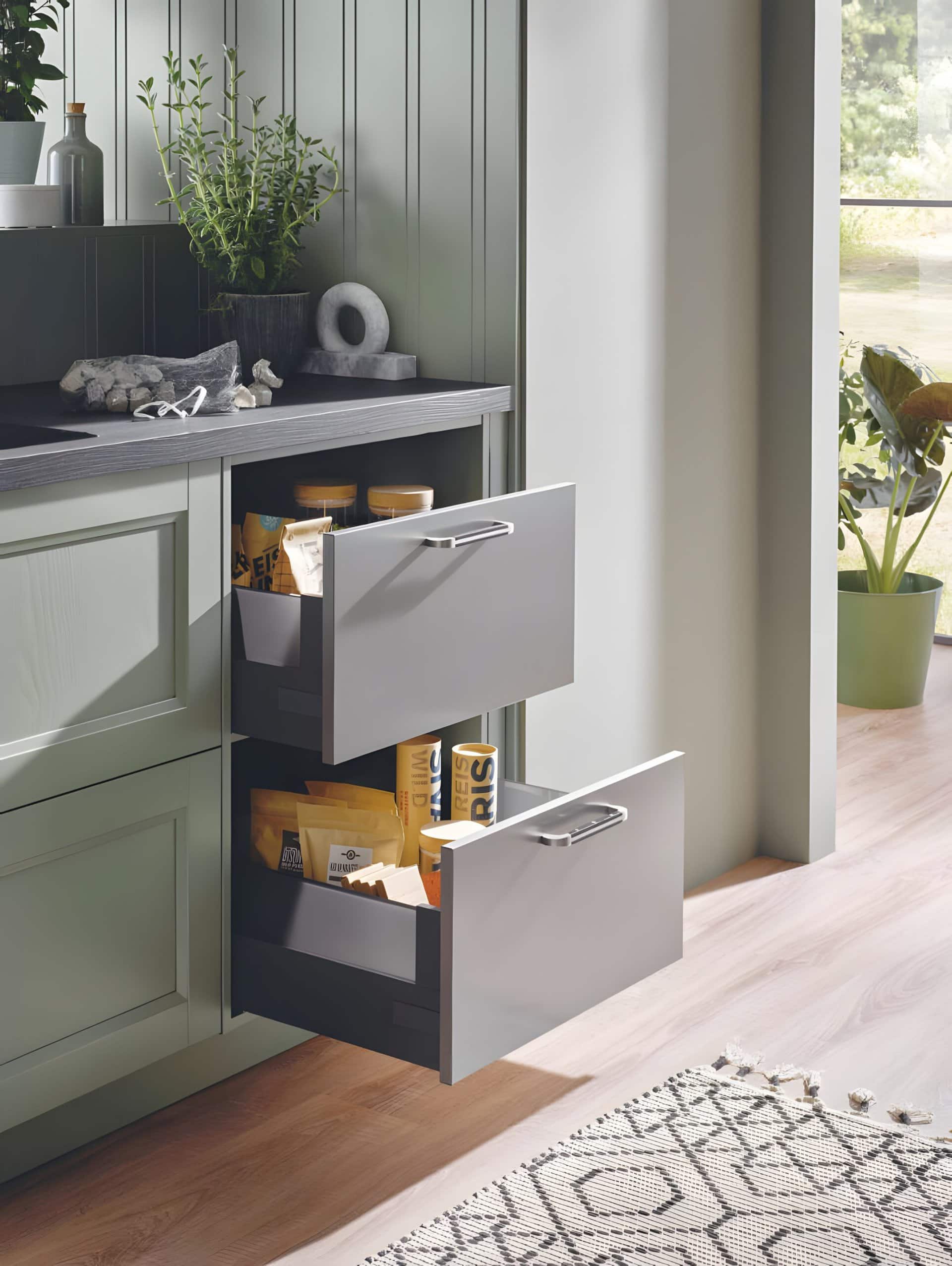
Bauformat fits full-extension soft-close runners and 3D-adjustable concealed hinges, and quality hardware of this kind is not shipped on faith. It is cycle-tested in the lab. Premium drawer runners are commonly certified to 50,000 opening and closing cycles, with some models also passing a 72-hour condensation test against rusting, while the most rigorously tested runners and hinges are rated to withstand 200,000 open-close cycles without damage (independent cabinet hardware testing, 2025). To put that in perspective, opening a drawer twenty times a day every day would take well over a quarter of a century to reach 200,000 cycles. The European standard EN 15570 covers exactly this kind of durability testing for cabinet hinges, rating them across performance levels based on how many cycles and how much load they survive (EN 15570 standard, 2025). The 3D-adjustable hinges add another layer of longevity, because a quick turn of a screw realigns a door that has shifted, so small movements get corrected instead of wearing the cabinet out.
Moisture and Humidity Resistance for the Coast
Vancouver kitchens live in a damp climate. Months of rain, ocean air, and the steam of everyday cooking keep indoor humidity high, and humidity is the slow enemy of cabinetry. It works into unsealed edges, swells unstable cores, corrodes cheap metal hardware, and lifts surfaces from the inside out. A cabinet that performs beautifully in a dry interior climate can quietly deteriorate in a coastal one if it was not built to resist moisture in the first place.
This is where the engineering choices above pay off all at once. Dimensionally stable carcass board resists swelling when the air is heavy. Continuously sealed edges deny moisture the entry point it needs. Hardware tested against condensation and corrosion keeps running smoothly in a steamy kitchen rather than seizing or rusting. None of that is a coincidence of climate. It is the same precision and material quality, applied to the one challenge that defines durability on the West Coast. For a home near the water, choosing cabinets engineered to handle damp is not a luxury detail. It is the difference between a kitchen that lasts a few years and one that lasts a few decades.
Made-to-Order Fit Avoids the Weak Points
Stock cabinets come in fixed sizes, so they almost never fill a real room exactly. The gaps get covered with filler strips, scribe pieces, and shims, and every one of those is a weak point. Filler strips flex and crack. Shimmed cabinets carry weight unevenly and work loose. Spaces that do not quite fit invite the awkward joints where moisture and movement do their damage.
Bauformat kitchens are made to order, measured and planned for your specific space and then installed by our local Vancouver team. Cabinets are built to the dimensions of your room rather than forced to fit it, which removes the filler-and-shim compromises before they can become problems. A kitchen that fits precisely sits flush against walls, carries its loads through the structure as designed, and presents no open seams for damp air to exploit. With three collections to choose from, Baulux, Bauformat with the widest range of options, and Burger for the best value, that made-to-order precision carries across the whole lineup. The fit is not just about looks. It removes the very places where durability tends to fail first.
The Long-Term Value of Buying Once
Durability is ultimately a money question, even if it does not feel like one at the showroom. A cabinet that needs replacing in 10 to 15 years costs you the full price again, plus the demolition, the disposal, and the disruption of living through a second renovation. Cabinets built to last 25 to 40 years skip that entire second round. Buying once, and buying well, is usually the cheaper path once you look past the first invoice.
There is resale value in it too. A quality kitchen refresh has consistently been one of the strongest returns in home improvement, with Zonda’s 2025 Cost vs. Value Report putting the minor kitchen remodel at a 113 percent return nationally, up from 96.1 percent the year before, the only interior project ranked in the top five (Zonda, 2025). A kitchen that still looks tight and runs smoothly after two decades protects that value rather than eroding it. Durable cabinets are not the expensive choice. Over the years you actually own them, they tend to be the economical one.
Frequently Asked Questions
How long do German kitchen cabinets actually last?
Well-built cabinets made from quality engineered board and properly installed commonly last 25 to 40 years or more, and industry sources put high-grade engineered carcass materials at 20 to 30 years on their own (cabinet industry data, 2025). German cabinets sit at the upper end of that range because of their precision construction, sealed edges, and cycle-tested hardware. Real-world lifespan also depends on installation quality and everyday care.
What makes the hardware so durable?
The runners and hinges are tested in the lab to survive decades of daily use. Premium drawer runners are commonly certified to 50,000 cycles, and the most rigorously tested hardware is rated to 200,000 open-close cycles without damage (independent cabinet hardware testing, 2025). The European EN 15570 standard formally rates cabinet hinge durability by cycle and load testing. The 3D-adjustable hinges also let small misalignments be corrected with a screwdriver, so the cabinet stays true instead of wearing out.
Do German cabinets really hold up in Vancouver’s damp climate?
That is one of their strengths. Dimensionally stable carcass board resists swelling, continuously sealed edges block moisture at the seams, and corrosion-tested hardware keeps running in steamy conditions. Some runners are also certified against a 72-hour condensation test. Those features matter most in a coastal climate, where high humidity is the main thing that shortens a kitchen’s life.
Is it worth paying more for durable cabinets?
For most homeowners, yes, once you look at the full timeline. Replacing cheaper cabinets in 10 to 15 years means paying twice and renovating twice. Cabinets built to last 25 to 40 years avoid that, and a quality kitchen also returns strong resale value, with the minor kitchen remodel returning 113 percent nationally in 2025 (Zonda, 2025).
Durability in a kitchen is never one feature. It is precision manufacturing, stable materials, sealed edges, tested hardware, and a made-to-order fit all working together, with each one covering for the daily stresses the others might miss. That is what built to last really means, and for a Metro Vancouver home facing years of coastal damp, it is what separates a kitchen you replace from one you simply keep.
Explore more from Bauformat BC
- Your German Kitchen, Step by Step: From First Sketch to Installation
- German Kitchen Design on a Budget: Your 2026 Options
- Unravelling the Secrets Elegance of Premium Custom Kitchen Design
German cabinetry, planned and built for Metro Vancouver
The kitchen is one of the highest-return rooms in a home: the 2025 Cost vs. Value Report found a minor kitchen remodel recoups roughly 96% of its cost at resale. Choosing cabinetry that lasts is central to that return, which is where German engineering earns its place. Every Bauformat kitchen is manufactured in Germany, then measured, planned, and installed by our Vancouver team, built to fit your room to the millimetre.
See the Baulux, Bauformat, and Burger collections in person at 1410 Marine Dr Unit 205, North Vancouver, learn more about the manufacturer at bauformat.de.
Book a 30-minute consultation with our Metro Vancouver kitchen designers to plan a kitchen built to last.
