
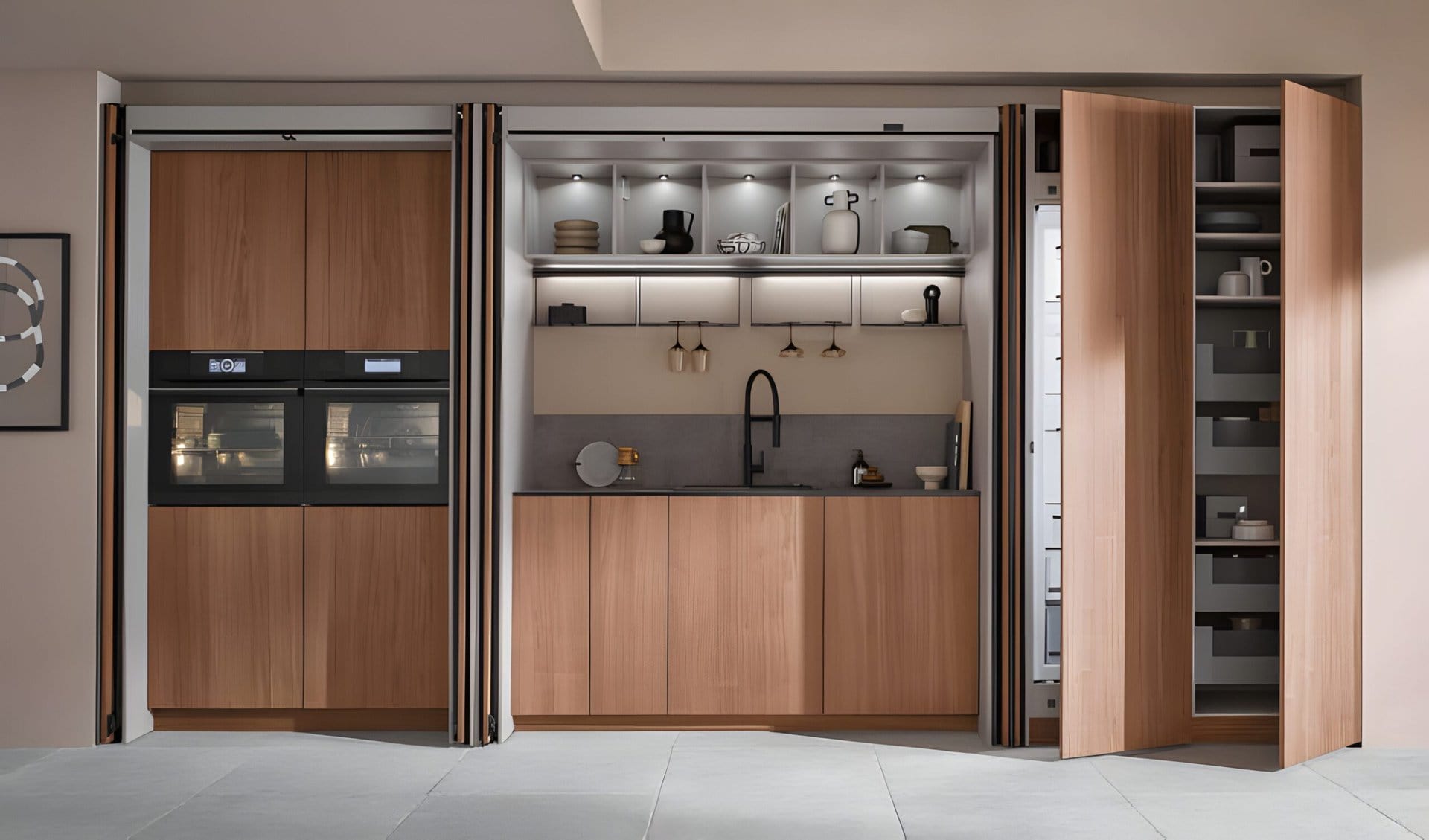
Walk through any Metro Vancouver kitchen built fifteen years ago and you can read the era in the cabinetry: raised-panel doors, decorative corbels, glossy thermofoil, a wall of upper cabinets with ornate crown moulding on top. It looked current then. Today it reads as dated, and the reason is not just colour. The cabinets themselves, how they open, what they are made of, how they are built, have changed at every level.
That arc is the real story of kitchen cabinet trends 2026. We have moved from busy and decorative to calm and tactile, from doors you tug to drawers and push-to-open fronts, from disposable flat-pack to made-to-order furniture meant to last decades. Here is how kitchens got here, and what defines a current Vancouver kitchen now.
Key Takeaways
- Flat and handleless won. Slab doors lead the NKBA 2026 report at 69 percent of designers naming them a growing style, and they are the base of every handleless kitchen.
- Wood is back. 59 percent of design pros call wood grain a rising trend, and wood overtook white for the first time in a decade, with white oak the top species.
- Drawers replaced doors below the counter, bringing storage to eye level and ending the crouch-and-dig.
- Matte beat gloss, and two-tone layouts (light uppers, deeper lowers and islands) are now mainstream.
- Focused renovations pay best: a minor kitchen remodel returns about 113 percent at resale nationally, far ahead of full gut jobs.
From Ornate to Clean and Handleless
The biggest shift is also the quietest one. For years a kitchen signalled quality through ornament: layered mouldings, applied trim, fluted columns flanking the range, glass-front uppers with mullions. The look borrowed from traditional furniture, and it carried a lot of visual noise. The cabinet front was something to decorate.
In 2026 the front is something to simplify. Flat, full-overlay slab doors top the NKBA and KBIS 2026 Kitchen Trends Report at 69 percent of designers naming them a growing style, the single highest-ranked door trend in the study (NKBA, 2026). The slab is also the foundation of the handleless kitchen, where there is no hardware to interrupt the run of cabinetry. Instead you get a recessed grip channel along the top edge, an integrated J-pull, or true push-to-open mechanics behind the door.
This is where German engineering earns its place. Handleless only works when the gaps are dead even and the doors swing back to exactly where they started, every time. Our Baulux collection is built around this clean, handleless language, and the 3D-adjustable concealed hinges let the local Vancouver team fine-tune each door on three axes after install, so the lines stay true even as a heritage Mount Pleasant home settles through the seasons.

The Return of Wood and Warmth
For most of the last decade the default answer to what colour cabinets was white. That era has closed. In the NKBA 2026 report, 59 percent of design professionals identified wood grain as a growing trend, and wood overtook white for the first time in ten years, with white oak the most-specified species at 51 percent (NKBA, 2026). Warm neutrals, the mushrooms, taupes and greiges, now dominate over stark white.
The reason is partly fatigue and partly feel. An all-white kitchen can read as clinical, and after years of them homeowners want a room that feels grounded. Wood grain brings that warmth without sacrificing the clean lines, because the grain itself becomes the only decoration the door needs. Reeded and fluted fronts have arrived for the same reason: texture you can run your hand across, doing the work that applied ornament used to do.
This suits Metro Vancouver well. So many homes here pair cabinetry with cedar, fir and big west-facing windows, and a warm wood-grain front sits more naturally in that light than a flat white box. The Bauformat collection carries the widest choice for exactly this reason, with authentic wood-grain finishes alongside shaker and handleless fronts, so a Kitsilano character home and a Brentwood tower condo can each find the right register.
Drawers and Smarter Storage
Open a kitchen built in 2005 and the lower cabinets are mostly doors: a hinged door, a fixed shelf, and a dark cavity behind it where the stockpots go to be forgotten. You crouch, you reach, you dig. The single biggest functional change in modern kitchens is that those base doors have been replaced by deep, full-extension drawers.
The logic is simple once you live with it. A drawer brings the entire contents out to you and up to eye level, so the back of the cabinet is as usable as the front. Pots, pans, dry goods and even dishes now live in graduated drawer banks. Around them sits a layer of interior intelligence: cutlery and utensil dividers, pull-out organizers for the corners that used to be dead space, and tall pantry pull-outs that use vertical room a swing door cannot.
Bauformat builds this in as standard rather than as an upsell. Full-extension soft-close runners mean every drawer glides fully open and closes itself without a slam, and the smart interior storage is planned around how you actually cook. In a compact Yaletown or Coal Harbour condo, where every centimetre of a galley kitchen counts, that planned interior is often the difference between a kitchen that works and one that fights you.

Integrated and Concealed Appliances
The older kitchen wore its appliances proudly: stainless faces lined up across the room, a microwave bulging from the upper run, small appliances colonizing the counter. The current direction is the opposite. Appliances are being concealed behind cabinet panels so the eye reads one continuous, calm surface.
Panel-ready fridges and dishwashers disappear behind matching fronts. The microwave moves into a drawer or a tall cabinet. And the appliance garage has been reinvented: instead of the old roll-top that jammed, 2026 favours tambour doors and lift-up fronts that tuck the kettle, toaster and coffee machine out of sight, keeping the counter clear while leaving everything within reach. Industry coverage of the NKBA 2026 findings points to integrated panel-ready appliances, slab backsplashes and hidden storage doors working together to create one cohesive space (Kitchen and Bath Business, 2026).
Concealment is unforgiving of sloppy fabrication. A panel-ready front only reads as built-in if it lines up perfectly with the cabinet doors beside it, which again comes back to precise carcass construction and adjustable hinges. This is the kind of detail that gets settled when a kitchen is measured and planned on site by the team that will install it, rather than ordered blind from a catalogue.
Matte Over Gloss, and Two-Tone
High-gloss lacquer was the shorthand for a modern kitchen not long ago: mirror-bright doors that bounced light around the room. In 2026 that look has cooled, literally and figuratively. Matte and satin finishes now read as the modern choice, and gloss has started to look of its moment. Matte hides fingerprints and small scuffs better, which matters more than ever in a handleless kitchen where you are touching the door faces to open them.
Alongside the finish shift came a colour structure: two-tone cabinetry. Rather than a single finish wrapping the whole room, designers now pair lighter uppers (cream, warm white, soft greige) with a deeper, grounding tone below, on the lower cabinets, the island, or both. Olive, charcoal and walnut are common partners. Industry reporting on the 2026 trends notes colour migrating onto the perimeter cabinets, not just the island, with many kitchens now layering two, three or more finishes in one room (Business of Home, 2026).
This is where the Baulux range fits the moment, with its ultra-matte, ceramic and glass fronts built for exactly this restrained, tactile look, and the breadth of the Bauformat line makes a considered two-tone scheme straightforward rather than a special order. For a budget-conscious renovation, the Burger collection delivers the same clean matte direction at the best value, which keeps a current-looking kitchen within reach for more Metro Vancouver households.
Durability Over Disposable
There is a deeper trend underneath all of these, and it is about how long a kitchen is meant to last. The flat-pack era trained people to think of cabinets as semi-disposable, fine for five or ten years, then replaced. The current direction treats cabinetry as built-in furniture: made to order, engineered to take daily use, and expected to outlast several rounds of paint and decor.
The renovation maths supports it. A minor kitchen remodel returns roughly 113 percent of its cost at resale nationally, the highest-performing interior renovation, while full gut jobs recoup closer to 50 to 60 percent (Kitchen Cabinet Kings 2026 ROI Report, citing Cost vs. Value data). The takeaway is that quality cabinetry, soft-close runners that survive tens of thousands of cycles, hinges you can readjust instead of replace, carcasses that stay square, is where the value sits, not in tearing everything to the studs.
That is the through-line for Bauformat. Made in Germany since 1917 in Lohne, then measured, planned and installed by the local Vancouver team, these are kitchens designed to be lived in hard and to still close cleanly a decade later. In a market where Metro Vancouver homeowners hold and improve rather than flip, cabinetry built to last is less a luxury than a sensible bet.
Frequently Asked Questions
Are handleless kitchens just a passing trend?
The evidence points the other way. Slab fronts, the basis of every handleless kitchen, lead the NKBA 2026 report at 69 percent of designers naming them a growing style. Handleless is less a fad than the logical end of a long move toward cleaner cabinetry, and the grip channels and push-to-open mechanics behind it are mature, proven hardware rather than something experimental.
Is wood grain replacing white cabinets entirely?
Not entirely, but the balance has shifted decisively. Wood overtook white for the first time in a decade in the NKBA 2026 findings, with white oak the leading species. White is still used, often as the lighter half of a two-tone scheme, but it is no longer the automatic default it was a few years ago.
Why are drawers better than doors in lower cabinets?
A drawer brings the full contents out to you, so you never have to crouch and reach into a dark cavity. The back of the cabinet becomes as usable as the front, and full-extension soft-close runners let heavy pots glide out completely. In smaller Vancouver condo kitchens, that recovered usability often matters more than any finish.
Does a kitchen renovation actually pay off at resale?
A focused one does. National Cost vs. Value data puts a minor kitchen remodel at around 113 percent return, well ahead of major gut renovations at roughly 50 to 60 percent. Investing in quality, durable cabinetry within a sensible scope tends to recover more than over-building.
The kitchens of 2026 are quieter, warmer and smarter than the ones they replaced, and the change runs deeper than colour. It is in the flat handleless fronts, the wood grain you want to touch, the drawers that bring everything to hand, and the made-to-order construction meant to last. For Metro Vancouver homeowners deciding where to put their renovation dollars, that is a reassuring direction: the current look and the durable choice are, for once, the same thing.
Explore more from Bauformat BC
- Your German Kitchen, Step by Step: From First Sketch to Installation
- German Kitchen Design on a Budget: Your 2026 Options
- Unravelling the Secrets Elegance of Premium Custom Kitchen Design
German cabinetry, planned and built for Metro Vancouver
The kitchen is one of the highest-return rooms in a home: the 2025 Cost vs. Value Report found a minor kitchen remodel recoups roughly 96% of its cost at resale. Choosing cabinetry that lasts is central to that return, which is where German engineering earns its place. Every Bauformat kitchen is manufactured in Germany, then measured, planned, and installed by our Vancouver team, built to fit your room to the millimetre.
See the Baulux, Bauformat, and Burger collections in person at 1410 Marine Dr Unit 205, North Vancouver, learn more about the manufacturer at bauformat.de.
Book a 30-minute consultation with our Metro Vancouver kitchen designers to plan a kitchen built to last.
