
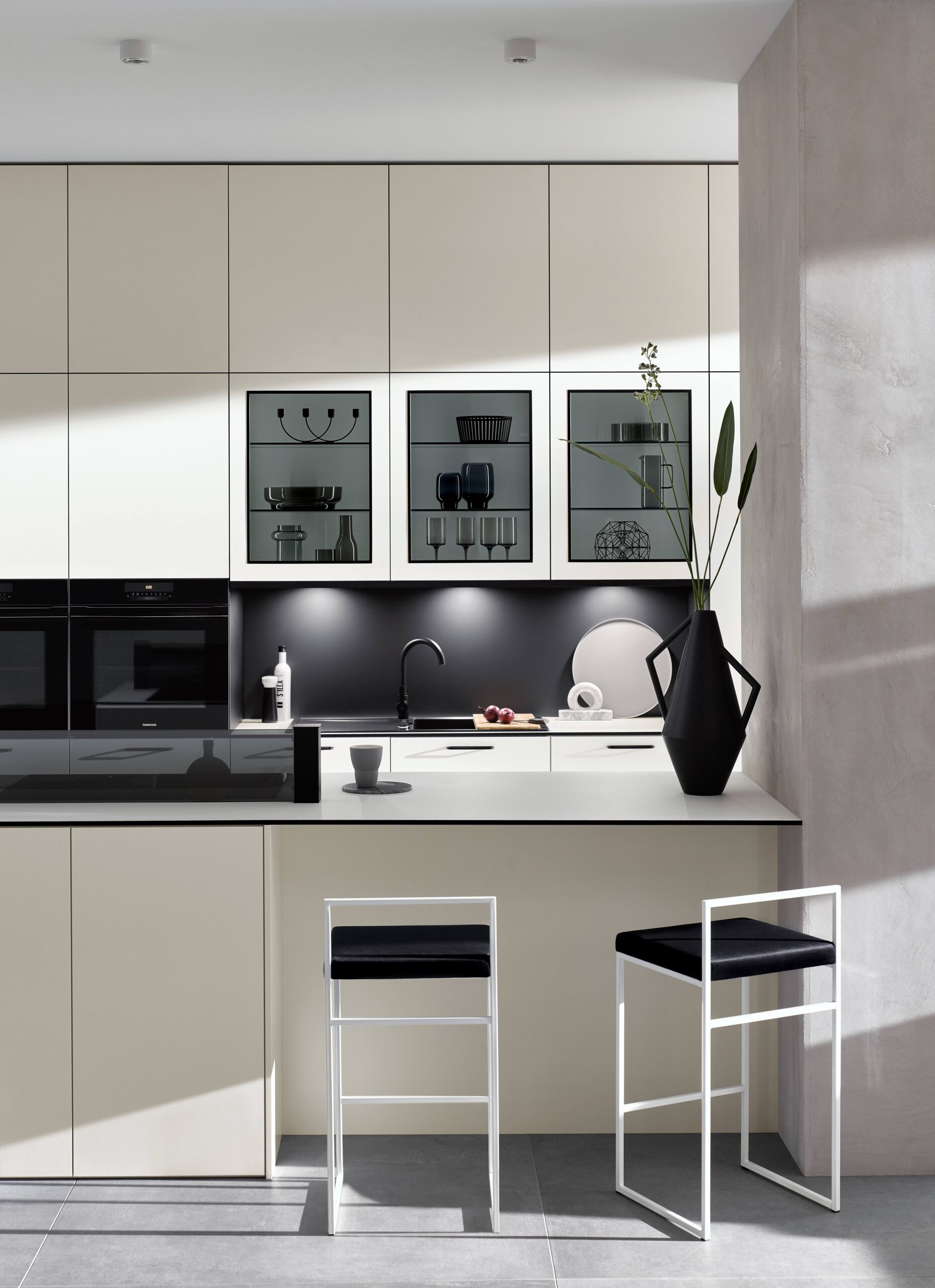
A kitchen is one of the few rooms you use every single day, often before your first coffee and again long after dinner. Drawers get yanked open with wet hands, doors get bumped by hips and grocery bags, and the cabinet under the sink quietly lives in a damp little microclimate of its own. After a few years, the difference between a kitchen that still feels solid and one that feels tired comes down to something most people never see when they sign off on a design: the materials underneath the finish.
In Metro Vancouver, where the air sits above 70 per cent relative humidity on average for much of the year (Weather and Climate, 2025), that difference shows up faster. Moisture is patient. It finds the weak edge, the cheap board, the hinge that was never built to be adjusted. So before you fall for a colour or a handle, it is worth understanding what actually makes a cabinet last, and how to tell good construction from a good photograph.
Key Takeaways
- The carcass board is the foundation. A dense, moisture-resistant board (EN 312 P3 grade or better) is what keeps a cabinet square and swelling-free in a coastal climate.
- Edges and fronts do the visible work. Tightly bonded edge banding and well-built door fronts, whether lacquer, ceramic, glass or real wood, are where wear and moisture try to get in first.
- Hardware decides the daily feel. Full-extension soft-close runners and adjustable concealed hinges are the parts you touch thousands of times a year, so they have to be engineered, not afterthoughts.
- Durability is a value and sustainability decision. With Vancouver kitchen renovations commonly running 35,000 to 85,000 dollars (Quay Construction, 2025), a cabinet that lasts 25 years instead of 12 is both cheaper per year and far kinder to the landfill.
- German engineering is built around longevity. Bauformat has been made in Lohne, Germany since 1917, with construction standards aimed at decades of use rather than a single trend cycle.
Start with the Carcass: the Board Nobody Sees
The carcass, or cabinet box, is the structural skeleton of every unit. It carries the weight of your dishes, holds the hinges and runners in place, and keeps everything square so doors close flush years from now. Yet it is the one component buyers almost never inspect, because it disappears the moment the doors go on.
Most quality cabinet boxes are made from engineered wood panels rather than solid timber, and that is not a compromise. Solid wood expands and contracts with humidity, which can crack panels and throw doors out of alignment. A well-made engineered board stays dimensionally stable. The key is density and moisture resistance.
What to look for in a carcass board
- Moisture resistance: Look for board rated to the European EN 312 P3 standard, which is designed for non-load-bearing use in humid areas and resists swelling when exposed to temporary higher humidity (Pfleiderer, 2025). In a Vancouver kitchen, that rating is not a luxury, it is the baseline.
- Density: A denser board holds screws and hinge mounts more firmly, so hardware does not loosen and sag over time. Lift a sample drawer if you can. Quality construction has a reassuring heft.
- Thickness: Sturdier side panels and backs resist racking, the slow twisting that makes old cabinets feel loose.
Plywood and MDF carcasses typically last 20 to 30 years depending on moisture exposure and daily use, while cheaper untreated particleboard can break down in a fraction of that time once water finds its way in (Coohom, 2025). The board is invisible, but it sets the ceiling on how long the whole kitchen can last.
Edge Banding: the Detail That Quietly Decides Everything
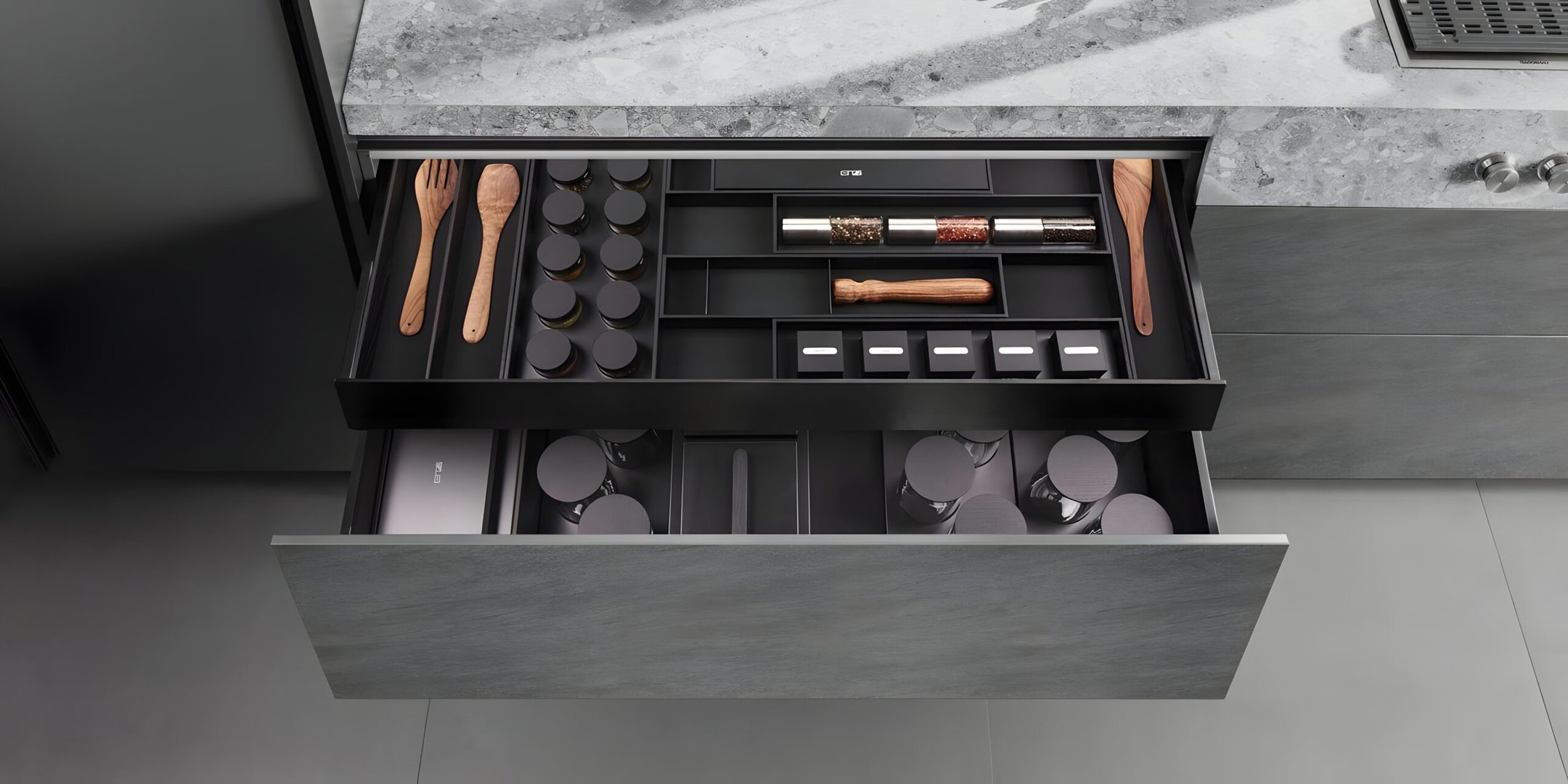
If the carcass is the skeleton, edge banding is the skin that protects it. Engineered boards are vulnerable along their cut edges, where the core is exposed. Edge banding seals those edges so moisture, steam and spills cannot soak in. It is a small strip of material, and it is one of the most reliable ways to judge a cabinet’s real quality.
Cheap edge banding is glued on with ordinary adhesive that, over years of humidity and dishwasher steam, lets go at the corners. Once an edge lifts, water wicks into the board and the swelling begins. Better cabinets use thicker, tightly bonded banding, often laser or hot-air applied, so the seam between band and surface is nearly invisible and far more durable.
How to test it in a showroom
- Run a fingernail along the top edge of a door and drawer. You should feel a smooth, continuous surface, not a ridge or a gap.
- Check the inside corners of cabinet boxes, especially near the sink base, the wettest spot in any kitchen.
- Ask what the banding is made of and how it is bonded. A confident answer is a good sign.
Door Fronts: Where Style Meets Longevity
Fronts are what you see, touch and clean every day, so they take the most visible abuse. Each material ages differently, and the right choice depends partly on how you cook and live.
Lacquer
Multi-coat lacquer, whether high-gloss or ultra-matte, gives a deep, even finish that resists moisture and cleans easily. Quality matters here: the number of coats and the curing process determine how well the surface resists scratching and yellowing. Ultra-matte lacquers, like those in the Baulux collection, also use anti-fingerprint technology so the surface does not show every touch in a busy family kitchen.
Ceramic and Glass
Ceramic and glass fronts are about as durable as kitchen surfaces get. They shrug off heat, moisture, UV fading and most scratches, and they wipe clean with a cloth. They carry a more premium feel and price, which is why they anchor the Baulux range. In a damp climate, their imperviousness to moisture is a genuine practical advantage, not just a design statement.
Real Wood
Solid wood and veneer fronts bring warmth and natural grain that engineered surfaces cannot fully imitate. They can last for decades and can often be refinished. They do ask for a little more care around moisture and direct sun, but a properly sealed wood front in a well-ventilated kitchen ages beautifully.
Across all of these, the lesson is the same: the surface you choose should match your life. Custom and premium fronts can stay functional for 30 years or more, while thinner laminate and foil fronts tend to show wear in the 10 to 20 year range (Coohom, 2025). The Bauformat collection offers the widest spread of fronts, and the Burger collection delivers durable construction at the best value, so longevity is available at more than one budget.
Hardware: the Parts You Touch Thousands of Times
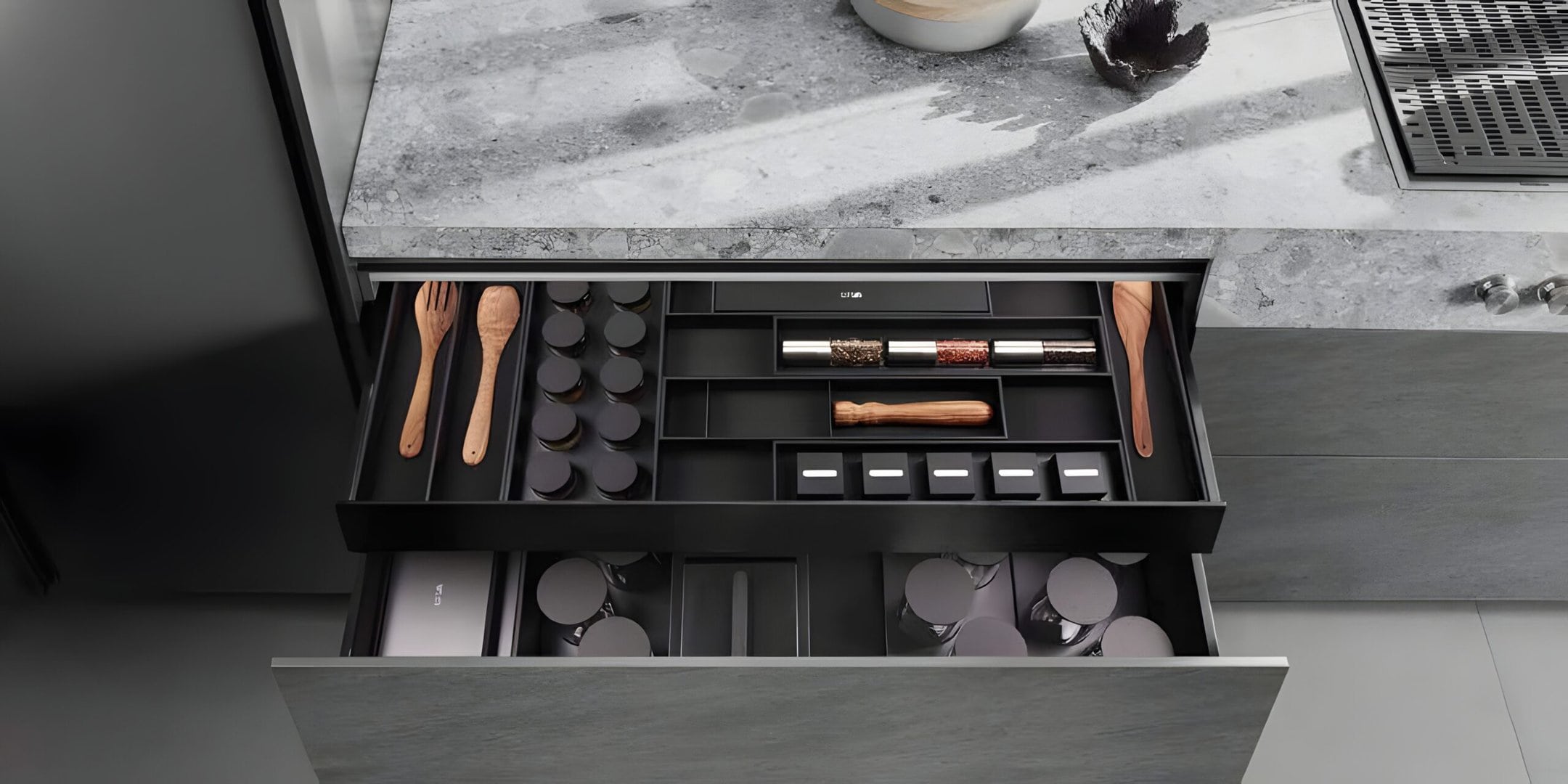
You open a kitchen drawer several times a day without thinking about it. Multiply that over years and the hardware quietly becomes the hardest-working component in the room. It is also the first thing to fail in a poorly built kitchen: drawers that scrape, doors that drop, runners that stick.
Good hardware is engineered to absorb that repetition. The features that matter most:
- Full-extension soft-close runners: Full extension means you can reach the very back of a deep drawer, so no storage is wasted. Soft-close means the drawer pulls itself shut gently instead of slamming, which protects both the contents and the cabinet over the long run. Bauformat fits these as standard.
- 3D-adjustable concealed hinges: Concealed hinges keep clean lines, but the real advantage is adjustability. A 3D-adjustable hinge lets your installer fine-tune each door in three directions, so the gaps stay even and the doors keep closing perfectly years after install, even as a house settles. In an older Vancouver home that shifts with the seasons, that adjustability is a quiet form of insurance.
Hardware quality is hard to fake and easy to test. Open and close. A well-made runner feels smooth and weighted. A cheap one tells you everything in the first inch of travel.
Durability and the Coastal Climate Factor
Everything above matters more here than it would in a dry interior climate. Metro Vancouver’s average relative humidity runs around 70 per cent and climbs past 80 per cent in the wettest winter months (Weather and Climate, 2025). That constant moisture in the air, combined with steam from cooking and dishwashing, is exactly what untreated boards and weak edges cannot handle.
In practice, the damp coast punishes shortcuts. A standard particleboard carcass with thin, lightly glued edge banding may look identical to a premium cabinet on day one. Two or three winters later, the difference is obvious: swollen edges near the sink, doors that no longer line up, a faint musty note under the counter. Moisture-resistant board, sealed edges and adjustable hardware are not upgrades in this region. They are what keeps a kitchen looking new through a decade of West Coast winters.
There is also a ventilation lesson worth noting. Even the best materials last longer with a good range hood and the occasional open window. Materials do the heavy lifting, but habits help them.
Durability as a Value and Sustainability Decision
It is tempting to treat durability as a quality preference, the sort of thing that is nice if you can afford it. The numbers tell a more practical story.
A full kitchen renovation in Vancouver commonly runs between 35,000 and 85,000 dollars, with high-end projects passing 100,000 dollars, and cabinets alone often account for 30 to 40 per cent of the total budget (Quay Construction, 2025; Magic Window, 2025). Spread that over the life of the cabinets and the math becomes clear. A cabinet that genuinely lasts 25 years costs far less per year than one that needs replacing at 12, even if the upfront price is higher. Durability is not the expensive choice, it is usually the economical one over time.
Then there is what gets thrown away. Canada’s construction, renovation and demolition sector generates roughly 4 million tonnes of waste a year, and a single kitchen remodel can produce 1 to 2 tonnes of material waste on its own (Miller Waste Systems, 2025). Replacing a kitchen twice instead of once doubles that footprint. The most sustainable kitchen is simply the one you do not have to tear out and rebuild.
This is where engineering and longevity meet. Bauformat has been built in Lohne, Germany since 1917, with construction standards aimed at decades of daily use, and in Metro Vancouver it is measured, planned and installed by a local team that understands how these materials behave in our climate. Buying once and buying well is the version of this decision that is easiest on both your budget and the landfill.
Frequently Asked Questions
How long should a quality kitchen last?
Well-built cabinets made from dense, moisture-resistant materials commonly last 20 to 30 years, and premium fronts and solid construction can stay functional for 30 years or more (Coohom, 2025). Many kitchens get replaced earlier for style reasons rather than failure, which is an argument for choosing timeless finishes alongside durable materials.
Are engineered boards worse than solid wood for cabinets?
No. For cabinet boxes, a quality moisture-resistant engineered board is often more stable than solid wood, because it does not expand and contract with humidity the way solid timber does. The grade of the board matters far more than the label. Look for moisture resistance to the EN 312 P3 standard or better (Pfleiderer, 2025).
Does Vancouver’s damp climate really affect cabinet life?
Yes. With average humidity around 70 per cent and winter levels above 80 per cent (Weather and Climate, 2025), moisture is a constant. Untreated boards and weakly bonded edges swell and fail faster here than in drier regions, which is why moisture-resistant construction and sealed edge banding are worth prioritizing on the coast.
What is the single best indicator of a durable cabinet?
If you can only check one thing, check the edges and the hardware together. Smooth, tightly bonded edge banding signals a sealed, moisture-protected box, and smooth, weighted soft-close runners signal engineering that will hold up. Both are easy to test by hand and hard to fake.
Choosing long-lasting kitchen cabinet materials is really a series of small, informed decisions: a denser board, a better-sealed edge, a front matched to how you cook, hardware built to be adjusted rather than replaced. Made individually, each feels minor. Added together, they are the difference between a kitchen that survives a decade of damp Vancouver winters and one that quietly looks great for a generation.
Explore more from Bauformat BC
- Kitchen Cabinet Hardware
- Why Opt for Economical Kitchen Cabinet Materials?
- Bauformat: Germany’s Elite Kitchen Cabinet Craftsmen
German cabinetry, planned and built for Metro Vancouver
The kitchen is one of the highest-return rooms in a home: the 2025 Cost vs. Value Report found a minor kitchen remodel recoups roughly 96% of its cost at resale. Choosing cabinetry that lasts is central to that return, which is where German engineering earns its place. Every Bauformat kitchen is manufactured in Germany, then measured, planned, and installed by our Vancouver team, built to fit your room to the millimetre.
See the Baulux, Bauformat, and Burger collections in person at our North Vancouver showroom at 1410 Marine Dr Unit 205, learn more about the manufacturer at bauformat.de.
Book a 30-minute consultation with our Metro Vancouver kitchen designers to plan a kitchen built to last.
